The deep roots of inequality
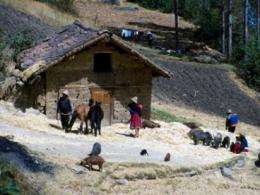
To an economist, a map of southern Peru has a peculiar appearance. If you draw a line forming a kind of jagged oval, outlining a chunk of the Andes running from northwest to southeast, you have enclosed a region of relative poverty lying among areas of greater wealth. Yet there is no readily apparent explanation for this disparity; the well-off districts do not appear to have more natural resources than the poor ones, for instance.
But Melissa Dell, a PhD student in MIT’s Department of Economics, thinks this economic riddle has an answer: the invisible hand of history. More specifically, Dell believes a system of labor conscription that the region’s Spanish colonial rulers used from 1573 to 1812 accounts for the pattern of economic development in the region today. The areas where the Spainish forced locals to leave the land and work in mines — a practice called the mita — are precisely the poorest today, while the places where workers were left alone are now wealthier.
“Historical institutions do matter,” says Dell. “We are still seeing these differences based on this forced labor practice that was abolished almost 200 years ago.” In a working paper produced in January, “The Persistent Effects of Peru’s Mining Mita,” Dell explains and quantifies the presence of this lingering effect.
In 1545, the mines around the town of Potosi, high in the Andes, were discovered to contain more silver than any other place in the Spanish empire. To the northwest, mines near the town of Huancavelica contained the mercury necessary for refining silver ore. By 1573, the Spanish instituted a conscription system through which 200 communities in the region were required to provide one-seventh of their workers — mostly farmers by trade — for these mines. During any given year, 3 percent of all adult men in Peru were conscripted for duty in Potosi and Huancavelica. The Spanish abolished the system in 1812, as the mines became depleted.
To examine the long-term effects of the mita, Dell identified one particular area within the larger mining region where towns subject to the mita have the same physical and social characteristics — they grow the same crops and have the same ethnic composition — as neighboring communities that were spared conscription.
In this way she created a sample group of mita-affected locales, and a kind of control group of non-mita areas, to assess the mita’s effects. Looking at current economic data, Dell found that the areas once subject to conscription feature a level of household consumption today that is 25 percent below that of the neighboring, non-mita communities. Moreover, in old mita locales, 6 percent more of the children have stunted growth than in the other areas. In short, places subject to the mita from the late 16th century through the early 19th century are significantly poorer in the 21st century.
Dell believes this poverty has persisted due to multiple, interconnected factors. After 1573, the areas unaffected by the mita often featured haciendas, large rural estates with many laborers, and stable property rights. In mita districts, by contrast, the Spanish rulers mostly just allowed small land tenants to exist, without substantial property rights. Over time, the larger landowners were better able to lobby for public goods, such as functioning roads leading to markets. This created a historical split that is still evident: The lack of similar public infrastructure in the mita areas means that even today, a greater portion of local residents are subsistence farmers with little access to markets and education.
To arrive at her conclusions, Dell also spent a month in Peru conducting interviewing. “I talked to everyone from peasants to agrarian scientists, and they told stories very consistent with the data,” Dell says. “Peasants would say, ‘Well, other people grow corn just like us, but they’re richer because they can take their corn to the market, whereas the government didn’t build any roads for us. So we just produce enough to eat, and that’s it.’”
The paper, under review at the journal Econometrica, is akin to the work of Dell’s graduate advisor, MIT economist Daron Acemoglu, who has extensively studied the relationship between economic development and legal institutions such as property rights. Dell believes her study complements our existing historical knowledge by showing the empirical effects of Spain’s colonial practices.
“I really think the value of this is to merge the history with current outcomes using statistical tools,” says Dell. “A historian could tell us more about the details of the mita, but they don’t necessarily have the quantitative tools to establish causality.”
Other economists in the field are impressed by Dell’s findings. “I think it’s a path-breaking paper,” says James Robinson, a professor of government at Harvard. “This is the first paper that’s taken a specific institution of this kind, and shown real evidence of the long-running impact of colonialism in Latin America and Peru today.” For economists interested in economic development, Robinson adds, “There is a lot of scope for more studies like this.”
Dell would also like the paper to usefully complicate ideas about growth in Latin America. Other economists have argued that the region has lagged economically because of its inequalities — because, for example, Latin America had structures like the hacienda system with a few large landowners, as opposed to the plethora of smaller, secure property owners in North America. But as Dell points out, because smaller landholders in Peru lacked solid property rights, the hacienda system, for all its inequalities, actually engendered greater public investment. Dell aims to find additional data sets that shed more light on the interaction of the state and private interests in Latin America, to better understand the unique economic trajectory within many parts of the region.
Provided by Massachusetts Institute of Technology


