Obama's asteroid goal: tougher, riskier than moon
April 16, 2010 By SETH BORENSTEIN , AP Science Writer
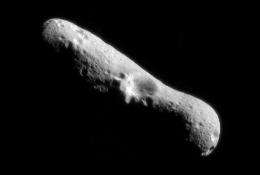
This Feb. 14, 2000 photo provided by NASA shows the north pole of the asteroid Eros. The crater seen on the surface of Eros measures 4 miles across. President Barack Obama on Thursday, April 15, 2010 said he expected astronauts to land on an asteroid in the next 15 years. (AP Photo/NASA)
(AP) -- Landing a man on the moon was a towering achievement. Now the president has given NASA an even harder job, one with a certain Hollywood quality: sending astronauts to an asteroid, a giant speeding rock, just 15 years from now.
Space experts say such a voyage could take several months longer than a journey to the moon and entail far greater dangers.
"It is really the hardest thing we can do," NASA Administrator Charles Bolden said.
Going to an asteroid could provide vital training for an eventual mission to Mars. It might help unlock the secrets of how our solar system formed. And it could give mankind the know-how to do something that has been accomplished only in the movies by a few square-jawed, squinty-eyed heroes: saving the Earth from a collision with a killer asteroid.
"You could be saving humankind. That's worthy, isn't it?" said Bill Nye, TV's Science Guy and vice president of the Planetary Society.
President Barack Obama outlined NASA's new path during a visit to the Kennedy Space Center on Thursday.
"By 2025, we expect new spacecraft designed for long journeys to allow us to begin the first-ever crewed missions beyond the moon into deep space," he said. "We'll start by sending astronauts to an asteroid for the first time in history."
On the day the president announced the goal, a NASA task force of scientists, engineers and ex-astronauts was meeting in Boston to work on a plan to protect Earth from a cataclysmic collision with an asteroid or a comet.
NASA has tracked nearly 7,000 near-Earth objects that are bigger than several feet across. Of those, 1,111 are "potentially hazardous asteroids." Objects bigger than two-thirds of a mile are major killers and hit Earth every several hundred thousand years. Scientists believe it was a 6-mile-wide asteroid that wiped out the dinosaurs 65 million years ago.
Landing on an asteroid and giving it a well-timed nudge "would demonstrate once and for all that we're smarter than the dinosaurs and can avoid what they didn't," said White House science adviser John Holdren.
Experts don't have a particular asteroid in mind for the deep-space voyage, but there are a few dozen top candidates, most of which pass within about 5 million miles of Earth. That is 20 times more distant than the moon, which is about 239,000 miles from Earth on average.
Most of the top asteroid candidates are less than a quarter-mile across. The moon is about 2,160 miles in diameter.
Going to an asteroid could provide clues about the solar system's formation, because asteroids are essentially fossils from 4.6 billion years ago, when planets first formed, said Don Yeomans, manager of NASA's Near Earth Object program at the Jet Propulsion Lab.
And an asteroid mission would be a Mars training ground, given the distance and alien locale.
"If humans can't make it to near-Earth objects, they can't make it to Mars," said MIT astronautics professor Ed Crawley.
Also, asteroids contain such substances as hydrogen, carbon, iron and platinum, which could be used by astronauts to make fuel and equipment - skills that would also be necessary on a visit to Mars.
While Apollo 11 took eight days to go to the moon and back in 1969, a typical round-trip mission to a near-Earth asteroid would last about 200 days, Crawley said. That would demand new propulsion and life-support technology. And it would be riskier. Aborting a mission in an emergency would still leave people stuck in space for several weeks.
The space agency may need to develop special living quarters, radiation shields or other new technology to allow astronauts to live in deep space so long, said NASA chief technology officer Bobby Braun.
Even though an asteroid would be farther than the moon, the voyage would use less fuel and be cheaper because an asteroid has no gravity. The rocket that carries the astronauts home would not have to expend fuel to escape the asteroid's pull.
On the other hand, because of the lack of gravity, a spaceship could not safely land on an asteroid; it would bounce off the surface. Instead, it would have to hover next to the asteroid, and the astronauts would have to spacewalk down to the ground, Yeomans said.
Once there, they would need some combination of jet packs, spikes or nets to enable them to walk without skittering off the asteroid and floating away, he said.
"You would need some way to hold yourself down," Yeomans said. "You'd launch yourself into space every time you took a step."
Just being there could be extremely disorienting, said planetary scientist Tom Jones, co-chairman of the NASA task force on protecting Earth from dangerous objects. The rock would be so small that the sun would spin across the sky and the horizon would only be a few yards long. At 5 million miles away, the Earth would look like a mere BB in the sky.
"It's going to be a strange alien environment being on an asteroid," Jones said.
But Jones, a former astronaut, said that wouldn't stop astronauts from angling to be a part of such a mission: "You'll have plenty of people excited about exploring an ancient and alien world."
More information:
NASA's Near Earth Object program: http://neo.jpl.nasa.gov/index.html
Association of Space Explorers' report on threat of asteroids: http://tinyurl.com/asterthreat
©2010 The Associated Press. All rights reserved. This material may not be published, broadcast, rewritten or redistributed.
-
MIT tether could aid asteroid missions
Sep 25, 2007 |
not rated yet |
0
-
Asteroid to Fly by Within Moon's Orbit Thursday
Apr 07, 2010 |
not rated yet |
0
-
Dawn moves closer to the asteroid belt
Sep 12, 2007 |
not rated yet |
0
-
Asteroid to Make Rare Close Flyby of Earth
Jan 24, 2008 |
not rated yet |
0
-
Huge asteroid hurtles toward Earth
Jun 29, 2006 |
not rated yet |
0
-
Engineers build first sub-10-nm carbon nanotube transistor
Feb 01, 2012 |
4.9 / 5 (30) |
30
-
Something old, something new: Evolution and the structural divergence of duplicate genes
Jan 31, 2012 |
4.6 / 5 (7) |
1
-
The hidden nanoworld of ice crystals: Revealing the dynamic behavior of quasi-liquid layers
Jan 30, 2012 |
5 / 5 (3) |
1
-
Stock market network reveals investor clustering
Jan 27, 2012 |
3.9 / 5 (23) |
8
-
Of microchemistry and molecules: Electronic microfluidic device synthesizes biocompatible probes
Jan 26, 2012 |
5 / 5 (1) |
0
-
Titan's lack of impact craters
Feb 09, 2012
-
Real pictures of black hole eating a star?
Feb 08, 2012
-
Hypothetical way to travel faster than light, but not technically exceed lightspeed
Feb 06, 2012
-
How do scientists monitor the Sun's activity?
Feb 05, 2012
-
Search patterns in observational studies
Feb 05, 2012
-
Derivation of Pogson's law
Feb 03, 2012
- More from Physics Forums - General Astronomy
More news stories
Could Venus be shifting gear?
(PhysOrg.com) -- ESAs Venus Express spacecraft has discovered that our cloud-covered neighbour spins a little slower than previously measured. Peering through the dense atmosphere in the infrared, the ...
Space & Earth / Space Exploration
3 hours ago |
5 / 5 (4) |
4
|
Humans may have helped the decline of African rainforests 3000 years ago
(PhysOrg.com) -- Large areas of rainforests in Central Africa mysteriously disappeared over three thousand years ago, to be replaced by savannas. The prevailing theory has been that the cause was a change ...
Clam fields found at deep, low-temperature Mariana vents
(PhysOrg.com) -- Scientists have marveled at the unusual life forms thriving at high temperature hydrothermal vents of the deep ocean.
Space & Earth / Earth Sciences
4 hours ago |
not rated yet |
0
|
Mars Science Laboratory computer issue resolved
(PhysOrg.com) -- Engineers have found the root cause of a computer reset that occurred two months ago on NASA's Mars Science Laboratory and have determined how to correct it.
Space & Earth / Space Exploration
4 hours ago |
5 / 5 (5) |
2
|
Two new moons for Jupiter
Advances in technology have lead to the discovery of new planets outside of our Solar System, and now even new moons in our own backyard.
Space & Earth / Space Exploration
3 hours ago |
not rated yet |
2
New understanding of DNA repair could eventually lead to cancer therapy
A research group in the Faculty of Medicine & Dentistry at the University of Alberta is hoping its latest discovery could one day be used to develop new therapies that target certain types of cancers.
Hovering not hard if you're top-heavy, researchers find
Top-heavy structures are more likely to maintain their balance while hovering in the air than are those that bear a lower center of gravity, researchers at New York University's Courant Institute of Mathematical Sciences ...
Grass to gas: Researchers' genome map speeds biofuel development
Researchers at the University of Georgia have taken a major step in the ongoing effort to find sources of cleaner, renewable energy by mapping the genomes of two originator cells of Miscanthus x giganteus, a large perenn ...
Night, weekend delivery OK for babies with birth defects
Weekday delivery is no better than night or weekend delivery for infants with birth defects, according to a new study presented today at The Pregnancy Meeting, the Society for Maternal-Fetal Medicine's annual conference. ...
Sonic Cradle lands spot in TED exhibition
A Simon Fraser University graduate student project that melds music, meditation and modern technology has landed a rare spot as an exhibit at TEDActive 2012 in Palm Springs, California this month.
Drug halts organ damage in inflammatory genetic disorder
A new study shows that Kineret (anakinra), a medication approved for the treatment of rheumatoid arthritis, is effective in stopping the progression of organ damage in people with neonatal-onset multisystem inflammatory disease ...
Apr 16, 2010
Rank: 3.4 / 5 (9)
Apr 16, 2010
Rank: 3.3 / 5 (7)
Apr 16, 2010
Rank: 1.7 / 5 (15)
Apr 16, 2010
Rank: 4.8 / 5 (13)
Yeah, you're right. Obama's over there in the Oval Office making all of this up, and we all have to obey his orders. That's how it works, right? He doesn't have teams of knowledgeable advisors who work in the space industry suggesting promising missions.
In case you can't connect the dots, Obama is working very hard at making space exploration profitable. He wants a larger role for private companies in space exploration. And the subtle comment in the article about platinum on the asteroid is not just a footnote. We're quickly using up scarce elements on Earth, where will we get them from 100 years from now? Mining asteroids might be big business in the future, wouldn't it be nice for the US to "stake our claim"? Or, we could go back to the moon, which is very easy and expensive in comparison with little chance of returning anything useful.
Apr 16, 2010
Rank: 2.3 / 5 (7)
Apr 16, 2010
Rank: 1.9 / 5 (8)
I've been around long enough to know that this is a fools mission.
Well at least the mission can be canceled in 2013.
Apr 16, 2010
Rank: 5 / 5 (8)
In case you had forgotten from High School, all matter has gravity.
In case you had forgotten from spaceflight history, NEAR landed on Eros.
In case you had forgotten from spaceflight history, all spaceflight is difficult and dangerous.
Apr 16, 2010
Rank: 1.8 / 5 (8)
In case you are a moron, the gravity from even a large asteroid would be negligible in relation to any propulsion system, on the scale of small fractions of that of the moon, which already proved troublesome, mainly due to the charged dust particles kicked about.
Apr 16, 2010
Rank: 3.5 / 5 (6)
I watched Armageddon so I know for a FACT asteroids have gravity.
Apr 16, 2010
Rank: 2.3 / 5 (3)
The asteroid would contain lots of iron, right? Maybe they could have a magnetic ship? At any rate I don't think it would be entirely impossible to land on it, it just may be easier to hover.
Apr 16, 2010
Rank: 4 / 5 (3)
Landing on an asteroid is challenging. If fact this entire mission is challenging in the extreme. It's so challenging that I'm not sure that NASA can accomplish it by 2025. But even if they don't, there is no harm in trying. The absolute worst that happens is what happened to Constellation: project cancelled due to missed deadlines and general overbudgetness, but the money spent on interesting research isn't wasted because that research can be repurposed toward other missions (as is happening right now with the research done for Constellation).
Apr 17, 2010
Rank: 1.7 / 5 (3)
In all honesty I feel we have the technology already to go to mars if we utilized our Nuclear submarine technology. After all they are underwater and out of sight for years. (though I'd say that is our(American) treasure box of advanced tech.)
ISS can recycle water. We just need a new propulsion system since nuclear propulsion due to some crazy ban.
Yeehaw then we can start the Wild Wild Space age :P
Apr 17, 2010
Rank: 2 / 5 (2)
Apr 17, 2010
Rank: 2 / 5 (2)
Apr 17, 2010
Rank: 3 / 5 (1)
Apr 17, 2010
Rank: 1.3 / 5 (3)
bwwwhahahahahah. What a maroon.
Apr 17, 2010
Rank: 4 / 5 (1)
Apr 17, 2010
Rank: 5 / 5 (1)
Apr 17, 2010
Rank: 5 / 5 (1)
Would you be so kindly as to expanse on your comment as to why I was a [sic]maroon in voicing my thoughts for this serious matter, in a comprehensive missive? I paraphrased the sentence that you quoted from the "Moon Treaty on Wiki : "...Bans altering the environment of celestial bodies and requires that states must take measures to prevent accidental contamination...". Thanks.
Apr 17, 2010
Rank: 2.3 / 5 (3)
as if the moon weren't a giant speeding rock . . .
""It is really the hardest thing we can do," NASA Administrator Charles Bolden said.":
Somebody needs to fire this clown.
Somebody needs to disband NASA and give Space Travel to the Navy.
Apr 17, 2010
Rank: 4.5 / 5 (2)
Apr 17, 2010
Rank: 3 / 5 (2)
Funny I don't remember any of the ISS supply vehicles, Shuttle, Soyuz et al. 'bouncing' off the Space station. Do you think that 1000's of scientists, 2500 years of mathematics and 200 generations of computers might be able to figure this out?
Apr 17, 2010
Rank: 3.4 / 5 (5)
Ok, Physorg, I write perfectly relevant and logical comments and they get removed. Yet something inane like this makes the 'cut'. Brilliant, guys. Just remove my f'ing account.
Apr 17, 2010
Rank: not rated yet
to Physorg editors: Why were my comments edited and some deleted? They were completely relevant, material, based on fact, and non-offensive. Why the censorship?
Apr 17, 2010
Rank: 5 / 5 (3)
Apr 17, 2010
Rank: not rated yet
Apr 18, 2010
Rank: 4 / 5 (1)
Soon space will be overtly militarized, no matter what the Americans do and there will be conflict over the most cheaply available resources and so-on. The direction Obama and his advisers are taking will put America ahead technologically and militarily, regardless of the actual success of the first manned NEO missions.
Apr 18, 2010
Rank: 5 / 5 (3)
Apr 18, 2010
Rank: 2 / 5 (1)
Apr 18, 2010
Rank: 5 / 5 (1)
There won't be too many charged dust particles clinging on as the gravity wouldn't be strong enough to overcome the electrostatic and velocity forces making the dust fly off for the most part. Solar wind would be buffeting the object clean in some cases.
Should be quite interesting to see what we find.
Apr 18, 2010
Rank: not rated yet
Hi GDM,
I am curious about the interesting idea of using concrete to make deep space ships. From what I know, concrete setting requires considerable time for the exothermic reactions between ingredients to set and harden. How would you do it it the cold deep space? Modifying the pre-cast technique with suitable insulations, and then assemble the pieces?
Apr 18, 2010
Rank: 4 / 5 (1)
Apr 18, 2010
Rank: 5 / 5 (1)
Without the need for food, water, air, heavy radiation shielding etc. needed by humans we can explore the solar system 10x faster and cheaper the way we're doing it now, with robotics, then only go someplace in person once a darn good reason has turned up.
While I've always enjoyed watching maned spaceflight it gets harder each year not to see it as a grossly inefficient industry living off national pride and bravado, trying to justify its own existence. We spent decades building the ISS, for example, with little scientific justification for its huge price tag, and did so with the (original) plan to scuttle it into the Pacific only a few years after its completion. It is hard not to see that as a sci-tech/aerospace industry welfare program.
Apr 18, 2010
Rank: 1 / 5 (2)
Apr 18, 2010
Rank: not rated yet
Apr 18, 2010
Rank: 2 / 5 (3)
Apr 19, 2010
Rank: 5 / 5 (1)
And as for comets and asteroids haveing gravity THEY DO NOT HAVE GRAVITY- at least nothing of value. lets use some of the current news stories- the new classifcation of a planetoid , only objects of a diameter of 300km have enough gravity to force it into a spherical ball. So if it isn't 180 miles around it is a big peanut- and earth is the most dense object in the solar system @ 5.52 g/cm^3 so if it was just as dense as earth (not likely) and the size of Ceres 950 km in diameter gives the equation :
(6.67300 * 10^-20 (km^3) (kg^(-1)) (s^(-2)))*((3 537 952 kg/151.197196 km^2) for surface gravity = 1.0327 * 10^-14 m / s2
which is 0.00000000000000105% of the surface grivty on earth- remember this is if we landed on the biggest planetoid which is on average 100 times larger than a meteor
escape velocity needed 5.58829932 * 10^-5 m / s
Apr 19, 2010
Rank: 5 / 5 (1)
If we were in the movie Armageddon -- and we had to land on a big freaking monster metoer the size of texas - 1,270 KM in diameter - 5.77902379 * 10^-15 m / s^2 surface gravity and an escape velocity of : 4.83333485 * 10^-5 m / s
if we had used a thruster to jump a canyon we would have gone past going into orbit and flown off into space -- heck even before that part if we didn't match the velocity of the metoer perfectly when trying to land the shuttle on it and did not GRAB it we would bounce off into space
if we were really unlucky and had issues firing our rockets someone could go outside the shuttle and pickit up like Superman - jump using leg muscles and achieve escape velocity. because 5 million lbs would feel like 2.3 micrograms
Apr 19, 2010
Rank: 2 / 5 (1)
Mars is far more important.
My priorities would be:
1. Continued development of viable plasma VASIMR type rocket engine. (possible moon mission to mine H-3 to fuel it would be a great project)
2. Mars colonization.
3. Unmanned return surveillance mission to binary star system Centauri using plasma rockets.
Apr 19, 2010
Rank: 5 / 5 (1)
I agree whole heartedly. Could you imagine taming these near earths to put them in stable orbits allowing them to be mined? This is a strategic step towards colonization of the solar system and has been outlined by many science fiction and non-fiction writers.
Apr 19, 2010
Rank: 5 / 5 (3)
-- It could also be the fact that over the next 30 years asteriods capable of destroying life on earth will come as close as high earth orbit. there are at least three times in the next thrity years earth will have real potential to be hit --
object name / date of miss / LD of miss / speed
LD=lunar distance ~ 384,000 km
------------------------------------------
(2004 QA22) / 2130-Aug-24 / 0.0003 / 3.74
(2009 WM1) /2059-Nov-23 / 0.08 / 14.25
(2007 UD6) / 2048-Oct-18 / 0.09 / 7.56
99942 Apophis / 2029-Apr-13 / 0.10 / 7.42
(2009 WQ6) / 2189-Nov-18 / 0.1 / 12.42
NASA website : http://neo.jpl.na...p;show=1
LD is a comparison of the distance to the moon to how close the object will possibly miss the earth
example:Apophis will come as close as one tenth the distance to the moon
Apr 19, 2010
Rank: 5 / 5 (1)
Apr 20, 2010
Rank: 5 / 5 (1)
Apr 20, 2010
Rank: not rated yet
Apr 24, 2010
Rank: 1 / 5 (3)
Just what would a "Community Organizer" know about anything other than graft and protection rackets?
Apr 24, 2010
Rank: 5 / 5 (3)
For a spherical object, the acceleration at its surface is given by:
g=G*M/r^2
For something with a diameter of 950km (475km radius) and the same density as the Earth:
g=G*[(4*pi*(475km)^3)/3]*[5.52g/cm^3]/[(100km)^2]
=> g = 0.733m/s^2
Your calculation is just a TAD bit off.
Apr 24, 2010
Rank: 5 / 5 (3)
He's not a community organizer. He's the president of the United States. He WAS, at one point, a community organizer. He was also at one point a law professor. But YOU were, at one point, a child. Are you, at this moment, a child? I would say yes, though you might disagree.