April 20, 2010 feature
Nanostructure of 5,000-year-old mummy skin reveals insight into mummification process
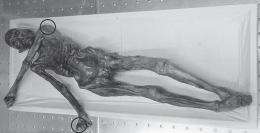
(PhysOrg.com) -- Using cutting-edge microscopy techniques, researchers have gained insight into how human mummies can be extremely well-preserved for thousands of years. A team of scientists from Germany and Italy has investigated skin samples from Europe's oldest natural mummy, the 5,300-year-old "Iceman" who was buried in a glacier shortly after death in the Otzal Alps between Italy and Austria. The researchers found that the underlying structure of the mummy's skin is largely unaltered compared with the skin of a modern living human, likely maintaining its protective function due to dehydration.
When the Iceman was discovered by tourists in 1991, the well-preserved body was first thought to be a modern corpse. After scientists realized that the body was that of a 45-year-old man (possibly a shepherd) living in the Copper Age, continued research has revealed a wealth of information on Neolithic culture in the region. Although the Iceman could have died from a number of causes, examinations have suggested that he was killed by an arrowhead that entered his body under the left shoulder blade and caused severe internal bleeding. He also had stab trauma on his right hand and a bruise at the head that possibly resulted from a blow to the head.
Since the Iceman’s discovery, investigations using optical and scanning electron microscopes have revealed that, while the epidermis (outer layer of skin) is missing, the remaining mummified skin collagen is extremely durable. However, the underlying reason for the durability is largely unclear. In the current study, the researchers have investigated three skin samples from the Iceman using atomic force microscopy (AFM) and Raman spectroscopy to try to understand how the mummified skin is so well-preserved. These techniques allowed the scientists to investigate the skin collagen’s nanostructure and molecular structure.
In their investigations, the researchers discovered that the mummy’s skin and recent skin samples were very similar. Among their findings was that both samples featured the nanoscale periodic banding patterns that are characteristic of collagen fibrils. Also, the Raman spectroscopy analysis showed that the ancient and recent skin spectra were very similar, indicating that the molecular structure of the mummy’s skin was largely unchanged.
However, by conducting AFM nanoindentation experiments, the researchers found that the mummified skin had a slightly higher Young’s modulus, meaning that it was slightly less elastic and stiffer than recent skin. As the researchers explain, the most probable cause of this increased stability of the mummified collagen is dehydration by freeze-drying. Dehydration may have resulted in more densely packed fibril structures, leading to the creation of additional cross-links between the subfibrils. In this way, the dehydrated skin could maintain its protective function and continue to prevent tissue decomposition.
“The most important finding of our study is that the type I collagen in the mummified skin of the Iceman retained its structure and thus maintained its protective function (against external influences, such as UV- irradiation, freeze-thaw damage, or microbiological degradation) enabling continuous tissue preservation for 5300 years,” Marek Janko, coauthor from the Ludwig-Maximilians-Universität (LMU) Munich and the European Academy of Bolzano (EURAC), told PhysOrg.com. “But it also covers important aspects of collagen structure and mechanical property analysis and gives important insight into mechanistic details about the mummification process, extending earlier work by Schweitzer, Lingham-Soliar, Williams, Hess and others.”
Overall, the researchers’ findings support the theory that the Iceman was covered by snow and ice immediately after his death, and - other than for a few thawing and refreezing cycles - likely remained frozen for the majority of the time until his discovery. The results could also have implications in different areas, as Robert Stark, coauthor from LMU Munich, explained.
“Often, mummies are an invaluable cultural heritage because they tell us a lot about life and death in former times,” said Stark. “There are various ways to mummify a corpse. Examples include the procedures used by the old Egyptians, the methods used to conserve Rosalia Lombardo (considered one of the most beautiful mummies) or the Iceman.”
“Last but not least,” Janko added, “our finding that the dehydration of the collagen may cause an increase in the collagen fibril elasticity can have suitable applications in surgery where collagen tissues with desired mechanical properties are needed.”
More information: Marek Janko, et al. “Nanostructure and mechanics of mummified type I collagen from the 5300-year-old Tyrolean Iceman.” Proceedings of the Royal Society B. Doi:10.1098/rspb.2010.0377
Copyright 2010 PhysOrg.com.
All rights reserved. This material may not be published, broadcast, rewritten or redistributed in whole or part without the express written permission of PhysOrg.com.


