Marine Life Census Reveals Previously Unknown Sea Creatures
April 20, 2010 By Christine Buckley
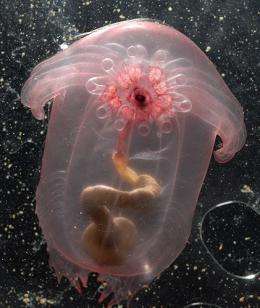
A pink sea cucumber living in the Celebes Sea, one of the potential new species discovered by the Census of Marine Zooplankton. Photo by L. Madin, Woods Hole Oceanographic Institute
(PhysOrg.com) -- UConn marine scientist Ann Bucklin headed one of the projects, surveying zooplankton around the world.
The Census of Marine Life, a decade-long international research program aimed at assessing the diversity of ocean life, has released its first data on tiny sea creatures.
One of the field projects within the Marine Life Census, the Census of Marine Zooplankton, has sampled the ocean’s zooplankton more extensively and systematically than any previous survey. It is directed by Professor Ann Bucklin, head of UConn’s Department of Marine Sciences.
“Invertebrates in general are lovely,” says Bucklin. “They’re just odd, weird, and sometimes scary. You look at them through a microscope and you think, wow, if that thing were big, it would really be something.”
The Census of Marine Life, with 14 different field projects, involves thousands of researchers in more than 80 countries collaborating to describe the ocean’s biodiversity. Before the advent of the Census, about 230,000 ocean species were known to science, but researchers estimate that two to three times this number actually exist. At least 5,300 new species have been discovered thus far in the Census.
Bucklin says, however, that convincing Census leaders that zooplankton - animals that drift on the ocean’s currents - were important to survey took some work. Although the Marine Life Census began in 2000, the Census of Marine Zooplankton didn’t begin until 2004.
“The census started by surveying the ‘charismatic megafauna’,” she says, referring to large marine mammals and fish. “It took four years of going to workshops to convince them that zooplankton are also interesting.”
The Census of Marine Zooplankton aims to survey the diversity, abundance, and distribution of marine holozooplankton - animals that spend their lives drifting on the ocean’s currents. Like other projects within the Marine Life Census, it uses DNA barcoding techniques to identify species with certainty, since many species are cryptic, or look a lot like one another. These techniques involve sequencing a short portion of an organism’s DNA to identify it.
Bucklin’s laboratory at UConn’s Avery Point campus is the project’s major hub for DNA barcoding. In addition to sequencing the DNA of many of the project’s collected species, the lab has now trained more than 20 students and post-doctoral researchers from around the world. The Census of Marine Zooplankton has discovered several hundred new species of zooplankton to date, but Bucklin and her colleagues suspect that once all their data have been analyzed from collections around the globe, the current number of known species will double from 7,000 to 14,000.
This recognition of species is very important, she says. In recent decades, scientific interest in many fields has shifted from studying individual species to a focus on ecological patterns and processes of groups of species, and the science of classifying species has fallen out of fashion.
“Species are a benchmark for understanding big issues like ecosystem health and responses to climate change,” she says. “The Census has been a big win for us: People are again appreciating the value of recognizing species.”
The Marine Life Census will report its final results in an official symposium and press conference on October 4 in London. With the Census drawing to a close, the researchers are now thinking about how to put all their data to good use. Knowing the distribution and abundance of so many of the ocean’s species will help them understand the inter-relationships of species that support Earth’s natural cycles, such as the marine food web and the global cycling of elements.
“The Census asked the question of what species are out there,” Bucklin says. “Now we need to use those data to ask why those species are where they are. We want to know how the oceans change over time.”
More information: http://www.coml.org/
-
Census of Marine Life and ocean in Google Earth bring ocean information to life
Feb 02, 2009 |
not rated yet |
0
-
Gulf of Maine census surprises scientists
Jan 05, 2006 |
not rated yet |
0
-
Ocean census uncovers 'new world' of marine microbe life
Apr 18, 2010 |
not rated yet |
0
-
Marine census grows near completion
Feb 19, 2010 |
not rated yet |
0
-
Understanding global climate change through new breakthroughs in polar research
Feb 18, 2010 |
not rated yet |
0
-
Stars containing dark matter should look different from other stars
Feb 20, 2012 |
4.5 / 5 (17) |
11
-
Physicists discover evidence of rare hypernucleus, a component of strange matter
Feb 17, 2012 |
4.7 / 5 (38) |
22
-
Fast photon control brings quantum photonic technologies closer
Feb 13, 2012 |
5 / 5 (8) |
1
-
Engineers build first sub-10-nm carbon nanotube transistor
Feb 01, 2012 |
4.9 / 5 (36) |
32
-
Something old, something new: Evolution and the structural divergence of duplicate genes
Jan 31, 2012 |
4.6 / 5 (7) |
1
-
Flowering Plant Revived After 30,000 Years in Permafrost
Feb 21, 2012
-
Toba volcano eruptions - 1.000 - 10,000 breeding pairsunb
Feb 20, 2012
-
How is a specific gene removed from DNA
Feb 20, 2012
-
Reproduction and Human evolution
Feb 19, 2012
-
Viruses: Living or Non-living organisms
Feb 19, 2012
-
Would you eat brainless animals?
Feb 16, 2012
- More from Physics Forums - Biology
More news stories
Surprising diversity at a synapse hints at complex diversity of neural circuitry
A new study reveals a dazzling degree of biological diversity in an unexpected place a single neural connection in the body wall of flies.
6 hours ago |
5 / 5 (4) |
0
|
Men might not 'become extinct' after all: Theory of the 'rotting' Y chromosome dealt a fatal blow
If you were to discover that a fundamental component of human biology has survived virtually intact for the past 25 million years, you'd be quite confident in saying that it is here to stay.
9 hours ago |
5 / 5 (6) |
1
|
Climate change affects bird migration timing in North America
Bird migration timing across North America has been affected by climate change, according to a study published Feb. 22 in the open access journal PLoS ONE.
5 hours ago |
4.5 / 5 (2) |
2
Chronic stress in elephants can affect long-term behavior
Stress is known to lead to short-term escape behavior, and new research on elephants in South Africa shows that it can also cause long-term escape behavior, affecting the extent that elephants use their habitat. The work ...
5 hours ago |
not rated yet |
0
New iridescent lizard species found in Cambodia
A new species of lizard with striking iridescent rainbow skin, a long tail and very short legs has been discovered in the rainforest in northeast Cambodia, conservationists announced Wednesday.
6 hours ago |
not rated yet |
0
Researchers build first physical 'metatronic' circuit
(PhysOrg.com) -- The technological world of the 21st century owes a tremendous amount to advances in electrical engineering, specifically, the ability to finely control the flow of electrical charges using ...
Faster than light neutrinos? More like faulty wiring
You can shelf your designs for a warp drive engine (for now) and put the DeLorean back in the garage; it turns out neutrinos may not have broken any cosmic speed limits after all.
Spitzer finds solid buckyballs in space
(PhysOrg.com) -- Astronomers using data from NASA's Spitzer Space Telescope have, for the first time, discovered buckyballs in a solid form in space. Prior to this discovery, the microscopic carbon spheres ...
Physicists surprised by disappearing and reappearing superconductivity in iron selenium chalcogenides
Superconductivity is a rare physical state in which matter is able to conduct electricity -- maintain a flow of electrons -- without any resistance. This phenomenon can only be found in certain materials at low temperatures, ...
Scientists create potent molecules aimed at treating muscular dystrophy
While RNA is an appealing drug target, small molecules that can actually affect its function have rarely been found. But now scientists from the Florida campus of The Scripps Research Institute have for the first time designed ...
Less is more: Study of tiny droplets could have big impact on industrial applications
(PhysOrg.com) -- Under a microscope, a tiny droplet slides between two fine hairs like a roller coaster on a set of rails until poof it suddenly spreads along them, a droplet no more.