Microbes found in natural asphalt lake

April 21, 2010 by Lin Edwards report
Microbes found in natural asphalt lake
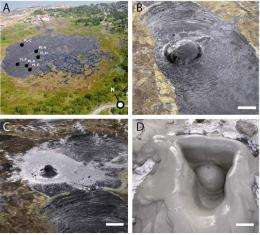
Enlarge

(A) Aerial photograph of Pitch Lake. Sampling sites marked by black circles. (B and C) Bubbles of varying sizes form on the surface of the liquid asphalt under varying viscosities. (D) Terrestrial mud volcano at Devil's Woodyard (MV). Scale bars indicate approximately 5 cm. Image credit: Dirk Schulze-Makuch, Arxiv, arxiv.org/abs/1004.2047

(PhysOrg.com) -- A lake of natural hot liquid asphalt in Trinidad and Tobago has been found to be teeming with microbes despite the toxic environment. The lake, aptly named Pitch Lake (since pitch is the old name for tar), is the nearest analog so far discovered to the seas of hydrocarbon on Saturn's moon, Titan, and raises the question of whether or not water should be considered as necessary for life.

Pitch , located near La Brea in southwest Trinidad, covers an area of almost 40 hectares (100 acres), is around 75 meters deep, and is the largest surface reservoir of liquid asphalt in the world, supplying asphalt for roads on the east coast of the US. The temperatures of the liquid range from 30 to 55°C, and a hydrocarbon mix of methane, propane and ethane constantly bubbles up from the liquid. Isotope studies of the suggest they are produced by microbial activity.

Researchers led by Washington State University astrobiologist Dr Dirk Schulze-Makuch found the Caribbean island lake is full of , despite the extremely toxic environment, and despite it having no oxygen and almost no water. The population levels reported by the researchers were 1-10 million single-celled organisms per gram of the foul-smelling liquid. of the showed many kinds were present, such as bacteria and archea, which are single-celled organisms lacking a nucleus. Around thirty percent of the species were previously unknown.

Dr Schulze-Makuch said some of the microbes lived on sulfur, iron, or methane and other hydrocarbons, and some even breathed out metals. Schulze-Makuch said the microbes were distinctly different from those found in the Los Angeles LaBrea tar pits and other natural pitch seeps, and the only similar life forms ever found were in samples of hydrocarbons taken from sub-sea oil wells.

The researchers were most excited by the implications their discovery may have for the possible presence of life on Titan. The Saturnian moon has all the necessary elements for life, except that its seas are filled with methane instead of water, but the asphalt lake microbes survive well with almost no water, and other microbes have been found that create their own water by breaking down hydrocarbons. Dr Schulze-Makuch stresses, however, that life surviving in such toxic environments and arising in them in the first place are very different propositions. He also admitted that it is possible the microbes could have lived in minute reservoirs of water trapped within the asphalt.

The findings may mean that NASA’s motto of “follow the water” in its search for extraterrestrial life forms could lead to missing life existing where there is far less than conventionally thought to be necessary.

More information: Microbial Life in a Liquid Asphalt Desert, Dirk Schulze-Makuch, et al., Arxiv, http://arxiv.org/abs/1004.2047

© 2010 PhysOrg.com

4.9 /5 (16 votes)  

Filter


Move the slider to adjust rank threshold, so that you can hide some of the comments.


Display comments: newest first

deatopmg
Apr 21, 2010

Rank: 4.3 / 5 (4)
Many yrs ago researchers were baffled as to why the asphalt roads, built during the early years of the atomic weapons program, were disintegrating. Investigation revealed that even in the desert there were micro-organisms gobbling up the asphalt.

NASA's "follow the water" policy (more like "follow the water" talk) is a good one until we learn more about these asphalt eaters. However, in spite of the obfuscations, the indications are that liquid water in commonplace on Mars and a good portion of that water is probably not saturated w/ salts nor contaminated w/ toxic levels perchlorate. Whether or not there is life on Mars remains to seen (well..., not quite true) because NASA has a policy of NOT sending any more life detecting instrumentation since the successful 70's voyager program. Why is that? NASA would never keep anything from it's paying public.
Caliban
Apr 21, 2010

Rank: 3.7 / 5 (3)
It always surprises me that these science professionals are so astonished by finds like these.

There are any number of metabolic pathways that life utilizes- and probably many that we can't even conceive of. So why should this discovery- especially since it is so closely paralleled by others right here on earth- be so damned surprising, much less suddenly an inkling that life might be able to exist in a little- to no-water environment?

One interesting observation- these microbes live in an anoxic, nonaqueous environment, and, given that there are substantial numbers of Archaea represented(which evolved well before the Carboniferous)-this might lead to substantiation of the "rock oil" hypothesis of Fossil Fuel origin. Or not. Interesting, though.
StarDust21
Apr 21, 2010

Rank: 5 / 5 (2)
Microbes have been known to live in these asphalt pits for years now....Is this site about news or am I misled?
Rank 4.9 /5 (16 votes)
Related Stories
Relevant PhysicsForums posts
  • Pertubance in a model
    created5 hours ago
  • Cancer drugs and Alzheimer's, Oh my!
    created13 hours ago
  • Squishing cells
    created14 hours ago
  • Any books/articles for evolutionary stable strategy models in humans?
    createdFeb 09, 2012
  • Science behind the bore feeling?
    createdFeb 09, 2012
  • Homo Sapien vs. Chimpanzee - Divergence Timeline
    createdFeb 09, 2012
  • More from Physics Forums - Biology

More news stories

Grass to gas: Researchers' genome map speeds biofuel development

Researchers at the University of Georgia have taken a major step in the ongoing effort to find sources of cleaner, renewable energy by mapping the genomes of two originator cells of Miscanthus x giganteus, a large perenn ...

Biology / Biotechnology

created 19 minutes ago | popularity 5 / 5 (1) | comments 0 | with audio podcast

The power of estrogen -- male snakes attract other males

A new study has shown that boosting the estrogen levels of male garter snakes causes them to secrete the same pheromones that females use to attract suitors, and turned the males into just about the sexiest ...

Biology / Plants & Animals

created 3 hours ago | popularity not rated yet | comments 0 | with audio podcast

Experts reveal how plants don't get sunburn

(PhysOrg.com) -- Experts at the University of Glasgow have discovered how plants survive the harmful rays of the sun.

Biology / Cell & Microbiology

created 3 hours ago | popularity 5 / 5 (2) | comments 0 | with audio podcast

Protein libraries in a snap

(PhysOrg.com) -- A Rice University undergraduate will depart with not only a degree but also a possible patent for his invention of an efficient way to create protein libraries, an important component of biomolecular ...

Biology / Cell & Microbiology

created 6 hours ago | popularity 5 / 5 (2) | comments 0 | with audio podcast

New drugs schedule makes horse racing a sure thing

What do Gai Waterhouse and Anthony Cummings have in common with Queen Elizabeth II?

Biology / Plants & Animals

created 3 hours ago | popularity not rated yet | comments 0


New understanding of DNA repair could eventually lead to cancer therapy

A research group in the Faculty of Medicine & Dentistry at the University of Alberta is hoping its latest discovery could one day be used to develop new therapies that target certain types of cancers.

Hovering not hard if you're top-heavy, researchers find

Top-heavy structures are more likely to maintain their balance while hovering in the air than are those that bear a lower center of gravity, researchers at New York University's Courant Institute of Mathematical Sciences ...

Night, weekend delivery OK for babies with birth defects

Weekday delivery is no better than night or weekend delivery for infants with birth defects, according to a new study presented today at The Pregnancy Meeting, the Society for Maternal-Fetal Medicine's annual conference. ...

Sonic Cradle lands spot in TED exhibition

A Simon Fraser University graduate student project that melds music, meditation and modern technology has landed a rare spot as an exhibit at TEDActive 2012 in Palm Springs, California this month.

Drug halts organ damage in inflammatory genetic disorder

A new study shows that Kineret (anakinra), a medication approved for the treatment of rheumatoid arthritis, is effective in stopping the progression of organ damage in people with neonatal-onset multisystem inflammatory disease ...

Cochlear implants may be safe, effective for organ transplant patients

Cochlear implants may be a safe, effective option for some organ transplant patients who've lost their hearing as an unfortunate consequence of their transplant-related drug regime, researchers report.