Breeding orchid species creates a new perfume
April 21, 2010
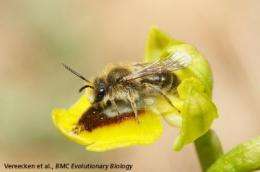
A male bee attempts to copulate with an orchid. Credit: Vereecken et al., BMC Evolutionary Biology
Some orchids mimic the scent of a female insect in order to attract males for pollination. Researchers writing in the open access journal BMC Evolutionary Biology found that breeding two of these orchid species to generate a novel hybrid resulted in a new scent. This new odour had no effect on normal solitary bees from the area but was highly attractive to another species of wild bee that never visited any of the parent orchid species.
Nicolas J Vereecken from the Université Libre de Bruxelles worked with a team of researchers based in Switzerland (Zürich) and Italy (Naples) to carry out the study in the terrestrial orchid species Ophrys arachnitiformis and O. lupercalis growing in southern France. The offspring of this pairing were sterile, but their floral odor was shown to be both novel and attractive to solitary bees unfamiliar with the parent plants' scent.
According to Vereecken, "Our study provides a unique window into the stepwise process by which apparent reproductive barriers can be broken down and how new combinations of floral traits can be generated, leading to the evolution of novel, highly specific plant-pollinator interactions".
This video is not supported by your browser at this time.
A video of a bee attempting copulation with an orchid
In a video accompanying the paper a male solitary bee can be seen attempting copulation with one of the plants, lured in by its deceptive scent. Speaking about this unusual behaviour, Vereecken said, " The fact that some plants reproduce by advertising a false promise of sex to patrolling male bees is an extraordinary strategy. These orchids rely almost exclusively on their floral fragrance to attract pollinators on a highly specific basis, and this pollination mechanism is so far only known from the orchid family". More information: Hybrid floral novelty drives pollinator shift in sexually deceptive orchids, Nicolas J Vereecken email, Salvatore Cozzolino email and Florian P Schiestl email, BMC Evolutionary Biology 2010, 10:103, doi:10.1186/1471-2148-10-103
-
New research explains orchids' sexual trickery
Dec 17, 2009 |
not rated yet |
0
-
Orchid sexual deceit has male wasps in a loved-up frenzy
Apr 29, 2008 |
not rated yet |
0
-
New orchid deception found: wearing the scent of hornet's prey
Aug 06, 2009 |
not rated yet |
0
-
The evolution of orchids
Nov 19, 2009 |
not rated yet |
0
-
Honeybees not fooled by cheating flowers
Apr 15, 2009 |
not rated yet |
0
-
Engineers build first sub-10-nm carbon nanotube transistor
Feb 01, 2012 |
4.9 / 5 (31) |
30
-
Something old, something new: Evolution and the structural divergence of duplicate genes
Jan 31, 2012 |
4.6 / 5 (7) |
1
-
The hidden nanoworld of ice crystals: Revealing the dynamic behavior of quasi-liquid layers
Jan 30, 2012 |
5 / 5 (3) |
1
-
Stock market network reveals investor clustering
Jan 27, 2012 |
3.9 / 5 (23) |
8
-
Of microchemistry and molecules: Electronic microfluidic device synthesizes biocompatible probes
Jan 26, 2012 |
5 / 5 (1) |
0
-
Mitosis
4 hours ago
-
Stem cell question.
6 hours ago
-
Protease cleavage
12 hours ago
-
Pertubance in a model
19 hours ago
-
Cancer drugs and Alzheimer's, Oh my!
Feb 09, 2012
-
Squishing cells
Feb 09, 2012
- More from Physics Forums - Biology
More news stories
The power of estrogen -- male snakes attract other males
A new study has shown that boosting the estrogen levels of male garter snakes causes them to secrete the same pheromones that females use to attract suitors, and turned the males into just about the sexiest ...
17 hours ago |
4.8 / 5 (6) |
2
|
Grass to gas: Researchers' genome map speeds biofuel development
Researchers at the University of Georgia have taken a major step in the ongoing effort to find sources of cleaner, renewable energy by mapping the genomes of two originator cells of Miscanthus x giganteus, a large perenn ...
14 hours ago |
3.8 / 5 (5) |
0
|
Miami battling invasion of giant African snails
No one knows how they got there. But an invasion of African giant snails has southern Florida in a panic over potential crop damage, disease and general yuckiness surrounding the slimy gastropods.
21 hours ago |
4 / 5 (1) |
4
Experts reveal how plants don't get sunburn
(PhysOrg.com) -- Experts at the University of Glasgow have discovered how plants survive the harmful rays of the sun.
17 hours ago |
4.8 / 5 (5) |
0
|
Protein libraries in a snap
(PhysOrg.com) -- A Rice University undergraduate will depart with not only a degree but also a possible patent for his invention of an efficient way to create protein libraries, an important component of biomolecular ...
20 hours ago |
4.8 / 5 (4) |
1
|
Anonymous knocks CIA website offline (Update)
The website of the Central Intelligence Agency was inaccessible on Friday after the hacker group Anonymous claimed to have knocked it offline.
New error-correcting codes guarantee the fastest possible rate of data transmission
Error-correcting codes are one of the triumphs of the digital age. Theyre a way of encoding information so that it can be transmitted across a communication channel such as an optical fiber o ...
Google users warned of threat to smartphone wallets
Users of Google smartphone wallets were being warned on Friday that there is a way to crack pass codes intended to thwart thieves from going on illicit shopping sprees.
Humans may have helped the decline of African rainforests 3000 years ago
(PhysOrg.com) -- Large areas of rainforests in Central Africa mysteriously disappeared over three thousand years ago, to be replaced by savannas. The prevailing theory has been that the cause was a change ...
New power source discovered
(PhysOrg.com) -- Researchers at the Massachusetts Institute of Technology (MIT) and RMIT University have made a breakthrough in energy storage and power generation.
Small modular reactor design could be a 'SUPERSTAR'
(PhysOrg.com) -- Though most of today's nuclear reactors are cooled by water, we've long known that there are alternatives; in fact, the world's first nuclear-powered electricity in 1951 came from a reactor ...