Bizarre matter could find use in quantum computers: Odd electron mix has fault-tolerant quantum registry
April 21, 2010
Bizarre matter could find use in quantum computers

Enlarge

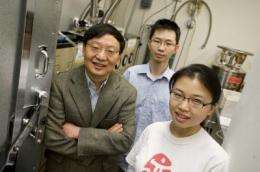
From left, Rice physicist Rui-Rui Du, graduate students Chi Zhang and Yanhua Dai, and former postdoctoral researcher Tauno Knuuttila (not pictured) have found that odd groupings of ultracold electrons could be useful in making fault-tolerant quantum computers. Credit: Jeff Fitlow/Rice University

There are enticing new findings this week in the worldwide search for materials that support fault-tolerant quantum computing. New results from Rice University and Princeton University indicate that a bizarre state of matter that acts like a particle with one-quarter electron charge also has a "quantum registry" that is immune to information loss from external perturbations.

The research appeared online April 21 in . The team of physicists found that ultracold mixes of caught in magnetic traps could have the necessary properties for constructing fault-tolerant quantum computers -- future computers that could be far more powerful than today's computers. The mixes of electrons are dubbed "5/2 quantum Hall liquids" in reference to the unusual that describe their makeup.

"The big goal, the whole driving force, besides deep academic curiosity, is to build a quantum computer out of this," said the study's lead author Rui-Rui Du, professor of physics at Rice. "The key for that is whether these 5/2 liquids have 'topological' properties that would render them immune to the sorts of quantum perturbations that could cause information degradation in a quantum computer."

Du said the team's results indicate the 5/2 liquids have the desired properties. In the parlance of condensed-matter physics, they are said to represent a "non-Abelian" .

Non-Abelian is a mathematical term for a system with "noncommutative" properties. In math, commutative operations, like addition, are those that have the same outcome regardless of the order in which they are carried out. So, one plus two equals three, just as two plus one equals three. In daily life, commutative and noncommutative tasks are commonplace. For example, when doing the laundry, it doesn't matter if the detergent is added before the water or the water before the detergent, but it does matter if the clothes are washed before they're placed in the dryer.

"It will take a while to fully understand the complete implications of our results, but it is clear that we have nailed down the evidence for 'spin polarization,' which is one of the two necessary conditions that must be proved to show that the 5/2 liquids are non-Abelian," Du said. "Other research teams have been tackling the second condition, the one-quarter charge, in previous experiments."

The importance of the noncommutative quantum properties is best understood within the context of fault-tolerant quantum computers, a fundamentally new type of computer that hasn't been built yet.

Computers today are binary. Their electrical circuits, which can be open or closed, represent the ones and zeros in binary bits of information. In quantum computers, scientists hope to use "quantum bits," or qubits. Unlike binary ones and zeros, the qubits can be thought of as little arrows that represent the position of a bit of quantum matter. The arrow might represent a one if it points straight up or a zero if it points straight down, but it could also represent any number in between. In physics parlance, these arrows are called quantum "states." And for certain complex calculations, being able to represent information in many different states would present a great advantage over binary computing.

The upshot of the 5/2 liquids being non-Abelian is that they have a sort of "quantum registry," where information doesn't change due to external quantum .

"In a way, they have internal memory of their previous state," Du said.

The conditions needed to create the 5/2 liquids are extreme. At Rice, Tauno Knuuttila, a former postdoctoral research scientist in Du's group, spent several years building the "demagnetization refrigerator" needed to cool 5-millimeter squares of ultrapure semiconductors to within one-10,000th of a degree of absolute zero. It took a week for Knuuttila to simply cool the nearly one-ton instrument to the necessary temperature for the Rice experiments.

The gallium arsenide semiconductors used in the tests are the most pure on the planet. They were created by Loren Pfieiffer, Du's longtime collaborator at Princeton and Bell Labs. Rice graduate student Chi Zhang conducted additional tests at the National High Magnetic Field Laboratory in Tallahassee, Fla., to verify that the 5/2 liquid was spin- polarized.

Provided by Rice University (news : web)

4.7 /5 (22 votes)  

Filter


Move the slider to adjust rank threshold, so that you can hide some of the comments.


Display comments: newest first

otto1923
Apr 21, 2010

Rank: 1 / 5 (1)
"Other research teams have been tackling the second condition, the one-quarter charge, in previous experiments."
Any relation to the hydrino?
http://en.wikiped...ht_Power
El_Nose
Apr 21, 2010

Rank: 3 / 5 (2)
is it me or is this article written like a clifhanger in a series --- it leaves you saying --- okay .. and then....

it simply stops without explaining anything okay so they made a liquid with 5/2 spin -- then what did they do with it??
solidspin
Apr 21, 2010

Rank: not rated yet
If it's non-Abelian, then therein lies the power...by taking a different pathway, you won't come up w/ the same result - hence the fault tolerance.

yes, this is a REAL cliffhanger, b/z for a quantum computer, it would be ideal to have a storage medium (just like RAM or HD memory). A 5/2 quantum Hall system has a step-wise decay, not a continuous one. This is excellent for 2 really important reasons 1) It has 2n+1 possible eigenstates 2) a quantum Hall system displays voltage @ right angles to both the current and the B field. So, if they're correct, they can not only generate the 2n+1 superpositional values, they can also store them!!!! This would bring the many-body problem to it's knees!!!
malapropism
Apr 21, 2010

Rank: not rated yet
In addition, if these quantum particles are truly non-Abelian *and* it is possible to entangle two or more of them and separate the entangled particles into remote and local systems, does this admit the possibility of an actualised instantaneous quantum communication of real-world information?

Disregarding for the moment difficulties of maintaining quantum-entangled states, if the prior state of the remote system is discoverable then presumably any change of state in the remote system, due to a change applied in the local entangled system, should also be discoverable. If so it ought to be able to be compared to the prior state and this information able to be used in a classical system?

Or possibly I have fundamentally misunderstood the implications of this article, as I always thought this communication concept to be impossible in practice. Is anyone able to clarify?
Parsec
Apr 21, 2010

Rank: not rated yet
"Other research teams have been tackling the second condition, the one-quarter charge, in previous experiments."
Any relation to the hydrino?
http://en.wikiped...ht_Power


Considering the very high degree of skepticism that hydrino's are even predicted by the theory proposed by the guy that suggests they exist, I would say probably not.
Bob_Kob
Apr 22, 2010

Rank: not rated yet
Anyone find it funny that "rice physicist" is an asian guy?
Rank 4.7 /5 (22 votes)
Related Stories
Relevant PhysicsForums posts
  • slit width order of wavelength
    created3 hours ago
  • Non-Uniform Charge Distribution of a Metal Cone
    created7 hours ago
  • velocity from acceleration if acceleration is a function of space...
    created10 hours ago
  • Electrohydroconvection Engine?
    created12 hours ago
  • Question about entropy=0 in an irreversible process
    created12 hours ago
  • Question about Firing tank shell in freefall
    created14 hours ago
  • More from Physics Forums - Classical Physics

More news stories

Researchers build first physical 'metatronic' circuit

(PhysOrg.com) -- The technological world of the 21st century owes a tremendous amount to advances in electrical engineering, specifically, the ability to finely control the flow of electrical charges using ...

Physics / General Physics

created 10 hours ago | popularity 4.7 / 5 (17) | comments 5 | with audio podcast

Faster than light neutrinos? More like faulty wiring

You can shelf your designs for a warp drive engine (for now) and put the DeLorean back in the garage; it turns out neutrinos may not have broken any cosmic speed limits after all.

Physics / General Physics

created 9 hours ago | popularity 4.2 / 5 (22) | comments 23 | with audio podcast

Physicists surprised by disappearing and reappearing superconductivity in iron selenium chalcogenides

Superconductivity is a rare physical state in which matter is able to conduct electricity -- maintain a flow of electrons -- without any resistance. This phenomenon can only be found in certain materials at low temperatures, ...

Physics / Superconductivity

created 13 hours ago | popularity 5 / 5 (5) | comments 2 | with audio podcast

Less is more: Study of tiny droplets could have big impact on industrial applications

(PhysOrg.com) -- Under a microscope, a tiny droplet slides between two fine hairs like a roller coaster on a set of rails until — poof — it suddenly spreads along them, a droplet no more.

Physics / General Physics

created 10 hours ago | popularity 3.7 / 5 (3) | comments 0 | with audio podcast

Study reveals switching mechanism in promising computer memory device

(PhysOrg.com) -- Sometimes knowing that a new technology works is not enough. You also must know why it works to get marketplace acceptance. New information from the National Institute of Standards and Technology ...

Physics / General Physics

created 17 hours ago | popularity 4 / 5 (4) | comments 0 | with audio podcast


Spitzer finds solid buckyballs in space

(PhysOrg.com) -- Astronomers using data from NASA's Spitzer Space Telescope have, for the first time, discovered buckyballs in a solid form in space. Prior to this discovery, the microscopic carbon spheres ...

Stanford research team cracks animated NuCaptcha

(PhysOrg.com) -- The research team from Stanford University, led by Elie Bursztein, that previously had cracked regular CAPTCHAs and then audio CAPTCHAs, now has also successfully cracked the animated version called NuCapt ...

CT colonography shown to be comparable to standard colonoscopy

Computerized tomographic (CT) colonography (CTC), also known as virtual colonoscopy, is comparable to standard colonoscopy in its ability to accurately detect cancer and precancerous polyps in people ages 65 and older, according ...

Going up: Japan builder eyes space elevator

A Japanese construction firm claimed Wednesday it could execute an out-of-this-world plan to put tourists in space within 40 years by building an elevator that stretches a quarter of the way to the moon.

Scientists create potent molecules aimed at treating muscular dystrophy

While RNA is an appealing drug target, small molecules that can actually affect its function have rarely been found. But now scientists from the Florida campus of The Scripps Research Institute have for the first time designed ...

Flesh-eating bacteria inspire superglue

(PhysOrg.com) -- A bio-inspired superglue has been developed by Oxford University researchers that can’t be matched for sticking molecules together and not letting go.