Endangered sturgeon fish flourishing in Wisconsin
April 23, 2010 By CARRIE ANTLFINGER , Associated Press Writer
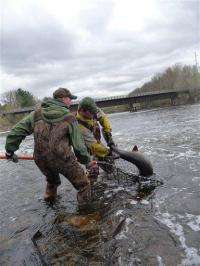
In this April 16, 2010 photo, Colt Christopherson, left, a fisheries technician with the Wisconsin Department of Natural Resources along with Chris Cahill, President of the Student Fisheries Society at the University of Wisconsin-Stevens Point, wrangle a sturgeon on the Wolf River in Shawano, Wis. They were tagging the fish while they spawned near the shores. (AP Photo/Carrie Antlfinger)
(AP) -- It's been a tough fight for the whisker-snouted sturgeon.
The fish survived whatever killed the dinosaurs and have struggled against habitat destruction and overfishing. Now many of its 25 species are endangered, but a small pocket in upper Wisconsin boasts of having one of the world's largest concentrations of the fish.
The success is because of the state's strict spearing limits, poaching laws, restocking efforts and the popular - and well-protected - spring spawning, which mostly finished last week.
"If we can restore the sturgeon population in the Great Lakes and manage the current population effectively, then we know we are doing a pretty good job of managing the other aspects of the aquatic community," said state sturgeon expert Ron Bruch.
In Lake Winnebago there are now around 40,000 lake sturgeons, likely where the population was in the 1800s, Bruch said. In the 1950s, it was 10,000. Whereas in the Great Lakes system, there are now about 156,750, less than 1 percent of what it was in early 1800s, said Rob Elliott, a U.S. Fish and Wildlife Service biologist.
Thousands from around the state and elsewhere visit the Lake Winnebago system tributaries to watch the enormous fish writhe and splash as they lay eggs in shallow, moving water. The fish, which grow up to 300 pounds and look like a cross between a catfish and shark, are close enough to touch.
"Some people say they are awful homely, awful bad looking, but to me ... they are beautiful fish, just like a beautiful blonde," said 73-year-old Pat Wudtke, who's speared sturgeon for 50 years during the state's annual season.
For the past decade, Wudtke also has been among the hundreds who volunteer to protect the fish from poachers.
"I'll do everything I can to preserve them," Wudtke said.
People love the animals because of their unique look, that the species is prehistoric and their size, Bruch said.
"This is the only place really in the world that you can see them to this extent," he said.
The spawning spectacle pumps $350,000 into three nearby cities, some of which have signs directing people to the spawning sites.
The fish's success in Lake Winnebago has Bruch concerned. Though only a few cases of poaching are reported each year, he worries there will be more since other areas have a sturgeon shortage and demand is high. And he thinks the taste of lake sturgeon caviar compares with the high-priced kind.
There also are reports of poaching of white sturgeon in California as its caviar has grown more popular, said Ellen Pikitch, executive director of the Institute for Ocean Conservation Science in New York. It is illegal to fish wild white sturgeon in California and sell its meat or eggs, but people can sell farm-raised white sturgeon. It's also illegal in the U.S. to sell lake sturgeon meat and its eggs from the states.
In the Black and Caspian Seas the beluga sturgeon is overfished for its caviar, which costs up to $5,000 a pound.
Wisconsin does allow sturgeon spearing, with thousands huddled in shanties on a frozen Lake Winnebago. Spearers are allowed one sturgeon per person. Most get none. The DNR ends spearing when 5 percent of the population is taken.
The spearing is why the group, Sturgeon for Tomorrow, started in 1977, because they wanted to keep that tradition alive, said a founder, Bill Casper. Bruch credits the group for part of the sturgeon's success. It runs the sturgeon guard program and raises funds for research and hatcheries, among other things.
But some say even one speared sturgeon is too many.
"If they were not removed from the water," Pikitch said, "They would have opportunity to spawn many, many times in a long lifetime."
©2010 The Associated Press. All rights reserved. This material may not be published, broadcast, rewritten or redistributed.
-
Sturgeon threatened with extinction
Sep 22, 2005 |
not rated yet |
0
-
Caviar demand threatens U.S. sturgeon
Dec 31, 2005 |
not rated yet |
0
-
California reacts to sturgeon decline
Mar 22, 2006 |
not rated yet |
0
-
Pallid sturgeon spawning in Missouri River
Jun 29, 2007 |
not rated yet |
0
-
German rivers repopulated with sturgeon
Oct 31, 2006 |
not rated yet |
0
-
Engineers build first sub-10-nm carbon nanotube transistor
Feb 01, 2012 |
4.9 / 5 (31) |
30
-
Something old, something new: Evolution and the structural divergence of duplicate genes
Jan 31, 2012 |
4.6 / 5 (7) |
1
-
The hidden nanoworld of ice crystals: Revealing the dynamic behavior of quasi-liquid layers
Jan 30, 2012 |
5 / 5 (3) |
1
-
Stock market network reveals investor clustering
Jan 27, 2012 |
3.9 / 5 (23) |
8
-
Of microchemistry and molecules: Electronic microfluidic device synthesizes biocompatible probes
Jan 26, 2012 |
5 / 5 (1) |
0
-
Protease cleavage
5 hours ago
-
Pertubance in a model
12 hours ago
-
Cancer drugs and Alzheimer's, Oh my!
20 hours ago
-
Squishing cells
20 hours ago
-
Any books/articles for evolutionary stable strategy models in humans?
Feb 09, 2012
-
Science behind the bore feeling?
Feb 09, 2012
- More from Physics Forums - Biology
More news stories
The power of estrogen -- male snakes attract other males
A new study has shown that boosting the estrogen levels of male garter snakes causes them to secrete the same pheromones that females use to attract suitors, and turned the males into just about the sexiest ...
10 hours ago |
4.8 / 5 (5) |
0
|
Grass to gas: Researchers' genome map speeds biofuel development
Researchers at the University of Georgia have taken a major step in the ongoing effort to find sources of cleaner, renewable energy by mapping the genomes of two originator cells of Miscanthus x giganteus, a large perenn ...
7 hours ago |
3.7 / 5 (3) |
0
|
Experts reveal how plants don't get sunburn
(PhysOrg.com) -- Experts at the University of Glasgow have discovered how plants survive the harmful rays of the sun.
10 hours ago |
5 / 5 (2) |
0
|
Protein libraries in a snap
(PhysOrg.com) -- A Rice University undergraduate will depart with not only a degree but also a possible patent for his invention of an efficient way to create protein libraries, an important component of biomolecular ...
13 hours ago |
5 / 5 (2) |
0
|
Miami battling invasion of giant African snails
No one knows how they got there. But an invasion of African giant snails has southern Florida in a panic over potential crop damage, disease and general yuckiness surrounding the slimy gastropods.
14 hours ago |
4 / 5 (1) |
4
Google users warned of threat to smartphone wallets
Users of Google smartphone wallets were being warned on Friday that there is a way to crack pass codes intended to thwart thieves from going on illicit shopping sprees.
Anonymous knocks CIA website offline (Update)
The website of the Central Intelligence Agency was inaccessible on Friday after the hacker group Anonymous claimed to have knocked it offline.
Complex wiring of the nervous system may rely on a just a handful of genes and proteins
Researchers at the Salk Institute have discovered a startling feature of early brain development that helps to explain how complex neuron wiring patterns are programmed using just a handful of critical genes. ...
NASA sees wide-eyed cyclone Jasmine
Cyclone Jasmine's eye has opened wider on NASA satellite imagery, as it moves through the Southern Pacific Ocean.
Putting the squeeze on planets outside our solar system
(PhysOrg.com) -- Using high-powered lasers, scientists at Lawrence Livermore National Laboratory and collaborators discovered that molten magnesium silicate undergoes a phase change in the liquid state, abruptly ...
NASA sees Giovanna reach cyclone strength, threaten Madagascar
Tropical Storm 12S built up steam and became a cyclone on February 10, 2012 as NASA's Terra satellite passed overhead. Residents of east-central Madagascar should prepare for this cyclone to make landfall ...
Apr 23, 2010
Rank: not rated yet
They were once considered a nuisance fish in the early 1800's, and were fished to extinction to eradicate them from Lake Ontario.