IBM demonstrates nonoscale 3D patterning technique (w/ Video)
April 23, 2010 by Lin Edwards report
IBM demonstrates nonoscale 3D patterning technique

Enlarge

Image credit: IBM/Science.

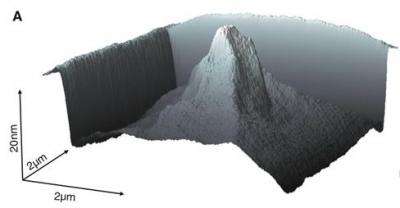
(PhysOrg.com) -- IBM Research in Zurich has demonstrated a new nanoscale patterning technique that could replace electron beam lithography (EBL). The demonstration carved a 1:5 billion scale three-dimensional model of the Matterhorn, a 4,478 meter high mountain lying on the border between Italy and Switzerland, to show how their technique could be used for a number of applications, such as creating nanoscale lenses on silicon chips for carrying optical circuits at a scale so small that electronic circuits are inefficient.

EBL (also called e-beam lithography) uses a focused beam of electrons to etch micro- or nano-scale patterns into a substrate covered by a film (the resist) that is sensitive to the electrons. It was initially developed for fabricating .

The 25-nanometer (nm) high model of the mountain was sculpted in around three minutes from a glassy using a 500-nm long and 5-nm thick silicon scanning probe heated to above 330°C for a few microseconds — long enough to break within the material without breaking other bonds. The probe was fixed to a flexible cantilever that can scan the substrate to an accuracy of 1 nm. The probe acts like a microscopic milling machine removing layers of the substrate by heat and force.

The demonstration also sculpted a relief map of the world that measured 22 by 11 micrometers. According to the IBM press release the scale of the map is so small 1,000 of them could be drawn on a single grain of salt. IBM says the current technology can go as small as 15 nanometers, but in the future could go even smaller.

This video is not supported by your browser at this time.

The movie depicts the process of carving the 'Matterhorn' out of the molecular glass resist layer in a series of topographical images. The initial surface was imaged and the following frames were taken with always 12 patterning steps in between the frames. A total of 10 frames was recorded. Credit: IBM/Science.

At that scale IBM’s technique could replace EBL, which costs 80 to 90% more and is slower. According Michel Despont, an IBM physicist and co-author of the research paper, the technique needs fewer processes than EBL, and the fact that it can be used to create structures in 3D means it could be used for applications no one has yet considered.

In their paper, published in the Science journal, the IBM researchers say they plan to use the technique to create meta-materials, optical components, for prototyping CMOS nanoelectronics components, and for making templates for nanorod or nanotube self-assembly. Despont said the system would not be commercially available for around five years, but they hope to make it available for universities and research laboratories before then.
This video is not supported by your browser at this time.

IBM scientists have created the smallest 3D map of the earth - so small that 1,000 maps could fit on a grain of salt.

IBM demonstrates nonoscale 3D patterning technique
Enlarge

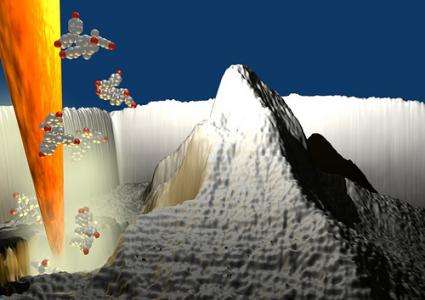
3D rendered image showing a heated nanoscale silicon tip, borrowed from atomic force microscopy, that is chiselling away material from a substrate to create a nanoscale replica of the Matterhorn. As reported in the scientific journal Science, IBM Researchers used this new nanopatterning technique to create a 25 nanometer high 3D replica of the Matterhorn, a famous Swiss mountain that soars 4,478 m (14,692 ft) high, in molecular glass, representing a scale of 1:5 billion (1 nanometer of the replica corresponds to 57 altitude meters). Image courtesy of IBM Research - Zurich


More information: Nanoscale Three-Dimensional Patterning of Molecular Resists by Scanning Probes, David Pires et al., Published Online April 22, 2010
Science DOI:10.1126/science.1187851

© 2010 PhysOrg.com

Filter


Move the slider to adjust rank threshold, so that you can hide some of the comments.


Display comments: newest first

lengould100
Apr 23, 2010

Rank: 2.5 / 5 (2)
the current technology can go as small as 15 nanometers
hmmm... Still at least 100 times too large features for making the diodes required for Optical Rectena solar cells, but getting there. Reduce the 5 nm probe tip size to 0.25 nm and away. Only problem is, at that size, we're down to single silicon molecules forming the tip, so no mechanical strength.
moj85
Apr 23, 2010

Rank: 4 / 5 (4)
Nonoscale? Is that a scale to which we cannot go?

Check titles, Physorg. Cmon.
AdrianMiller
Apr 23, 2010

Rank: 5 / 5 (2)
We've set the author's related work, published at the same time as the Science paper in Advanced Materials, free to access for the next few week. So, if anyone's interested in more of the science behind this story, you can find it here: http://www.materi..._3D.html

Adrian Miller
Advanced Materials
GDM
Apr 23, 2010

Rank: not rated yet
Adrian, not quite...the link doesn't find the data.
antialias
Apr 23, 2010

Rank: not rated yet
Would be interesting to know how long the tip lasts. If it needs to be replaced all the time that won't be of much use.

Reminds me a lot of their millipede project http://en.wikiped...e_memory
guiding_light
Apr 23, 2010

Rank: not rated yet
The tip wear is definitely a key issue. I also wonder why no 15 nm line space patterns were shown, maybe the tip stil has some curvature.
Dr_McFoo
Apr 24, 2010

Rank: not rated yet
The guys in Rueschlikon refuse to give up on the scanning probe. Five years after the millipede was canceled they do lithography instead. Look out for the 1000x1000 tip probe scanner....
winthrom
Apr 24, 2010

Rank: not rated yet
At this scale the possibility exists to make a high resolution electronic retina for certain types of blindness.
AdrianMiller
Apr 26, 2010

Rank: not rated yet
Adrian, not quite...the link doesn't find the data.


Sorry GDM, quite right; we got the link wrong in the original story, and didn't notice over the weekend. Fixed now!
Rank 5 /5 (25 votes)
Relevant PhysicsForums posts
  • Books To Inspire a Beginnig Physics Student
    created2 hours ago
  • Pith balls problem
    created3 hours ago
  • Electrostatics
    created3 hours ago
  • what is phase constant
    created3 hours ago
  • Basics In electromagnetic wave
    created3 hours ago
  • How to calculate theoretical initial velocity?
    created4 hours ago
  • More from Physics Forums - General Physics

More news stories

What lies beneath: Mapping hidden nanostructures

The ability to diagnose and predict the properties of materials is vital, particularly in the expanding field of nanotechnology. Electron and atom-probe microscopy can categorize atoms in thin sheets of material, ...

Nanotechnology / Nanophysics

created 17 hours ago | popularity 5 / 5 (3) | comments 1

New kind of solar cell could capture significantly more energy than current cells

New solar cells could increase the maximum efficiency of solar panels by over 25%, according to scientists from the University of Cambridge.

Nanotechnology / Nanophysics

created Feb 08, 2012 | popularity 4.5 / 5 (12) | comments 14 | with audio podcast

Nanoshell whispering galleries improve thin solar panels

Visitors to Statuary Hall in the U.S. Capitol Building may have experienced a curious acoustic feature that allows a person to whisper softly at one side of the cavernous, half-domed room and for another on ...

Nanotechnology / Nanomaterials

created Feb 07, 2012 | popularity 4.3 / 5 (6) | comments 6 | with audio podcast

'Dark plasmons' transmit energy

Microscopic channels of gold nanoparticles have the ability to transmit electromagnetic energy that starts as light and propagates via "dark plasmons," according to researchers at Rice University.

Nanotechnology / Nanophysics

created Feb 09, 2012 | popularity 4.8 / 5 (8) | comments 1 | with audio podcast

Revealing how a battery material works

Since its discovery 15 years ago, lithium iron phosphate (LiFePO4) has become one of the most promising materials for rechargeable batteries because of its stability, durability, safety and ability to deliver ...

Nanotechnology / Nanomaterials

created Feb 08, 2012 | popularity 5 / 5 (5) | comments 0 | with audio podcast


Anonymous knocks CIA website offline (Update)

The website of the Central Intelligence Agency was inaccessible on Friday after the hacker group Anonymous claimed to have knocked it offline.

New error-correcting codes guarantee the fastest possible rate of data transmission

Error-correcting codes are one of the triumphs of the digital age. They’re a way of encoding information so that it can be transmitted across a communication channel — such as an optical fiber o ...

Google users warned of threat to smartphone wallets

Users of Google smartphone wallets were being warned on Friday that there is a way to crack pass codes intended to thwart thieves from going on illicit shopping sprees.

Humans may have helped the decline of African rainforests 3000 years ago

(PhysOrg.com) -- Large areas of rainforests in Central Africa mysteriously disappeared over three thousand years ago, to be replaced by savannas. The prevailing theory has been that the cause was a change ...

New power source discovered

(PhysOrg.com) -- Researchers at the Massachusetts Institute of Technology (MIT) and RMIT University have made a breakthrough in energy storage and power generation.

The power of estrogen -- male snakes attract other males

A new study has shown that boosting the estrogen levels of male garter snakes causes them to secrete the same pheromones that females use to attract suitors, and turned the males into just about the sexiest ...