Lessons from the Brain: Toward an Intelligent Molecular Computer
April 25, 2010 By Marcia Goodrich
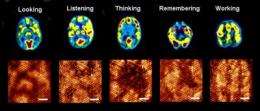
Magnetic resonance images of human brain during different functions appear on top. Similar evolving patterns have been generated on the molecular monolayer one after another (bottom). A snapshot of the evolving pattern for a particular brain function is captured using Scanning Tunneling Microscope at 0.68 V tip bias (scale bar is 6 nm). The input pattern to mimic particular brain function is distinct, and the dynamics of pattern evolution is also typical for a particular brain operation. Credit: Anirban Bandyopadhyay
(PhysOrg.com) -- Information processing circuits in digital computers are static. In our brains, information processing circuits—neurons—evolve continuously to solve complex problems. Now, an international research team from Japan and Michigan Technological University has created a similar process of circuit evolution in an organic molecular layer that can solve complex problems. This is the first time a brain-like "evolutionary circuit" has been realized.
A team of researchers from Japan and Michigan Technological University has built a molecular computer using lessons learned from the human brain.
Physicist Ranjit Pati of Michigan Tech provided the theoretical underpinnings for this tiny computer composed not of silicon but of organic molecules on a gold substrate. “This molecular computer is the brainchild of my colleague Anirban Bandyopadhyay from the National Institute for Materials Science,” says Pati. Their work is detailed in “Massively Parallel Computing on an Organic Molecule Layer,” published April 25 online in Nature Physics.
“Modern computers are quite fast, capable of executing trillions of instructions a second, but they can’t match the intelligent performance of our brain,” says Pati. “Our neurons only fire about a thousand times per second. But I can see you, recognize you, talk with you, and hear someone walking by in the hallway almost instantaneously, a Herculean task for even the fastest computer.”
That’s because information processing is done sequentially in digital computers. Once a current path is established along a circuit, it does not change. By contrast, the electrical impulses that travel through our brains follow vast, dynamic, evolving networks of neurons that operate collectively.
The researchers made their different kind of computer with DDQ, a hexagonal molecule made of nitrogen, oxygen, chlorine and carbon that self-assembles in two layers on a gold substrate.
The DDQ molecule can switch among four conducting states—0, 1, 2 and 3—unlike the binary switches—0 and 1—used by digital computers.
“The neat part is, approximately 300 molecules talk with each other at a time during information processing,” Pati says. “We have mimicked how neurons behave in the brain.”
“The evolving neuron-like circuit network allows us to address many problems on the same grid, which gives the device intelligence," Pati says. As a result, their tiny processor can solve problems for which algorithms on computers are unknown, especially interacting many-body problems, such as predictions of natural calamities and outbreaks of disease. To illustrate this feature, they mimicked two natural phenomena in the molecular layer: heat diffusion and the evolution of cancer cells.
In addition, their molecular processor heals itself if there is a defect. This property comes from the self-organizing ability of the molecular monolayer. “No existing man-made computer has this property, but our brain does,” Bandyopadhyay says. “If a neuron dies, another neuron takes over its function.”
“This is very exciting, a conceptual breakthrough,” Pati says. “This could change the way people think about molecular computing.”
An abstract of “Massively Parallel Computing on an Organic Molecule Layer” is available at Nature Physics.
-
Quantum Computer Science on the Internet
Jul 31, 2004 |
not rated yet |
0
-
New Way of Connection: 'Grid Computing' to Solve Insoluble
Jul 30, 2004 |
not rated yet |
0
-
Structure of a Molecular-Scale Circuit Component
Feb 09, 2006 |
not rated yet |
0
-
An organic transistor paves the way for new generations of neuro-inspired computers
Jan 22, 2010 |
not rated yet |
0
-
Scientists create first electronic quantum processor
Jun 28, 2009 |
not rated yet |
0
-
Stars containing dark matter should look different from other stars
Feb 20, 2012 |
4.5 / 5 (17) |
11
-
Physicists discover evidence of rare hypernucleus, a component of strange matter
Feb 17, 2012 |
4.7 / 5 (38) |
22
-
Fast photon control brings quantum photonic technologies closer
Feb 13, 2012 |
5 / 5 (8) |
1
-
Engineers build first sub-10-nm carbon nanotube transistor
Feb 01, 2012 |
4.9 / 5 (36) |
32
-
Something old, something new: Evolution and the structural divergence of duplicate genes
Jan 31, 2012 |
4.6 / 5 (7) |
1
-
which college offer Light and modern physics in summer?
59 minutes ago
-
linear wave equation vs. linear system
2 hours ago
-
adhesive force and surface tension
2 hours ago
-
Newbie here.
4 hours ago
-
Rainbows in space?
4 hours ago
-
taking mechanical physics next fall
5 hours ago
- More from Physics Forums - General Physics
More news stories
Researchers build first physical 'metatronic' circuit
(PhysOrg.com) -- The technological world of the 21st century owes a tremendous amount to advances in electrical engineering, specifically, the ability to finely control the flow of electrical charges using ...
10 hours ago |
4.7 / 5 (17) |
5
|
Faster than light neutrinos? More like faulty wiring
You can shelf your designs for a warp drive engine (for now) and put the DeLorean back in the garage; it turns out neutrinos may not have broken any cosmic speed limits after all.
9 hours ago |
4.2 / 5 (22) |
23
|
Physicists surprised by disappearing and reappearing superconductivity in iron selenium chalcogenides
Superconductivity is a rare physical state in which matter is able to conduct electricity -- maintain a flow of electrons -- without any resistance. This phenomenon can only be found in certain materials at low temperatures, ...
13 hours ago |
5 / 5 (5) |
2
|
Less is more: Study of tiny droplets could have big impact on industrial applications
(PhysOrg.com) -- Under a microscope, a tiny droplet slides between two fine hairs like a roller coaster on a set of rails until poof it suddenly spreads along them, a droplet no more.
10 hours ago |
3.7 / 5 (3) |
0
|
Study reveals switching mechanism in promising computer memory device
(PhysOrg.com) -- Sometimes knowing that a new technology works is not enough. You also must know why it works to get marketplace acceptance. New information from the National Institute of Standards and Technology ...
17 hours ago |
4 / 5 (4) |
0
|
Spitzer finds solid buckyballs in space
(PhysOrg.com) -- Astronomers using data from NASA's Spitzer Space Telescope have, for the first time, discovered buckyballs in a solid form in space. Prior to this discovery, the microscopic carbon spheres ...
Stanford research team cracks animated NuCaptcha
(PhysOrg.com) -- The research team from Stanford University, led by Elie Bursztein, that previously had cracked regular CAPTCHAs and then audio CAPTCHAs, now has also successfully cracked the animated version called NuCapt ...
CT colonography shown to be comparable to standard colonoscopy
Computerized tomographic (CT) colonography (CTC), also known as virtual colonoscopy, is comparable to standard colonoscopy in its ability to accurately detect cancer and precancerous polyps in people ages 65 and older, according ...
Going up: Japan builder eyes space elevator
A Japanese construction firm claimed Wednesday it could execute an out-of-this-world plan to put tourists in space within 40 years by building an elevator that stretches a quarter of the way to the moon.
Scientists create potent molecules aimed at treating muscular dystrophy
While RNA is an appealing drug target, small molecules that can actually affect its function have rarely been found. But now scientists from the Florida campus of The Scripps Research Institute have for the first time designed ...
Flesh-eating bacteria inspire superglue
(PhysOrg.com) -- A bio-inspired superglue has been developed by Oxford University researchers that cant be matched for sticking molecules together and not letting go.
Apr 25, 2010
Rank: not rated yet
Apr 25, 2010
Rank: 3 / 5 (2)
Apr 25, 2010
Rank: 4.5 / 5 (2)
Apr 25, 2010
Rank: not rated yet
Ray Kurzweil and so fourth.
Nitish Kannan
Apr 26, 2010
Rank: not rated yet
No enslave Bob, Free Bob, Free Bob now.
Apr 26, 2010
Rank: not rated yet
True, but simulation is not the same as the real thing. While your normal digital computer will be busy running extra processes to simulate a structure that dynamically changes, this thing actually does that. To simulate one second of the dynamic "brain-like" processor a normal digital computer might require a thousand seconds. I'd rather have the real thing than a simulation, as it will be faster and more energy efficient than a clunky simulation.
Apr 26, 2010
Rank: not rated yet