Soil Microbes Produce Less Atmospheric Carbon Dioxide Than Expected With Climate Warming

April 26, 2010
Many species of fungi proliferate in Alaska's boreal forest. Credit: Steven D. Allison
(PhysOrg.com) -- In dark, rich soils on every continent, microbes dealing with the effects of climate change aren't accelerating global warming the way scientists had predicted, a study by researchers at the University of California at Irvine, Colorado State University and Yale University shows.
Results of the study appear in a paper published on-line this week in the journal Nature Geoscience. The work was supported by the National Science Foundation (NSF) and U.S. Department of Energy.
"Microbes continually surprise us in the diverse ways they respond to environmental conditions," said Saran Twombly, program director in NSF's Division of Environmental Biology, which funded the research along with NSF's Advancing Theory in Biology program, part of the Directorate for Biological Sciences Office of Emerging Frontiers.
"Microbes play a central role in ecological processes," said Twombly, "and their responses change our understanding of natural communities in fundamental ways."
Conventional scientific wisdom holds that even a few degrees of human-caused climate warming will shift fungi and bacteria that consume soil-based carbon into overdrive, and that their growth will accelerate the release of carbon dioxide into the atmosphere.
But a research team led by ecologist Steve Allison of UC Irvine took a closer look, and found something different.
While microbial soil decomposition, and resulting carbon dioxide emissions, increase initially, microbes eventually overheat and grow more slowly.
As their numbers decline, they release decreasing amounts of climate-warming greenhouse gases.
"Microbes are the engines that drive carbon cycling in soils," said Allison.
"In a balanced environment, plants store carbon in the soil and microbes use that carbon to grow. Enzymes produced by microbes convert soil carbon into atmospheric carbon dioxide."
A previous study by Mark Bradford of Yale and Matthew Wallenstein of Colorado State found that microbes became less efficient at decomposing soil carbon after several years of experimental warming.
They asked Allison to develop a computer model to test how adaptation of microbes to climate change might affect the carbon cycle.
"The issue we have in predicting whether soil carbon loss will accelerate climate warming is that the microbial processes causing this loss are poorly understood," said Bradford. "More research in this area will help reduce uncertainties in climate prediction."
In the resulting computer model, microbes became less efficient at converting their carbon food source into biomass as climate warmed.
In short, the microbes were not well adapted to a warmer climate. As their growth slowed, so did enzyme production.
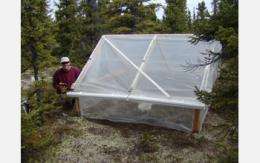
Biologist Steven Allison in Alaskan forest, maintaining the greenhouse warming experiment. Credit: Krista McGuire
"When we developed a model based on the actual biology of soil microbes, we found that soil carbon may not be lost to the atmosphere as the climate warms," Allison said. "Conventional ecosystem models that didn't include enzymes did not make the same predictions."The next steps include studying more microbes and more ecosystems.
Microbes from a Massachusetts forest inspired this study, then Allison began collecting soil samples from California, Alaska, Maine and Costa Rica.
"Nearly one-third of all soil-based carbon is sequestered in permafrost or Arctic regions, which might respond differently to warming," said Wallenstein, who is researching sites in Greenland and Alaska.
"We need to develop more models to include microbe diversity," Allison said. "But the general principle that's important in our model is the decline of carbon dioxide production after an initial increase."
-
Researcher seeks 'missing piece' in climate change models
Feb 13, 2007 |
not rated yet |
0
-
Limitations of charcoal as an effective carbon sink
May 02, 2008 |
not rated yet |
0
-
Soil contributes to climate warming more than expected
Feb 09, 2010 |
not rated yet |
0
-
Even soil feels the heat: Soils release more carbon dioxide as globe warms
Mar 24, 2010 |
not rated yet |
0
-
Microbes as climate engineers
Jan 29, 2008 |
not rated yet |
0
-
Engineers build first sub-10-nm carbon nanotube transistor
Feb 01, 2012 |
4.9 / 5 (31) |
30
-
Something old, something new: Evolution and the structural divergence of duplicate genes
Jan 31, 2012 |
4.6 / 5 (7) |
1
-
The hidden nanoworld of ice crystals: Revealing the dynamic behavior of quasi-liquid layers
Jan 30, 2012 |
5 / 5 (3) |
1
-
Stock market network reveals investor clustering
Jan 27, 2012 |
3.9 / 5 (23) |
8
-
Of microchemistry and molecules: Electronic microfluidic device synthesizes biocompatible probes
Jan 26, 2012 |
5 / 5 (1) |
0
-
Discrepancy between oxygen and carbon-dioxide levels
Feb 09, 2012
-
where gems are found in the world
Feb 09, 2012
-
Wind Waves in Reservoir ~ Wind run-up and Wind set-up
Feb 08, 2012
-
Balance of oxygen in the atmosphere
Feb 01, 2012
-
The case for a methanol-based economy
Jan 30, 2012
-
Weather in a rotating cylinder
Jan 25, 2012
- More from Physics Forums - Earth
More news stories
Humans may have helped the decline of African rainforests 3000 years ago
(PhysOrg.com) -- Large areas of rainforests in Central Africa mysteriously disappeared over three thousand years ago, to be replaced by savannas. The prevailing theory has been that the cause was a change ...
Could Venus be shifting gear?
(PhysOrg.com) -- ESAs Venus Express spacecraft has discovered that our cloud-covered neighbour spins a little slower than previously measured. Peering through the dense atmosphere in the infrared, the ...
Space & Earth / Space Exploration
17 hours ago |
5 / 5 (7) |
7
|
NASA budget will axe Mars deal with Europe: scientists
US President Barack Obama's budget proposal to be submitted next week for 2013 will cut NASA's budget by 20 percent and eliminate a major partnership with Europe on Mars exploration, scientists said Thursday.
Space & Earth / Space Exploration
20 hours ago |
5 / 5 (2) |
18
Two new moons for Jupiter
Advances in technology have lead to the discovery of new planets outside of our Solar System, and now even new moons in our own backyard.
Space & Earth / Space Exploration
17 hours ago |
4 / 5 (1) |
7
Mars Science Laboratory computer issue resolved
(PhysOrg.com) -- Engineers have found the root cause of a computer reset that occurred two months ago on NASA's Mars Science Laboratory and have determined how to correct it.
Space & Earth / Space Exploration
18 hours ago |
4.7 / 5 (6) |
3
|
Anonymous knocks CIA website offline (Update)
The website of the Central Intelligence Agency was inaccessible on Friday after the hacker group Anonymous claimed to have knocked it offline.
New error-correcting codes guarantee the fastest possible rate of data transmission
Error-correcting codes are one of the triumphs of the digital age. Theyre a way of encoding information so that it can be transmitted across a communication channel such as an optical fiber o ...
Google users warned of threat to smartphone wallets
Users of Google smartphone wallets were being warned on Friday that there is a way to crack pass codes intended to thwart thieves from going on illicit shopping sprees.
New power source discovered
(PhysOrg.com) -- Researchers at the Massachusetts Institute of Technology (MIT) and RMIT University have made a breakthrough in energy storage and power generation.
The power of estrogen -- male snakes attract other males
A new study has shown that boosting the estrogen levels of male garter snakes causes them to secrete the same pheromones that females use to attract suitors, and turned the males into just about the sexiest ...
Small modular reactor design could be a 'SUPERSTAR'
(PhysOrg.com) -- Though most of today's nuclear reactors are cooled by water, we've long known that there are alternatives; in fact, the world's first nuclear-powered electricity in 1951 came from a reactor ...

Apr 26, 2010
Rank: not rated yet
We'd do well to recognize that in all things. Life moderates its environment to ensure survival. Evolution works both ways.
Apr 26, 2010
Rank: 5 / 5 (2)
May 28, 2010
Rank: not rated yet
My question is:
What is the minimum concentration range for CO2 for plant life to sustain?
Twice the current 385 ppm works,does 200 ppm ,or 150 ppm or 40 ppm work?
Just asking,in case these CO2 eating hybrid bacteria work too well.