CEOs who look the part earn more
April 26, 2010 By Laura Brinn
CEOs who look the part earn more

Enlarge

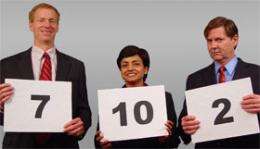
Duke business professors (L-R) John Graham, Manju Puri and Campbell Harvey submit themselves for judgment. Who looks more friendly, or more competent? | Duke University's Fuqua School of Business

(PhysOrg.com) -- There were no evening gowns, swimsuits, or artistic talents on display, but a corporate beauty contest staged by Duke University researchers nevertheless revealed strong ties between appearance and success in the business world.

By pairing photos of the chief executive officers of large and small companies with photos of non-executives with similar , hairstyles and clothing, finance professors John Graham, Campbell Harvey and Manju Puri of Duke's Fuqua School of Business found that CEOs are more likely than non-CEOs to be rated as competent looking, but less likely to be classified as likeable.

The trio found that CEOs who appear competent earn more money than less competent-looking CEOs, even though appearance is not associated with measurable differences in company profitability.

"Other researchers have found links between beauty and workers' pay, and demonstrated that politicians benefit from good looks at election time," Graham said. "We wanted to see whether appearance also plays a role at the corporate executive level."

The researchers staged a variety of online experiments to ask nearly 2,000 participants to assess photos of more than 100 CEOs and non-executives.

In one experiment, 765 participants were asked to rank the people in each pair of photos according to their attractiveness, competence, and likeability. The actual CEOs were rated as more competent-looking and more attractive. However, CEOs were more frequently rated as less trustworthy and less likable than the non-CEOs with whom their photos were paired.

Similar results were found when 762 participants were asked to rate CEOs of large firms against CEOs of small firms. Large-firm CEOs were rated as more competent 55 percent of the time, while their small-firm counterparts were judged as looking more trustworthy, likeable and .

For the purposes of the experiments, only photos of white male CEOs were used. "It would be fascinating to study the role appearance may play in the careers of women and minorities," said Puri. "However, because there are fewer female and minority CEOs, including them in our set of photos would have increased the odds of participants recognizing a CEO, which could have inadvertently influenced their rating of the person's characteristics."

The team found that CEOs rated competent just by their appearance tended to have higher income. CEOs who were rated four or above on a five-point scale for competence had an average total compensation 7.5 percent higher than CEOs who scored three out of five on competence.

Despite the relationship between appearance and salary, the researchers found no evidence that a CEO's appearance is related to company profitability.

"I thought the appearance thing was possible for politicians winning elections -- but for CEOs, no way," said Harvey. "We are told that CEOs are very carefully vetted by boards of directors and professional consultants - as they should be for their multi-million dollar jobs. The fact that our research shows that appearance is unquestionably significant turns my stomach."

"Given there is no relation between appearance and company performance, I hope our research changes the way we select our corporate leaders: 'looks' should not be a factor!"

More information: "A Corporate Beauty Contest," is National Bureau of Economic Research working paper number 15906, and is available for download at: http://ssrn.com/ab … ract=1571469

Provided by Duke University (news : web)

Filter


Move the slider to adjust rank threshold, so that you can hide some of the comments.


Display comments: newest first

pauljpease
Apr 26, 2010

Rank: not rated yet
Why is this surprising? Everyone knows, or should know, that looks affect many aspects of a person's life. How someone looks affects how other people treat them, thus it affects their relationships. And relationships have much to do with career success.
Rank 5 /5 (2 votes)
Relevant PhysicsForums posts
  • Can I forget a language?
    created18 hours ago
  • The Biggest Lie Ever
    createdFeb 09, 2012
  • What are the limits of learning?
    createdFeb 06, 2012
  • Isn't that grammatically wrong?
    createdFeb 06, 2012
  • What does it mean when traders are indifferent?
    createdFeb 04, 2012
  • Peak of Our Civilization
    createdFeb 04, 2012
  • More from Physics Forums - Social Sciences

More news stories

A frank discussion of the power law and linking correlation to causation

(PhysOrg.com) -- Michael Stumpf a mathematics professor at Imperial College in London, and Mason Porter a lecturer at Oxford have teamed together to write and publish a perspective piece in Science regarding the in ...

Other Sciences / Mathematics

created 21 hours ago | popularity 5 / 5 (3) | comments 8 | with audio podcast report

Employers feel no love for unscrupulous practice of 'service sweethearting'

A new study led by two Florida State University marketing professors finds that some frontline service employees who are rewarded for hikes in customer loyalty and satisfaction also may engage in "service ...

Other Sciences / Economics & Business

created 15 hours ago | popularity 4 / 5 (1) | comments 7

The question of life in the ancient world

There’s a general feeling that we don’t get the Greeks – ancient or modern. Many, including heads of state like Angela Merkel, visibly shake their head in exasperation, rightly or wrongly, at ...

Other Sciences / Archaeology & Fossils

created 20 hours ago | popularity 1.3 / 5 (3) | comments 4

Sonic Cradle lands spot in TED exhibition

A Simon Fraser University graduate student project that melds music, meditation and modern technology has landed a rare spot as an exhibit at TEDActive 2012 in Palm Springs, California this month.

Other Sciences / Other

created 17 hours ago | popularity not rated yet | comments 0

Do we no longer care about the collective good?

The Transformation of Solidarity, a book co-edited by University of Queensland sociologist Dr Mara Yerkes, tackles the subject of globalisation of national economies and societies where we put a high value ...

Other Sciences / Social Sciences

created Feb 06, 2012 | popularity 3.9 / 5 (8) | comments 39


Anonymous knocks CIA website offline (Update)

The website of the Central Intelligence Agency was inaccessible on Friday after the hacker group Anonymous claimed to have knocked it offline.

New error-correcting codes guarantee the fastest possible rate of data transmission

Error-correcting codes are one of the triumphs of the digital age. They’re a way of encoding information so that it can be transmitted across a communication channel — such as an optical fiber o ...

Humans may have helped the decline of African rainforests 3000 years ago

(PhysOrg.com) -- Large areas of rainforests in Central Africa mysteriously disappeared over three thousand years ago, to be replaced by savannas. The prevailing theory has been that the cause was a change ...

Small modular reactor design could be a 'SUPERSTAR'

(PhysOrg.com) -- Though most of today's nuclear reactors are cooled by water, we've long known that there are alternatives; in fact, the world's first nuclear-powered electricity in 1951 came from a reactor ...

New power source discovered

(PhysOrg.com) -- Researchers at the Massachusetts Institute of Technology (MIT) and RMIT University have made a breakthrough in energy storage and power generation.

The power of estrogen -- male snakes attract other males

A new study has shown that boosting the estrogen levels of male garter snakes causes them to secrete the same pheromones that females use to attract suitors, and turned the males into just about the sexiest ...