To have or not to have ribs (a vertebrate story)
April 27, 2010
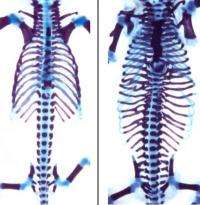
Mice have a ribcage with 12 pairs of ribs (image on the left). When the gene Hox6 is activated in ribless regions of the embryo, extra ribs are formed, extending from the ribcage to the tail (image on the right). Credit: Image provided by Moises Mallo.
Like all vertebrates, snakes, mice and humans have in common a skeleton made of segments, the vertebrae. But a snake has between 200-400 ribs extending from all vertebrae, from the neck to the tail-end, whereas mice have only 13 pairs of ribs, and humans have 12 pairs, in both cases making up the ribcage. In the latest issue of Developmental Cell, researchers from the Instituto Gulbenkian de Ciencia, in Portugal, reveal that, contrary to what was thought, making ribs is not the default state for vertebrates, but is actually an active process of balancing the activities of a remarkable class of genes - the Hox genes.
It was thought that the rib less region of the mouse embryo was the result of a rib-inhibiting programme, driven by Hox10 genes. Indeed, previous studies, in which Hox10 genes were inactivated in the embryo, generated mice with extra ribs. However, by forcing another class of Hox genes (Hox6) to be activated in future rib-less regions of the mouse embryo, Moises Mallo and his team bred mice that also have extra ribs, both in the neck area, and from just after the rib cage, all the way down to the tail, resembling a snake-like skeleton.
'It was an extraordinary, and clear-cut result', says Mallo, 'suggesting that these two groups of Hox genes balance each other out: one actively promotes rib formation to produce the thoracic region, while the other blocks this activity in the lumbar region. Our results have unveiled this balance.'
The researchers went on to unpick the genes involved in this process, and came up with yet another surprising finding: that the whole process relies on first hitting so-called muscle genes in the embryo, which then provide signals to switch on the 'rib' genes to make both ribs and muscle, in a coordinated process.
According to Mallo, 'Our findings reveal a more complicated process than we would have imagined, but one that makes perfect sense, from a functional and evolutionary point of view: it is no good to make ribs without muscle, so, in the embryo, the production of both ribs and their associated muscles is under the control of a single and coordinated mechanism.
-
The skeleton: Size matters
Oct 27, 2009 |
not rated yet |
0
-
How cobras form hood flares
Apr 20, 2010 |
not rated yet |
0
-
Study shows modified technique further reduces lung surgery pain
Jun 06, 2008 |
not rated yet |
0
-
Stem cell surprise for tissue regeneration (w/ Podcast)
Jun 25, 2009 |
not rated yet |
0
-
Scientists identify gene linked to deadly disorder in newborns
Apr 01, 2009 |
not rated yet |
0
-
Engineers build first sub-10-nm carbon nanotube transistor
Feb 01, 2012 |
4.9 / 5 (31) |
30
-
Something old, something new: Evolution and the structural divergence of duplicate genes
Jan 31, 2012 |
4.6 / 5 (7) |
1
-
The hidden nanoworld of ice crystals: Revealing the dynamic behavior of quasi-liquid layers
Jan 30, 2012 |
5 / 5 (3) |
1
-
Stock market network reveals investor clustering
Jan 27, 2012 |
3.9 / 5 (23) |
8
-
Of microchemistry and molecules: Electronic microfluidic device synthesizes biocompatible probes
Jan 26, 2012 |
5 / 5 (1) |
0
-
Is Everyday Technology Killing Us?
Feb 08, 2012
-
Exercise and weight loss
Feb 08, 2012
-
Why do we have head aches? Our brains can't feel anything.
Feb 07, 2012
-
"The end of diseases" by David Agus, interview from Daily Show with Jon Stewart
Feb 04, 2012
-
Oncolytic adenovirus
Feb 04, 2012
-
Nutrition label stuffs and diets
Feb 02, 2012
- More from Physics Forums - Medical Sciences
More news stories
Complex wiring of the nervous system may rely on a just a handful of genes and proteins
Researchers at the Salk Institute have discovered a startling feature of early brain development that helps to explain how complex neuron wiring patterns are programmed using just a handful of critical genes. ...
4 hours ago |
5 / 5 (7) |
0
|
Both maternal and paternal age linked to autism
Older maternal and paternal age are jointly associated with having a child with autism, according to a recently published study led by researchers at The University of Texas Health Science Center at Houston (UTHealth).
Medicine & Health / Psychology & Psychiatry
9 hours ago |
5 / 5 (1) |
0
|
New understanding of DNA repair could eventually lead to cancer therapy
A research group in the Faculty of Medicine & Dentistry at the University of Alberta is hoping its latest discovery could one day be used to develop new therapies that target certain types of cancers.
8 hours ago |
4.8 / 5 (4) |
0
|
Curry spice component may help slow prostate tumor growth
Curcumin, an active component of the Indian curry spice turmeric, may help slow down tumor growth in castration-resistant prostate cancer patients on androgen deprivation therapy (ADT), a study from researchers ...
10 hours ago |
4.5 / 5 (6) |
0
|
Human cognitive performance suffers following natural disasters, researchers find
Not surprisingly, victims of a natural disaster can experience stress and anxiety, but a new study indicates that it might also cause them to make more errors - some serious - in their daily lives. In their upcoming Human Fa ...
Medicine & Health / Psychology & Psychiatry
6 hours ago |
4 / 5 (1) |
0
Google users warned of threat to smartphone wallets
Users of Google smartphone wallets were being warned on Friday that there is a way to crack pass codes intended to thwart thieves from going on illicit shopping sprees.
Anonymous knocks CIA website offline (Update)
The website of the Central Intelligence Agency was inaccessible on Friday after the hacker group Anonymous claimed to have knocked it offline.
New error-correcting codes guarantee the fastest possible rate of data transmission
Error-correcting codes are one of the triumphs of the digital age. Theyre a way of encoding information so that it can be transmitted across a communication channel such as an optical fiber o ...
Putting the squeeze on planets outside our solar system
(PhysOrg.com) -- Using high-powered lasers, scientists at Lawrence Livermore National Laboratory and collaborators discovered that molten magnesium silicate undergoes a phase change in the liquid state, abruptly ...
The power of estrogen -- male snakes attract other males
A new study has shown that boosting the estrogen levels of male garter snakes causes them to secrete the same pheromones that females use to attract suitors, and turned the males into just about the sexiest ...
NASA sees wide-eyed cyclone Jasmine
Cyclone Jasmine's eye has opened wider on NASA satellite imagery, as it moves through the Southern Pacific Ocean.