Melting sea ice major cause of warming in Arctic, new study reveals
April 28, 2010
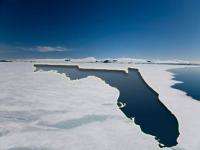
Melting sea ice has been shown to be a major cause of warming in the Arctic according to a University of Melbourne, Australia study.
Findings published in Nature today reveal the rapid melting of sea ice has dramatically increased the levels of warming in the region in the last two decades.
Lead author Dr James Screen of the School of Earth Sciences at the University of Melbourne says the increased Arctic warming was due to a positive feedback between sea ice melting and atmospheric warming.
"The sea ice acts like a shiny lid on the Arctic Ocean. When it is heated, it reflects most of the incoming sunlight back into space. When the sea ice melts, more heat is absorbed by the water. The warmer water then heats the atmosphere above it. "
"What we found is this feedback system has warmed the atmosphere at a faster rate than it would otherwise," he says.
Using the latest observational data from the European Centre for Medium-Range Weather Forecasting, Dr Screen was able to uncover a distinctive pattern of warming, highly consistent with the loss of sea ice.
"In the study, we investigated at what level in the atmosphere the warming was occurring. What stood out was how highly concentrated the warming was in the lower atmosphere than anywhere else. I was then able to make the link between the warming pattern and the melting of the sea ice."
The findings question previous thought that warmer air transported from lower latitudes toward the pole, or changes in cloud cover, are the primary causes of enhanced Arctic warming.
Dr Screen says prior to this latest data set being available there was a lot of contrasting information and inconclusive data.
"This current data has provided a fuller picture of what is happening in the region," he says.
Over the past 20 years the Arctic has experienced the fastest warming of any region on the planet. Researchers around the globe have been trying to find out why.
Researchers say warming has been partly caused by increasing human greenhouse gas emissions. At the same time, the Arctic sea ice has been declining dramatically. In summer 2007 the Arctic had the lowest sea ice cover on record. Since then levels have recovered a little but the long-term trend is still one of decreasing ice.
Professor Ian Simmonds, of the University's School of Earth Sciences and coauthor on the paper says the findings are significant.
"It was previously thought that loss of sea ice could cause further warming. Now we have confirmation this is already happening."
-
Arctic sea ice may be at 'tipping point'
Sep 16, 2005 |
not rated yet |
0
-
Scientists want polar bear protection
Jun 20, 2006 |
not rated yet |
0
-
Melting Arctic ice affecting walrus calves
Apr 13, 2006 |
not rated yet |
0
-
Without its insulating ice cap, Arctic surface waters warm to as much as 5 C above average
Dec 12, 2007 |
not rated yet |
0
-
NASA data show Arctic saw fastest August sea ice retreat on record
Sep 28, 2008 |
not rated yet |
0
-
Engineers build first sub-10-nm carbon nanotube transistor
Feb 01, 2012 |
4.9 / 5 (31) |
30
-
Something old, something new: Evolution and the structural divergence of duplicate genes
Jan 31, 2012 |
4.6 / 5 (7) |
1
-
The hidden nanoworld of ice crystals: Revealing the dynamic behavior of quasi-liquid layers
Jan 30, 2012 |
5 / 5 (3) |
1
-
Stock market network reveals investor clustering
Jan 27, 2012 |
3.9 / 5 (23) |
8
-
Of microchemistry and molecules: Electronic microfluidic device synthesizes biocompatible probes
Jan 26, 2012 |
5 / 5 (1) |
0
-
Discrepancy between oxygen and carbon-dioxide levels
18 hours ago
-
where gems are found in the world
21 hours ago
-
Wind Waves in Reservoir ~ Wind run-up and Wind set-up
Feb 08, 2012
-
Balance of oxygen in the atmosphere
Feb 01, 2012
-
The case for a methanol-based economy
Jan 30, 2012
-
Weather in a rotating cylinder
Jan 25, 2012
- More from Physics Forums - Earth
More news stories
Humans may have helped the decline of African rainforests 3000 years ago
(PhysOrg.com) -- Large areas of rainforests in Central Africa mysteriously disappeared over three thousand years ago, to be replaced by savannas. The prevailing theory has been that the cause was a change ...
Could Venus be shifting gear?
(PhysOrg.com) -- ESAs Venus Express spacecraft has discovered that our cloud-covered neighbour spins a little slower than previously measured. Peering through the dense atmosphere in the infrared, the ...
Space & Earth / Space Exploration
6 hours ago |
5 / 5 (5) |
7
|
Mars Science Laboratory computer issue resolved
(PhysOrg.com) -- Engineers have found the root cause of a computer reset that occurred two months ago on NASA's Mars Science Laboratory and have determined how to correct it.
Space & Earth / Space Exploration
7 hours ago |
5 / 5 (5) |
3
|
Clam fields found at deep, low-temperature Mariana vents
(PhysOrg.com) -- Scientists have marveled at the unusual life forms thriving at high temperature hydrothermal vents of the deep ocean.
Space & Earth / Earth Sciences
7 hours ago |
not rated yet |
0
|
Two new moons for Jupiter
Advances in technology have lead to the discovery of new planets outside of our Solar System, and now even new moons in our own backyard.
Space & Earth / Space Exploration
6 hours ago |
not rated yet |
4
Complex wiring of the nervous system may rely on a just a handful of genes and proteins
Researchers at the Salk Institute have discovered a startling feature of early brain development that helps to explain how complex neuron wiring patterns are programmed using just a handful of critical genes. ...
The power of estrogen -- male snakes attract other males
A new study has shown that boosting the estrogen levels of male garter snakes causes them to secrete the same pheromones that females use to attract suitors, and turned the males into just about the sexiest ...
Human cognitive performance suffers following natural disasters, researchers find
Not surprisingly, victims of a natural disaster can experience stress and anxiety, but a new study indicates that it might also cause them to make more errors - some serious - in their daily lives. In their upcoming Human Fa ...
New error-correcting codes guarantee the fastest possible rate of data transmission
Error-correcting codes are one of the triumphs of the digital age. Theyre a way of encoding information so that it can be transmitted across a communication channel such as an optical fiber o ...
Both maternal and paternal age linked to autism
Older maternal and paternal age are jointly associated with having a child with autism, according to a recently published study led by researchers at The University of Texas Health Science Center at Houston (UTHealth).
Curry spice component may help slow prostate tumor growth
Curcumin, an active component of the Indian curry spice turmeric, may help slow down tumor growth in castration-resistant prostate cancer patients on androgen deprivation therapy (ADT), a study from researchers ...
Apr 28, 2010
Rank: 2.3 / 5 (13)
Apr 28, 2010
Rank: 2.9 / 5 (13)
Old ice vs. new ice is one way to look at it.
Volume is another.
Ice albedo is just one more way.
And you went for the simplistic 2D view. What does that say about your capabilities?
Apr 28, 2010
Rank: 2.9 / 5 (7)
Kidding of course, but I really am curious about the concentration of warming near the surface. What does that mean in regard to temperatures at other elevations? I seem to remember reading that it's difficult to get accurate temperature data anywhere but here at the surface. I don't think satelites can do it if I remember correctly. Balloons and aircraft are poor because of the limited sample rates possible, and rapid variation in speed and direction are another problem. I understand that they do the best they can with ground based observations because that's all they have, but they are only looking at a paper-thin slice of the total atmosphere. They seem to be making a lot of conclusions from very limited data. It's rare in science for serious researchers to make public conclusions without first gathering substantive data.
Apr 28, 2010
Rank: 3.4 / 5 (10)
http://data.giss....gistemp/
I'm going to be nice and just point out that you're wrong about a lot of the science, and leave it at that.
Apr 28, 2010
Rank: 2.3 / 5 (12)
One thousand years ago there were dairy farms in Greenland and Vineyards in Scotland. Today it is too cold.
Christmas 1776 it was cold enough at Haarlem Heights New York that Washington ordered cannon dragged across. Today it is too warm.
Apr 28, 2010
Rank: 4.3 / 5 (11)
Apr 28, 2010
Rank: 4.2 / 5 (5)
I'm merely saying that there are likely to be factors at play in the atmosphere that they realy haven't studied or perhaps even discovered yet. We didn't know about el-nino until recently and they just discovered a new major ocean current system in arctic waters even more recently. I know for sure that they are trying to get a better understanding of aerosols for one thing. Another HUGE puzzle remaining is how water vapor will react to or influence climate change, as mentioned here: http://www.ncdc.n...ses.html
I'm just wondering how accurate the models are. It could be even worse than they think, but I really don't think they know.
Apr 28, 2010
Rank: 3 / 5 (6)
http://www.remss....ion.html
Temperature gathering via satellite has been done since the 70's. New satellites are going up at incredible rates to watch weather patterns.
Apr 28, 2010
Rank: 2.3 / 5 (7)
Apr 28, 2010
Rank: 2.2 / 5 (10)
Apr 28, 2010
Rank: 2.1 / 5 (9)
I have no doubt global warming is real, but I also have no doubt that we have very little impact on it...the earth's gonna do what the earth's gonna do...but I do agree with you that our little bit does slightly contribute, but I would argue hard that we are not the cause, and never have been.
There is a difference between the planet and the species that live on it...sure, we can fish out the world, by fishing faster than their reproductive cycle can reproduce...but, with the earth pumping out tons more greenhouse gases than we do annually, and we know this has occurred since long before humans walked the earth, its better to me to think of it as the earth going through its normal cycles of hot and cold...we're still coming out of a cold cycle (the last ice age), so to me, this isnt surprising at all.
Apr 28, 2010
Rank: 2.4 / 5 (9)
I also have evidence of Viking settlers growing sugar cane and Limes in Greenland and the Irish grew cocoa and coffee in the MWP, I haven't the evidence to hand as yet but it is coming soon :)
Apr 28, 2010
Rank: 3.8 / 5 (5)
Apr 28, 2010
Rank: 4.9 / 5 (8)
Here's a link to a picture of the florida coastline. Draw your own conclusions.
http://www.lager2...ida1.jpg
Apr 28, 2010
Rank: 4.3 / 5 (6)
Apr 28, 2010
Rank: 3 / 5 (1)
Apr 28, 2010
Rank: 4.1 / 5 (9)
There are dairy farms today in iceland. Does that means that temps are warmer today than 1000 years ago? Of course not. Last winter had some of the coldest days in decades. So what? Single data points do not a trend make.
Apr 28, 2010
Rank: 4.2 / 5 (9)
Apr 29, 2010
Rank: 2.1 / 5 (7)
I wonder if they noticed if this happens at night?
Next they will prove that roosters make the planet rotate and it will be worse than we thought...
Apr 29, 2010
Rank: 1 / 5 (5)
Apr 29, 2010
Rank: 1.9 / 5 (7)
Wow- it only takes one of those to raise the average of the whole month half a degree.
At least the meteorologist at Eureka, Alaska is going to 'make an effort' to have his particular archives corrected.
Who's going to look after the others?
Apr 29, 2010
Rank: 2.7 / 5 (6)
They left when it iced up a few hundred years ago. They like it warm.
May 03, 2010
Rank: 1 / 5 (1)
1. This is simply a hoax picture to see who could be taken in, or
2. They put Florida there to show the size - unfortunately, if the size were that large, you would see more curvature on the horizon.