Cheap hydrogen fuel from seawater may be a step closer
April 29, 2010 by Lin Edwards
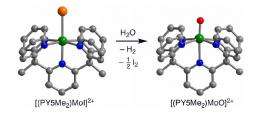
Reaction of [(PY5Me2)MoI]2+ with water to form [(PY5Me2)MoO]2+ and release H2 and half an equivalent of I2. The release of hydrogen was confirmed by mass spectrometry. Image credit: Nature, doi:10.1038/nature08969.
(PhysOrg.com) -- A new catalyst has been developed to generate hydrogen from water cheaply, but the research was originally intended to make molecules that behaved like magnets. Hydrogen is a clean power source currently produced from natural gas, with carbon dioxide as a by-product. Producing hydrogen from water produces oxygen as a by-product instead.
Conventional catalysts capable of splitting water into hydrogen and oxygen are generally too expensive or too weak to work on water effectively enough to produce hydrogen for an inexpensive fuel, but new research has developed a molybdenum catalyst that is robust and cheap enough to do the job, but still requires too much energy to be immediately useful. It does open up new possibilities for scientists to follow in the search for the perfect water-splitting catalyst.
One conventional means of splitting water into H2 and O2 is to use a platinum catalyst but the metal is far too expensive for the process to be commercially viable. Other methods use microbial enzymes called hydrogenases containing proteins using nickel and iron, but these methods are either too bulky, slow, or too inefficient to be successful on a commercial basis.
The new study by scientists at the University of California, Berkeley, aimed at combining metal atoms with organic molecular groups (called PY5) to produce molecules with the properties of bulk magnets. The researchers, led by Jeffrey Long, found that one of their molecules, a molybdenum-oxo complex, was capable of transferring electrons. This is a major requirement of water-splitting systems, so they tested its ability to split water to generate hydrogen gas and found it was highly successful.
The molybdenum compound was so successful it could work on seawater or pure water without additives. The compound is stable due to five bonds holding the molybdenum in place. Long said the molecule is stable for long periods in aqueous solutions, and they saw no degradation in catalytic activity over their three-day experiment. The molecule remains stable even when impurities, such as those found in seawater, are present. This would further reduce the cost since no organic acids or solvents are needed.
The compound’s stability makes it more durable than the nickel and iron compounds used previously, but it is slower than the natural hydrogenases and needs a higher electric voltage to operate. The group is now experimenting with different metals and "tweaking" the PY5 groups to see if they can improve the speed and efficiency and reduce the energy requirements. They are also looking at the possibility of coupling the system to solar-generated electricity to make it even more viable.
More information: A molecular molybdenum-oxo catalyst for generating hydrogen from water, Nature 464, 1329-1333 (29 April 2010), doi:10.1038/nature08969
© 2010 PhysOrg.com
-
Efficient Catalysts for Making Oxygen for 'Artificial Photosynthesis'
Mar 10, 2008 |
not rated yet |
0
-
Water oxidation advance boosts potential for solar fuel
Mar 11, 2010 |
not rated yet |
0
-
Scientists develop a unique approach for splitting water into hydrogen and oxygen
Apr 06, 2009 |
not rated yet |
0
-
A water splitter with a double role
Mar 09, 2009 |
not rated yet |
0
-
Unprecedented efficiency in producing hydrogen from water
Dec 04, 2006 |
not rated yet |
0
-
Engineers build first sub-10-nm carbon nanotube transistor
Feb 01, 2012 |
4.9 / 5 (31) |
30
-
Something old, something new: Evolution and the structural divergence of duplicate genes
Jan 31, 2012 |
4.6 / 5 (7) |
1
-
The hidden nanoworld of ice crystals: Revealing the dynamic behavior of quasi-liquid layers
Jan 30, 2012 |
5 / 5 (3) |
1
-
Stock market network reveals investor clustering
Jan 27, 2012 |
3.9 / 5 (23) |
8
-
Of microchemistry and molecules: Electronic microfluidic device synthesizes biocompatible probes
Jan 26, 2012 |
5 / 5 (1) |
0
-
Stoichiometry
19 hours ago
-
Boiling and melting point of impure substances
20 hours ago
-
Safe nitrogen compound to decompose a 500 deg C in a furnace?
Feb 09, 2012
-
[ask]electron inside drinking water
Feb 08, 2012
-
How to avoid formation of Lithium Chromate ???
Feb 08, 2012
-
how to choose a reduced or oxidated form in a redox
Feb 08, 2012
- More from Physics Forums - Chemistry
More news stories
Fool's gold may prove an unlikely alternative to overexploited catalytic materials
Catalytic materials, which lower the energy barriers for chemical reactions, are used in everything from the commercial production of chemicals to catalytic converters in car engines. However, with current catalytic materials ...
11 hours ago |
4.3 / 5 (6) |
3
|
Unpicking HIV’s invisibility cloak
Drug researchers hunting for alternative ways to treat human immunodeficiency virus (HIV) infections may soon have a novel targetits camouflage coat. HIV hides inside a cloak unusually rich in a sugar ...
11 hours ago |
5 / 5 (4) |
0
No entry without protein recycling: Researchers discover new coherence in enzyme transport
The group of Prof. Dr. Ralf Erdmann at the Ruhr-Universität Bochum, Germany, discovered a connection of peroxisomal protein import and receptor export. In the Journal of Biological Chemistry, they disclo ...
11 hours ago |
not rated yet |
0
Under the microscope #7
In this video Dr Ingrid Graz shows us a thin layer of gold on top of rubber. Cracks in the gold allow it to stretch and we can use this for stretchable electronics.
13 hours ago |
not rated yet |
0
Hydrogen from acidic water: Researchers develop potential low cost alternative to platinum for splitting water
A technique for creating a new molecule that structurally and chemically replicates the active part of the widely used industrial catalyst molybdenite has been developed by researchers with the Lawrence Berkeley ...
Feb 09, 2012 |
5 / 5 (12) |
13
|
Google users warned of threat to smartphone wallets
Users of Google smartphone wallets were being warned on Friday that there is a way to crack pass codes intended to thwart thieves from going on illicit shopping sprees.
Anonymous knocks CIA website offline (Update)
The website of the Central Intelligence Agency was inaccessible on Friday after the hacker group Anonymous claimed to have knocked it offline.
Complex wiring of the nervous system may rely on a just a handful of genes and proteins
Researchers at the Salk Institute have discovered a startling feature of early brain development that helps to explain how complex neuron wiring patterns are programmed using just a handful of critical genes. ...
New error-correcting codes guarantee the fastest possible rate of data transmission
Error-correcting codes are one of the triumphs of the digital age. Theyre a way of encoding information so that it can be transmitted across a communication channel such as an optical fiber o ...
The power of estrogen -- male snakes attract other males
A new study has shown that boosting the estrogen levels of male garter snakes causes them to secrete the same pheromones that females use to attract suitors, and turned the males into just about the sexiest ...
Putting the squeeze on planets outside our solar system
(PhysOrg.com) -- Using high-powered lasers, scientists at Lawrence Livermore National Laboratory and collaborators discovered that molten magnesium silicate undergoes a phase change in the liquid state, abruptly ...
Apr 29, 2010
Rank: 2 / 5 (4)
Build 100 1GW Fission plants and use either electrolysis or steam flashing to produce your "cheap" hydrogen. This route also allows you to recharge those battery powered cars and desalinate seawater for those idiots in Los Angeles.
Apr 29, 2010
Rank: 2 / 5 (2)
Either desalination method still dumps concentraded salt water back into the ocean in a localized area. which may potentially be harmful.
No, this article is talking about stripping the H2 from the H2O which produces more O2 , O3 as a byproduct. O3 is harder to produce as it normally need electricity to excite the eletrons to produce the triple bond. but O2 is normal oxygen.
Apr 29, 2010
Rank: 1 / 5 (1)
Shootist: what about mining "nasty dirty" uranium? or manufacturing plutonium? or storing the waste from 100 nuclear power plants. I support nuclear power, but don't pretend it isn't without it's cons as well.
Apr 29, 2010
Rank: 2 / 5 (1)
I only know it's used in a lot of steel alloys and as a transportable parent isotope for a medical radio isotope (technetium-99)
But then again, I'm by no means an engineer.
Apr 29, 2010
Rank: 1 / 5 (1)
Without having to mine nasty dirty uranium?
Your 'route' is also retarded.
Apr 30, 2010
Rank: not rated yet
Apr 30, 2010
Rank: not rated yet
It is expensive relative to other energy resources and as it is not available all of the time to make use of the hydrogen producing equipment economically you would have to add expensive storage.
Throwing in solar is just a way of getting more funds by pressing the 'right' buttons.
Apr 30, 2010
Rank: 3 / 5 (2)
Apr 30, 2010
Rank: not rated yet
Ignore my previous comment please.
May 01, 2010
Rank: not rated yet
You can't have a catalyst for an oxidation or reduction reaction without having another catalyst or a sacrifical species for the corresponding reduction or oxidation reaction, respectively.
The iodine complex is the one they made, and adding water creates the Mo-O species and H2. Giving this species a reductant turns the "O" in the species on the right into water, and regenerates the active Mo-H2O complex that can produce hydrogen.
Also, the whole "solar" thing is about an easy way to regenerate the catalyst, by making molecular photodiodes or using solar to run the reaction. Otherwise, all these "H2" production catalysts are stupid.
Protip: if you don't understand something, ask a question instead of insulting others and showing everyone how much an idiot you are.
May 01, 2010
Rank: not rated yet