MEMS device generates power from body heat
April 29, 2010 By Lisa Zyga feature
MEMS device generates power from body heat

Enlarge

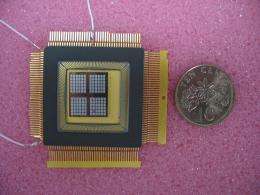
A prototype of the thermoelectric power generator assembled in a ceramic package and placed next to a Singapore ten-cent coin. Image credit: Jin Xie, et al.

(PhysOrg.com) -- In an attempt to develop a power source that is compact, environmentally friendly, and has an unlimited lifetime, a team of researchers from Singapore has fabricated an energy harvesting device that generates electricity from body heat or any environment where there is a temperature gradient. Their device, called a thermoelectric power generator, attaches to the body and generates a power output of a few microwatts, which could be useful for powering implanted medical devices and wireless sensors.

The researchers, Jin Xie and Hanhua Feng from Institute of Microelectronics, A*STAR, Singapore’s government Agency for Science, Technology and Research, along with Chengkuo Lee from the National University of Singapore, have published their study in a recent issue of the Journal of Microelectromechanical Systems.

The entire generator consists of a chip with a size of 1 x 1 cm2, which holds more than 30,000 thermocouples. The thermocouples, when arranged in groups called thermopiles, detect a temperature difference between the hot and cold junctions and produce a voltage. With a temperature difference of 5K, the device can generate a voltage of 16.7 volts and a of 1.3 microwatts. The researchers hope that future improvements to the device could increase the power output to several microwatts. By accumulating this energy over time, it could be used to prolong the battery life of such as pressure sensors, and also recycle heat generated from the devices during operation. By powering the wearer’s medical implants, this technology could enable patients to avoid difficult, high-cost battery replacement methods.

Although similar devices have previously been developed that generate electricity from , the new makes several improvements that increase its overall energy efficiency. For example, the researchers incorporated vacuum cavities, a heat-sink layer, and a peripheral cavity, which are aimed at increasing the temperature difference between the side of the generator touching the body and the side exposed to ambient (cooler) air. The greater the temperature difference between the two sides of the generator, the greater the output voltage.

“The advantages include (1) top and bottom vacuum cavities are created to maximize the between the two junctions of the thermocouples; (2) a heat sink layer is on the cold side of the device to effectively disperse heat from the cold side of the device to ambient air; and (3) a peripheral cavity is designed to cut off heat from the surrounding silicon substrate, so that cold junctions of thermocouples at the rim edge of the device area are not affected by the heat coming from the surrounding silicon,” Xie explained to PhysOrg.com.

As Xie added, another advantage of the new thermoelectric power generator is that it is CMOS-compatible, meaning it can be fabricated in normal CMOS manufacturing lines. This feature allows the generator to serve as a novel on-chip power source for self-powered CMOS and MEMS devices that have low power consumption requirements.

More information: Jin Xie, Chengkuo, and Hanhua Feng. “Design, Fabrication, and Characterization of CMOS MEMS-Based Thermoelectric Power Generators.” Journal of Microelectromechanical Systems, Vol. 19, No. 2, April 2010.

Copyright 2010 PhysOrg.com.
All rights reserved. This material may not be published, broadcast, rewritten or redistributed in whole or part without the express written permission of PhysOrg.com.

4.3 /5 (16 votes)  

Filter


Move the slider to adjust rank threshold, so that you can hide some of the comments.


Display comments: newest first

mysticfree
Apr 29, 2010

Rank: 3.2 / 5 (5)
Given the aging population, we could put these on all the menopausal women and power the planet with hot flashes!
Birthmark
Apr 29, 2010

Rank: not rated yet
haha!! That was good! ^^

This is a cool article, hopefully the device will advance so it could charge phones and other devices quickly.
SincerelyTwo
Apr 29, 2010

Rank: 1 / 5 (3)
They should attach these to chickens in slaughter houses as they grow up or what ever, ... on people in jails, i guess just take advantage of all weak life forms with these.
HealingMindN
Apr 29, 2010

Rank: 5 / 5 (3)
They should attach these to chickens in slaughter houses as they grow up or what ever, ... on people in jails, i guess just take advantage of all weak life forms with these.


Is this how the machines did it in The Matrix?
random
Apr 30, 2010

Rank: not rated yet
They should attach these to chickens in slaughter houses as they grow up or what ever, ... on people in jails, i guess just take advantage of all weak life forms with these.


Is this how the machines did it in The Matrix?


That is specifically, precisely, exactly what they did. Now all we need is an AI smart enough to put two and two together and we're set to go.
sender
Apr 30, 2010

Rank: not rated yet
If NASA applied this technology to plasma contactor probes on the Z1 segment of the ISS; a constant source of amplified electrical power could be utilized only limited by the surface area of the total panelling and outer hull.

As it stands the power is dissipated into a phantom loop which seems a little wasteful for what hazards space can hold.
Royale
Apr 30, 2010

Rank: not rated yet
My only concern is the "heat sink" they're talking about on the outside, allowing the heat to disperse in the ambient air. Wouldn't that make you feel cold? Who would wear a sweater that actually pulled away their body heat. Sure, maybe in Africa, but solar panels would work well there too. I'd be a little cautious of this one.
Eco_R1
May 02, 2010

Rank: not rated yet
slap a few of these puppies on a cpu and whola!!!
BrianH
May 03, 2010

Rank: not rated yet
What if the air's hotter than 37°C? Would it discharge or maybe generate extra heat next to the skin?
Rank 4.3 /5 (16 votes)
Related Stories
Relevant PhysicsForums posts
  • Calling function with no input argument
    created2 hours ago
  • Force free body diagram problem on gym equipment
    created3 hours ago
  • Empirical data regarding shower heads and water
    created11 hours ago
  • feed hold button on CNC lathe
    createdFeb 09, 2012
  • RFAC in Fortran
    createdFeb 09, 2012
  • dynamics 2/32
    createdFeb 08, 2012
  • More from Physics Forums - General Engineering

More news stories

Zuckerberg's focus drives Facebook's ascent

When Mark Zuckerberg showed up to rent Judy Fusco's Los Altos, Calif., house in the fall of 2004, soon after he'd arrived in Silicon Valley, the landlord was immediately struck by his confidence.

Technology / Internet

created 1 hour ago | popularity 1 / 5 (1) | comments 0

Review: Netflix and Hulu's new scripted originals

Within just over a week, Netflix and Hulu are both debuting their first stabs at original scripted programming.

Technology / Business

created 1 minute ago | popularity not rated yet | comments 0

Tailor-made search tools for the Web

For companies, customer feedback is a matter of strategic importance. Smart apps for the semantic analysis of user opinions from the Web help businesses keep an eye on feedback. Users benefit as well: with ...

Technology / Software

created 16 minutes ago | popularity not rated yet | comments 0

New error-correcting codes guarantee the fastest possible rate of data transmission

Error-correcting codes are one of the triumphs of the digital age. They’re a way of encoding information so that it can be transmitted across a communication channel — such as an optical fiber o ...

Technology / Computer Sciences

created 5 hours ago | popularity 5 / 5 (3) | comments 2 | with audio podcast

Netflix light on flicks as viewers soak up TV shows

Like most fresh faces that arrive in Hollywood, Netflix wanted to be a movie star. But now it's learning what many in Tinseltown have known for decades: Movies are sexy, but the real money is in television.

Technology / Business

created 2 hours ago | popularity not rated yet | comments 1


New understanding of DNA repair could eventually lead to cancer therapy

A research group in the Faculty of Medicine & Dentistry at the University of Alberta is hoping its latest discovery could one day be used to develop new therapies that target certain types of cancers.

Hovering not hard if you're top-heavy, researchers find

Top-heavy structures are more likely to maintain their balance while hovering in the air than are those that bear a lower center of gravity, researchers at New York University's Courant Institute of Mathematical Sciences ...

Grass to gas: Researchers' genome map speeds biofuel development

Researchers at the University of Georgia have taken a major step in the ongoing effort to find sources of cleaner, renewable energy by mapping the genomes of two originator cells of Miscanthus x giganteus, a large perenn ...

Both maternal and paternal age linked to autism

Older maternal and paternal age are jointly associated with having a child with autism, according to a recently published study led by researchers at The University of Texas Health Science Center at Houston (UTHealth).

Night, weekend delivery OK for babies with birth defects

Weekday delivery is no better than night or weekend delivery for infants with birth defects, according to a new study presented today at The Pregnancy Meeting, the Society for Maternal-Fetal Medicine's annual conference. ...

Sonic Cradle lands spot in TED exhibition

A Simon Fraser University graduate student project that melds music, meditation and modern technology has landed a rare spot as an exhibit at TEDActive 2012 in Palm Springs, California this month.