Cancer and diabetes: One discovery is affecting two areas of research
April 30, 2010
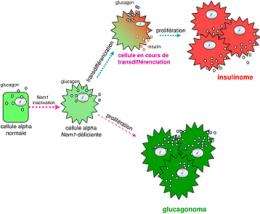
Summary of the observation of transdifferentiation of alpha cells in mutant mice. The data indicate that invalidation of the Nem 1 gene, specific to pancreatic alpha cells, leads first to an increased proliferation of these cells. Then, via as yet unknown mechanisms, these alpha cells transdifferentiate into insulin secreting cells, leading to the development of insulinomas. © Inserm/CX Zhang
Killing two birds with one stone. Sometimes, research results open up unexpected possibilities. This was what happened in the experiments of Chang Xian Zhang, a senior research scientist at Inserm, and his collaborators in the Laboratoire Géeetique Moleculaire, Signalisation et Cancer (CNRS, France). Their recent work on pancreatic endocrine tumours is also proving beneficial to research on the development of diabetes treatments. The results were published today in the May 2010 issue of the journal Gastroenterology.
While studying the origins of certain pancreatic endocrine tumours, the scientists have observed the phenomenon of transdifferentiation of pancreatic alpha cells into insulin secreting cells. As well as shedding light on the mystery of the formation of these tumours, the results provide very useful information for the development of treatments for diabetes. Type 1 diabetes is characterised by loss of beta cells which produce insulin. Finding a way to restore those cells and their function is one of the main objectives of research into that disease.
For over 10 years, Chang Xian Zhang and his collaborators have been one of the world's most active teams in the search to understand the functions of the Nem1 gene. Inactivation of this gene results in the appearance of several types of endocrine tumour (the syndrome is known as "Multiple Endocrine Neoplasia Type 1"), including pancreatic endocrine tumours. These are known for their complexity. A little less than one third of these tumours consist of cells which, unlike normal cells, secrete several hormones, giving rise to several hypotheses on their cellular origin. Uncovering the processes involved in the appearance and development of these tumours is therefore key to understanding them better, improving their diagnosis and refining their prognosis, as well as for monitoring or even treatment of pancreatic cancers.
How does inactivation of the Nem1 gene give rise to the birth of such tumours?
Using murine models, the team inactivated this gene in the pancreatic alpha cells which secrete glucagon. In a very surprising way, these mice develop not only alpha cell tumours but also insulin secreting beta cell tumours, as well as mixed tumours secreting both hormones. Using various analysis techniques, members of the team have been able to show, for the first time, that inactivation of the Nem1 gene leads, initially, to proliferation of alpha cells after which these cells become insulin secreting. This involves the phenomenon of transdifferentiation leading, in this case, to the development of both alpha cell and beta cell tumours, as well as mixed tumours. The Nem1 gene therefore plays an important role in controlling the plasticity of pancreatic alpha cells.
A discovery that has benefits for two diseases
Understanding the mechanisms of transdifferentiation of pancreatic alpha cells into insulin secreting cells may provide a better explanation for the cellular origin of observed pancreatic endocrine tumours. The objective was to refine the diagnosis and prognosis for these tumours and to identify possible suitable therapeutic targets.
"As well as new approaches to research against cancer, the investigation of mechanisms responsible for transdifferentiation revealed in this article, will allow a better understanding of the biology of pancreatic endocrine cells and the design of new strategies for regeneration of pancreatic beta cells, a major challenge in the treatment of diabetes" concludes Chang Xian Zhang.
More information: α-cell-specific Men1 ablation triggers the transdifferentiation of glucagon-expressing cells and insulinoma development, Gastroenterology, May 2010; 138:1954-1965
Provided by CNRS
-
Study pinpoints role of insulin on glucagon levels
Apr 07, 2009 |
not rated yet |
0
-
Discovery of new signal pathway important to diabetes research
Jun 04, 2008 |
not rated yet |
0
-
Blocking beta1-integrin to treat cancer
Jun 06, 2007 |
not rated yet |
0
-
Possible origins of pancreatic cancer revealed
Nov 02, 2009 |
not rated yet |
0
-
Fat cells send message that aids insulin secretion
Nov 06, 2007 |
not rated yet |
0
-
Engineers build first sub-10-nm carbon nanotube transistor
Feb 01, 2012 |
4.9 / 5 (31) |
30
-
Something old, something new: Evolution and the structural divergence of duplicate genes
Jan 31, 2012 |
4.6 / 5 (7) |
1
-
The hidden nanoworld of ice crystals: Revealing the dynamic behavior of quasi-liquid layers
Jan 30, 2012 |
5 / 5 (3) |
1
-
Stock market network reveals investor clustering
Jan 27, 2012 |
3.9 / 5 (23) |
8
-
Of microchemistry and molecules: Electronic microfluidic device synthesizes biocompatible probes
Jan 26, 2012 |
5 / 5 (1) |
0
-
Classical and Quantum Mechanics via Lie algebras
Apr 15, 2011
- More from Physics Forums - Independent Research
More news stories
Complex wiring of the nervous system may rely on a just a handful of genes and proteins
Researchers at the Salk Institute have discovered a startling feature of early brain development that helps to explain how complex neuron wiring patterns are programmed using just a handful of critical genes. ...
11 hours ago |
4.9 / 5 (9) |
1
|
Team isolates nerve cells involved in storing long term memory and gene proteins associated with them
(Medical Xpress) -- A research team in Taiwan has succeeded in isolating two nerve cells in fruit fly brains that are believed to be the major players in allowing for the formation of long term memories. Furthermore, ...
Seeing colors in music, tasting flavors in shapes may happen in life's early months
Famed violinist Itzhak Perlman sees a deep forest green whenever he plays a B-flat on his Stradivarius' G string. The A on the E string is red.
Medicine & Health / Psychology & Psychiatry
18 hours ago |
4.5 / 5 (2) |
2
|
Both maternal and paternal age linked to autism
Older maternal and paternal age are jointly associated with having a child with autism, according to a recently published study led by researchers at The University of Texas Health Science Center at Houston (UTHealth).
Medicine & Health / Psychology & Psychiatry
15 hours ago |
4.3 / 5 (3) |
0
|
New understanding of DNA repair could eventually lead to cancer therapy
A research group in the Faculty of Medicine & Dentistry at the University of Alberta is hoping its latest discovery could one day be used to develop new therapies that target certain types of cancers.
15 hours ago |
4.8 / 5 (6) |
0
|
Anonymous knocks CIA website offline (Update)
The website of the Central Intelligence Agency was inaccessible on Friday after the hacker group Anonymous claimed to have knocked it offline.
New error-correcting codes guarantee the fastest possible rate of data transmission
Error-correcting codes are one of the triumphs of the digital age. Theyre a way of encoding information so that it can be transmitted across a communication channel such as an optical fiber o ...
Humans may have helped the decline of African rainforests 3000 years ago
(PhysOrg.com) -- Large areas of rainforests in Central Africa mysteriously disappeared over three thousand years ago, to be replaced by savannas. The prevailing theory has been that the cause was a change ...
Google users warned of threat to smartphone wallets
Users of Google smartphone wallets were being warned on Friday that there is a way to crack pass codes intended to thwart thieves from going on illicit shopping sprees.
New power source discovered
(PhysOrg.com) -- Researchers at the Massachusetts Institute of Technology (MIT) and RMIT University have made a breakthrough in energy storage and power generation.
The power of estrogen -- male snakes attract other males
A new study has shown that boosting the estrogen levels of male garter snakes causes them to secrete the same pheromones that females use to attract suitors, and turned the males into just about the sexiest ...