Transportation governed by simple rules
(PhysOrg.com) -- All life on earth is threatened by chaos. In this sense, a cell is like a ship which could at any moment sink in a sea of chaos. It must constantly consume energy to maintain the same level of order to avoid going under - metaphorically speaking, the infiltrating water of chaos needs to be pumped out, permanently.
Scientists from the Max Planck Institute of Molecular Physiology in Dortmund have now discovered how cells ensure the correct distribution of proteins throughout their interior. What they have found is that many of the proteins which need to be transported to the cell membrane are furnished with a kind of anchor consisting of a fatty acid, which serves to embed the proteins in the cell membrane. But since the membrane is also from where they gain access to the cell organelle, the anchor is removed from the proteins after a short while. So the cell adopts an unspecific approach to plugging this leak, unlike when transporting them to the membrane.
In discovering this, the scientists have lifted the lid on the simple principle that cells use to control the complex localisation of proteins and thereby maintain a high level of order. Furthermore, these findings may also pave the way for new methods of cancer therapy: in an additional study the scientists successfully managed to jumble the spatial distribution of the cancer protein Ras using a new inhibitor, thereby disrupting its transforming signals. (Cell, 23 April 2010; Nature Chemical Biology, 25 April 2010)
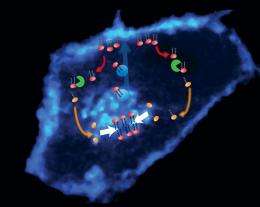
Within a cell there are a huge number of substances that need to be transported. An organelle known as the Golgi apparatus serves as the ‘shunting yard’ for the process. Proteins and other substances are made ready to do their respective jobs and prepared for transportation inside the Golgi, which is surrounded by a membrane of its own. Little bubbles (vesicles) are pinched off from the membrane and directed towards their ultimate destinations. Many of the proteins which need to be transported to the cell membrane are first furnished with a molecule of fatty acid, or lipid. This process, known as palmitoylation, equips the membrane proteins with a kind of address label and ships them off to the cell membrane. The cell uses this directed transportation from the Golgi apparatus to the cell membrane as a means of countering the permanent ‘leakage’ into other membranes that occurs. This is important because, besides the cell membrane, the cell is filled with membranes from organelles connected to one another via vesicles. Consequently, palmitoylated membrane proteins, originally intended for the cell membrane only, also reach other locations. With time, these proteins would then be distributed randomly throughout the cell.
The scientists in Dortmund were able to use cutting-edge microscopy techniques to monitor customised molecular probes in living cells and thereby analyse the location and the transportation of palmitoylated proteins in real time. What they found is that palmitoylation takes place predominantly at the Golgi apparatus. From there, palmitoylated proteins reach the cell membrane on the surface of the vesicles that are pinched off. In order to prevent the proteins from building up in other membranes, special enzymes remove the lipid anchor from all palmitoylated proteins indiscriminately. The proteins then swim freely throughout the cell until they find themselves thrown back into the transport mechanism of the Golgi apparatus. In this way, the cell ensures that misdirected proteins are quickly and continually fed back into the transport network and conveyed to their correct destination. "A state of this kind, one which is not in equilibrium and can only be sustained by constant energy consumption, is what characterises all life - in contrast to complex non-living systems like crystals, which occupy a state of equilibrium with minimal energy consumption," explains Philippe Bastiaens, Head of the Department of Systemic Cell Biology at the Max Planck Institute of Molecular Physiology. Thus, the scientists have discovered a fundamental principle of life.
Complex task, simple solution
But how does the cell know which proteins need to be addressed to the cell membrane whilst they are in the Golgi apparatus? According to the scientists, any protein can obtain a lipid anchor if it has the amino acid called cysteine readily accessible on its surface. It would then be transported automatically to the cell membrane. Such transportation therefore does not require any receptors which specifically bind to the protein at the cellular site where it is supposed to go.
This is a fascinating example of how complex processes can be controlled with simple physical and chemical rules. At first glances, it would appear to be enormously challenging to identify the proteins that need to be transported to a certain location, to spot any that have been transported to the wrong place and to stop them radiating off from their ultimate destination. Yet the cell manages this in a really simple way without any additional receptors or regulatory mechanisms. Other self-organising systems, too - such as insect colonies - often work on relatively simple principles. They would otherwise be unable to handle the multitude of tasks they need to perform. "These findings represent a milestone. They will change the way research in cellular biology is done. It’s only when we as scientists understand the principles by which life works that we are truly able to understand life. Focussing on the many different signalling pathways within the cell doesn’t really help that much," says Philippe Bastiaens.
New substance inhibits cancer protein
The research group even went a step further, laying the foundations for the findings to potentially be applied in cancer therapy. The Ras protein is a prominent representative of the palmitoylated proteins. Mutations in the ras gene can be found in many tumours. However, it is only able to function fully when it is embedded in the cell membrane and does not get into any other membranes. So the scientists developed an inhibitor they called palmostatin B to counteract the enzyme responsible for detaching the lipid anchor. When the enzyme is switched off, the palmitoylated Ras remains embedded in the cell membrane, from whence it gets into the membrane of other cellular organelles. "This was a brand new approach - and it actually goes against common sense. That’s why it was never taken any further in pharmaceutical research. What we did was this: instead of inhibiting directed transportation from the Golgi apparatus, we promoted random distribution within the cell," explains Herbert Waldmann, Head of the Department of Chemical Biology at the Max Planck Institute in Dortmund.
For the first time ever, the scientists using palmostatin B were able to inhibit the Ras protein without switching it off completely. If Ras is completely inactivated, even healthy cells die. By contrast, random distribution within the cell suppresses only the harmful impact of the mutated Ras protein. Cancer cells thus become normal cells again. Thanks to this discovery, Ras-dependent tumours could one day be treated in a manner that does not damage healthy cells.
More information:
-- Oliver Rocks, Marc Gerauer, Nachiket Vartak, Sebastian Koch, Zhi-Ping Huang, Markos Pechlivanis, Jürgen Kuhlmann, Lucas Brunsveld, Anchal Chandra, Bernhard Ellinger, Herbert Waldmann, and Philippe I.H. Bastiaens, The Palmitoylation Machinery Is a Spatially Organizing System for Peripheral Membrane Proteins, Cell, 23 April 2010
-- Frank J. Dekker, Oliver Rocks, Nachiket Vartak, Sascha Menninger, Christian Hedberg, Rengarajan Balamurugan, Stefan Wetzel, Steffen Renner, Marc Gerauer, Beate Schölermann, Marion Rusch, John W. Kramer, Daniel Rauh, Geoffrey J. Coates, Luc Brunsveld, Philippe Bastiaens, Herbert Waldmann, Small molecule inhibition of acyl protein thioesterase 1 (APT1) affects Ras localization and signaling, Nature Chemical Biology, 25 April 2010
Provided by Max-Planck-Gesellschaft


