Purple is the new green: Researcher examines light harvesting properties of purple bacteria
May 3, 2010
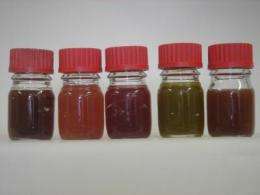
These are cultures of several bacteria. From left to right: Phaeospirillum molischianum, Rhodopseudomonas palustris, Rhodobacter Sphaeroides (strain Ga), Rhodospirillum photometricum and Rhodospirillum rubrum. Credit: James Sturgis
Purple bacteria were among the first life forms on Earth. They are single celled microscopic organisms that play a vital role in sustaining the tree of life. This tiny organism lives in aquatic environments like the bottom of lakes and the colorful corals under the sea, using sunlight as their source of energy. Its natural design seems the best structural solution for harvesting solar energy. Neil Johnson, a physicist and head of the inter-disciplinary research group in complexity in the College of Arts and Sciences at the University of Miami, thinks its cellular arrangement could be adapted for use in solar panels and other energy conversion devices to offer a more efficient way to garner energy from the sun.
"These bacteria have been around for billions of years, you would think they are really simple organisms and that everything is understood about them. However, purple bacteria were recently found to adopt different cell designs depending on light intensity," says Johnson. "Our study develops a mathematical model to describe the designs it adopts and why, which could help direct design of future photoelectric devices."
Johnson and his collaborators from the Universidad de los Andes in Colombia share their findings in a study entitled "Light-harvesting in bacteria exploits a critical interplay between transport and trapping dynamics," published in the current edition of Physical Review Letters.
Solar energy arrives at the cell in "drops" of light called photons, which are captured by the light-gathering mechanism of bacteria present within a special structure called the photosynthetic membrane. Inside this membrane, light energy is converted into chemical energy to power all the functions of the cell. The photosynthetic apparatus has two light harvesting complexes. The first captures the photons and funnels them to the second, called the reaction center (RC), where the solar energy is converted to chemical energy. When the light reaches the RCs, they close for the time it takes the energy to be converted.
According to the study, purple bacteria adapt to different light intensities by changing the arrangement of the light harvesting mechanism, but not in the way one would think by intuition.
"One might assume that the more light the cell receives, the more open reaction centers it has," says Johnson. "However, that is not always the case, because with each new generation, purple bacteria create a design that balances the need to maximize the number of photons trapped and converted to chemical energy, and the need to protect the cell from an oversupply of energy that could damage it."
To explain this phenomenon, Johnson uses an analogy comparing it to what happens in a typical supermarket, where the shoppers represent the photons, and the cashiers represent the reaction centers.
"Imagine a really busy day at the supermarket, if the reaction center is busy it's like the cashier is busy, somebody is doing the bagging," Johnson says. "The shopper wonders around to find an open checkout and some of the shoppers may get fed up and leave…The bacteria are like a very responsible supermarket," he says. "They would rather lose some shoppers than have congestion on the way out, but it is still getting enough profit for it to survive."
The study develops the first analytical model that explains this observation and predicts the "critical light intensity," below which the cell enhances the creation of RCs. That is the point of highest efficiency for the cell, because it contains the greatest number and best location of opened RCs, and the least amount of energy loss.
Because these bacteria grow and repair themselves, the researchers hope this discovery can contribute to the work of scientists attempting to coat electronic devices with especially adapted photosynthetic bacteria, whose energy output could become part of the conventional electrical circuit, and guide the development of solar panels that can adapt to different light intensities.
Currently, the researchers are using their mathematical model and the help of supercomputers, to try to find a photosynthetic design even better than the one they found in purple bacteria, although outsmarting nature is proving to be a difficult task.
-
Rhodopsin phototrophy promotes bacterial survival
Apr 27, 2010 |
not rated yet |
0
-
'Molecular glass fibers'
Apr 26, 2010 |
not rated yet |
0
-
A new energy source from the common pea
Mar 04, 2010 |
not rated yet |
0
-
'Safety valve' protects photosynthesis from too much light
Nov 25, 2009 |
not rated yet |
0
-
Scientists determine the structure of highly efficient light-harvesting molecules in green bacteria
May 04, 2009 |
not rated yet |
0
-
Engineers build first sub-10-nm carbon nanotube transistor
Feb 01, 2012 |
4.9 / 5 (31) |
30
-
Something old, something new: Evolution and the structural divergence of duplicate genes
Jan 31, 2012 |
4.6 / 5 (7) |
1
-
The hidden nanoworld of ice crystals: Revealing the dynamic behavior of quasi-liquid layers
Jan 30, 2012 |
5 / 5 (3) |
1
-
Stock market network reveals investor clustering
Jan 27, 2012 |
3.9 / 5 (23) |
8
-
Of microchemistry and molecules: Electronic microfluidic device synthesizes biocompatible probes
Jan 26, 2012 |
5 / 5 (1) |
0
-
Pith balls problem
59 minutes ago
-
Electrostatics
1 hour ago
-
what is phase constant
1 hour ago
-
Basics In electromagnetic wave
1 hour ago
-
How to calculate theoretical initial velocity?
2 hours ago
-
Question about Gravity?
3 hours ago
- More from Physics Forums - General Physics
More news stories
Putting the squeeze on planets outside our solar system
(PhysOrg.com) -- Using high-powered lasers, scientists at Lawrence Livermore National Laboratory and collaborators discovered that molten magnesium silicate undergoes a phase change in the liquid state, abruptly ...
11 hours ago |
4.3 / 5 (7) |
0
|
Hovering not hard if you're top-heavy, researchers find
Top-heavy structures are more likely to maintain their balance while hovering in the air than are those that bear a lower center of gravity, researchers at New York University's Courant Institute of Mathematical Sciences ...
12 hours ago |
5 / 5 (1) |
1
|
SLAC, Stanford team focuses on high-energy electrons to treat cancer
Accelerator physicists at SLAC and cancer specialists from Stanford are working on a new technology that could dramatically reduce the time needed for cancer radiation treatments. The team ran an initial experiment ...
15 hours ago |
5 / 5 (2) |
0
Measurements from high-energy collisions lead to better understanding of why meson particles disappear
For several years, physicists at the Relativistic Heavy Ion Collider (RHIC) at Brookhaven National Laboratory (BNL), USA, have studied an unusual state of matter called the quarkgluon plasma, which they ...
16 hours ago |
4.5 / 5 (4) |
0
Explained: Sigma
It's a question that arises with virtually every major new finding in science or medicine: What makes a result reliable enough to be taken seriously? The answer has to do with statistical significance -- but ...
Feb 09, 2012 |
5 / 5 (16) |
53
Anonymous knocks CIA website offline (Update)
The website of the Central Intelligence Agency was inaccessible on Friday after the hacker group Anonymous claimed to have knocked it offline.
Google users warned of threat to smartphone wallets
Users of Google smartphone wallets were being warned on Friday that there is a way to crack pass codes intended to thwart thieves from going on illicit shopping sprees.
New error-correcting codes guarantee the fastest possible rate of data transmission
Error-correcting codes are one of the triumphs of the digital age. Theyre a way of encoding information so that it can be transmitted across a communication channel such as an optical fiber o ...
Humans may have helped the decline of African rainforests 3000 years ago
(PhysOrg.com) -- Large areas of rainforests in Central Africa mysteriously disappeared over three thousand years ago, to be replaced by savannas. The prevailing theory has been that the cause was a change ...
New power source discovered
(PhysOrg.com) -- Researchers at the Massachusetts Institute of Technology (MIT) and RMIT University have made a breakthrough in energy storage and power generation.
The power of estrogen -- male snakes attract other males
A new study has shown that boosting the estrogen levels of male garter snakes causes them to secrete the same pheromones that females use to attract suitors, and turned the males into just about the sexiest ...
May 13, 2010
Rank: 1 / 5 (1)
Permutation & Combination of Tithons as One Unit to Work is an ERGON, that interminably beget a working quantum unit of dimorphic element known as ERG (unit of work as Joule) and DYNE (unit of work as Newton) having its prolific process into unit of working as ERGY... which in turn host the quadri-morphic role of Calorie (heat), Ampere (electric), Candela (light-luminous) and Molecule (chemical-compound).
TITHONS` is source of Energy, a legitimate candidate of being the paramount elucubration and ultimate realization for and as Theory Of Everything.
Greetings..
CHARANJEET SINGH LAMBA
astral scientist : gnosiologist