Scientists Explain Why Computers Crash But We Don't
May 3, 2010
Yale Scientists Explain Why Computers Crash But We Don't

Enlarge

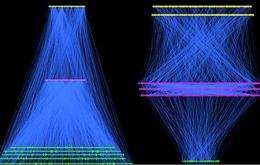
The hierarchical organization of the transcriptional regulatory network of bacterium E. Coli, left, shows a pyramidal structure compared to the Linux call graph, which has many more routines controlling few generic functions at the bottom.

(PhysOrg.com) -- Nature and software engineers face similar design challenges in creating control systems. The different solutions they employ help explain why living organisms tend to malfunction less than computers, a Yale study has found.

The Yale team compared the evolution of organisms and computer operating systems by analyzing the control networks in both a and the Linux operating system. They report their findings online in the May 3 edition of the .

“It is a commonplace metaphor that the genome is the operating system of a . We wanted to see if the analogy actually holds up,” said Mark Gerstein, the Albert L. Williams Professor of Biomedical Informatics; professor of molecular biophysics and biochemistry, and computer science; and senior author of the paper.

Both E coli and the Linux networks are arranged in hierarchies, but with some notable differences in how they achieve operational efficiencies. The molecular networks in the bacteria are arranged in a pyramid, with a limited number of master regulatory genes at the top that control a broad base of specialized functions, which act independently.

In contrast, the Linux operating system is organized more like an inverted pyramid, with many different top-level routines controlling few generic functions at the bottom of the network. Gerstein said that this organization arises because software engineers tend to save money and time by building upon existing routines rather than starting systems from scratch.

“But it also means the is more vulnerable to breakdowns because even simple updates to a generic routine can be very disruptive,” Gerstein said. To compensate, these generic components have to be continually fine-tuned by designers.

Operating systems are like urban streets - engineers tend to focus on areas that get a lot of traffic,” said Gerstein. “We can do this because we are designing these changes intelligently.”

However, he noted, if the analogy is extended to an organism like E coli, the situation is different: Without fine-tuning, a disruption of such major molecular roadways by random mutations would be fatal. That’s why E. coli cannot afford generic components and has preserved an organization with highly specialized modules, said Gerstein, adding that over billions of years of evolution, such an organization has proven robust, protecting the organism from random damaging mutations.


PhysOrg.com iPhone Apps
PhysOrg.com Audio Podcasts / iTunes
Join PhysOrg.com on Facebook!
Follow PhysOrg.com on Twitter!

Provided by Yale University (news : web)

4.7 /5 (67 votes)  

Filter


Move the slider to adjust rank threshold, so that you can hide some of the comments.


Display comments: newest first

SirChazwell
May 03, 2010

Rank: 4.1 / 5 (7)
Excellent!
JJC
May 03, 2010

Rank: 3.6 / 5 (11)
Of course we also crash less often because new software is not constantly being added to the system. Each new "program" takes millions of years to evolve, and every organism that can't handle the program is selected against.

Whereas in a computer, new things that might cause problems are constantly added.
LWM
May 03, 2010

Rank: 4.3 / 5 (7)
That is the power of evolution ... each bacteria can slowly rewrite small portions of its actions. This can't be applied to an OS unless each application has this right, which is impossible when security and efficiency are factored in.
Megadeth312
May 03, 2010

Rank: 1 / 5 (1)
New meaning for the term "computer virus"
meeker
May 03, 2010

Rank: 4.9 / 5 (9)
Of course, we crash ... it's called "Death." ;)

Hopefully, human beings will be getting an upgrade within the next two decades to prevent that.
bottomlesssoul
May 03, 2010

Rank: 4.2 / 5 (5)
Of course we also crash less often because new software is not constantly being added to the system. Each new "program" takes millions of years to evolve, and every organism that can't handle the program is selected against.

Whereas in a computer, new things that might cause problems are constantly added.
You only account for the genetics of conception, once the blastocyst forms it's completely dependent on input from it's environment to adapt to it's local environment.

It's true, software is too monolithic, the world needs an open source library of tens of thousands of tiny almost useless routines like a pool of genes that everyone develops from. Sure it may be susceptible to viruses but single patches can be transmitted globally in hours since this system can evolve at the speed of thought.
Hunnter
May 03, 2010

Rank: 3 / 5 (2)
@ bottomlesssoul
This partially exists, but in many, many separate groups.
Most languages tend to have group followings with large samples of functions and routines for people to grab and throw in to a library somewhere.

And of course, we can't forget out friend, the software patent.
Without him, we'd be like, controlling computers with our thoughts or something. Sickening, it's against everything decent.
Yay software patents! (sarcasm for the slow)
Yet again, patents ruin an industry.
HealingMindN
May 03, 2010

Rank: 1.5 / 5 (2)
You know those people who you feel like you have to walk on egg shells all the time, so you have to be careful what you do or say to that person or else you might disrupt him and break his concentration? Well, that's Xandros, the queeen of all linux bit_hes. I feel like I want to crash.
malapropism
May 03, 2010

Rank: 4.3 / 5 (3)
So I wonder what the Windows graph looks like?
zaai
May 03, 2010

Rank: 5 / 5 (1)
A slightly overlooked aspect is that of parallelism. When one element of a program fails the whole thing can crash. In an organism that element just dies off while the rest just keeps going.
dianearbus
May 04, 2010

Rank: 5 / 5 (1)
Of course I don’t use my brain. It makes me a natural conservative…

Bol Apartments
Skepticus
May 04, 2010

Rank: 4.8 / 5 (4)
A good knock on the back of the head is all that required to make the brain crash..:-)
finitesolutions
May 04, 2010

Rank: not rated yet
Uitati ceva: faptul ca un om moare nu inseamna ca si softwareul se opreste! Ba din contra programele de calculator continua. Exista sisteme informatice care inca functioneaza mult timp dupa ce creatori lor au murit.

frajo
May 04, 2010

Rank: 5 / 5 (2)
Uitati ceva: faptul ca un om moare nu inseamna ca si softwareul se opreste! Ba din contra programele de calculator continua. Exista sisteme informatice care inca functioneaza mult timp dupa ce creatori lor au murit.
You're right - it depends on the boundary conditions. In a friendly environment, an OS/2 server has the potential to run forever. A multicellular biological being does not have this potential, even in a friendly environment.
Shaffer
May 04, 2010

Rank: 4 / 5 (1)
New meaning for the term "computer virus"


I was going to say 'Now all we need is a life virus' but then I realized this already happens all the time with viral illness...I reverse engineered the re-invented wheel....oh my.

Maybe PcCillin was a good idea after all.
Skeptic_Heretic
May 04, 2010

Rank: 4 / 5 (2)
A lot of people would disagree and argue that we crash often. Just like old school Microsoft systems, the Human OS functions via daily reboots, called sleep and dreaming.
Rosario_Elliot
May 04, 2010

Rank: not rated yet
A light bulb that is turned on and never turned off in theory will burn forever. Because it is the surge of power from the switch that most times blows the bulb. PC's last longer when they are never turned off, for example the one I am on now is 7 years old and runs like a tank. It is rebooted once or twice a month for 7 years.

Thats about all I can say about that..lol
Skeptic_Heretic
May 04, 2010

Rank: 5 / 5 (1)
PC's last longer when they are never turned off, for example the one I am on now is 7 years old and runs like a tank. It is rebooted once or twice a month for 7 years.

The physical components and software components are not one in the same.

Your body could run forever if your telomeres were never damaged or shortened by the environment and cellular replication.
Royale
May 04, 2010

Rank: 3.5 / 5 (4)
Although you're right about the light switch usually being what blows the bulb, you're wrong about the theory. The tungsten in the bulb is burning, that's what makes it light up. When it burns to thing the bulb will go out regardless. Try it. A light bulb in theory will not burn forever.
Ravenrant
May 04, 2010

Rank: not rated yet
I don't see the comparison. A computer processes data, the human body is an engine. Only the brain processes data. There is a fundamental difference between the brain and a computer which I think better explains 'crashing'. An OS operates by default, it resists doing what you want and will only co-operate as a last resort (which explains why they are so damn aggravating). When it has exhausted every possible way to NOT do what you want, only then will it do anything. Every single detail has to be exactly right for it to do anything. The human brain does not work like that, it will try to do what you want in every way possible until it succeeds. This is why computers crash, the least little thing it doesn't like and you've stymied it. Also if you compare an OS that has been running for 5 years to a 90 year old brain you might have a closer crashing correlation.
Jungle
May 04, 2010

Rank: 5 / 5 (2)
The study isn't talking about human brains, it's talking about E. Coli genetic regulatory systems. Genes do require input to run most of the time- if they didn't then the organism would probably die pretty quickly. I think the study was less about determining why computers crash and humans don't and more about how we can attempt to reorganize our operating systems so they crash less.
mastergmr
May 04, 2010

Rank: 1 / 5 (1)
A windows graph would look like a Seventeenth stellation of icosahedron, some smoothe edges, and a lot of tight corners that lead into eachother because you will eventually run into the same windows OS problems no matter what you do to avoid them. (i.e the corners of the tetrahedra represent the problems one faces using windows.)

IMAGE: http://en.wikiped...dron.png
RealScience
May 04, 2010

Rank: 5 / 5 (2)
Royale - the tungsten is not lighting up because it is burning.
It is hot from electrical current times its resistance to that current, not from oxidation.

What happens is that any thin spot on the filament has higher resistance and hence gets hotter, which tends to evaporate the tungsten slightly more, which makes the thin spot grow even thinner, which makes it even hotter, etc. until the filament breaks at the thin spot (but the tungsten has not 'burned', it has evaporated and been deposited on the iside of the glass which also makes the bulb grow darker as it ages).
RealScience
May 04, 2010

Rank: 1 / 5 (2)
Royale - the tungsten is not lighting up because it is burning.
It is hot from electrical current times its resistance to that current, not from oxidation.

What happens is that any thin spot on the filament has higher resistance and hence gets hotter, which tends to evaporate the tungsten slightly more, which makes the thin spot grow even thinner, which makes it even hotter, etc. until the filament breaks at the thin spot (but the tungsten has not 'burned', it has evaporated and been deposited on the iside of the glass which also makes the bulb grow darker as it ages).
tkjtkj
May 05, 2010

Rank: 5 / 5 (1)
In a friendly environment, an OS/2 server has the potential to run forever. A multicellular biological being does not have this potential, even in a friendly environment.


Well, first of all, i think the analogy concerning a genome and operating system is incorrect: a genome ought better to be considered as a database. The cellular OS would be the mechanisms for managing the DB to the benefit of the organism.. But that was not related to your own comment, one with which I disagree also: The entire concept of cell death only appeared with the introduction of sexual reproduction! Only then did it seem that in most cases the organism itself became expendable. Consider the primative unicellular amoeba: it divides. so it can be then seen as still the same 'individual' but now living in two places at once.. ie, since the inception of that life-form, death is impossible if there are any of its kind existing at all!
See my next comment, im out of room here ..
Onceler37
May 09, 2010

Rank: not rated yet
People crash all the times it is called fainting or passing out or coma
Rank 4.7 /5 (67 votes)
Related Stories
Relevant PhysicsForums posts
  • Power sets.
    created44 minutes ago
  • Equal arc length
    created2 hours ago
  • coordinate geometry - bisector of two lines
    created6 hours ago
  • Compendium of formulae?
    created7 hours ago
  • Summation notation
    created11 hours ago
  • Complex 3d vector intersection formula..
    created18 hours ago
  • More from Physics Forums - General Math

More news stories

Some formerly cohabiting couples with children keep romantic relationship

(PhysOrg.com) -- When low-income cohabiting couples with children decide to no longer live together, that doesn’t necessarily mean the end of their romantic relationship.

Other Sciences / Social Sciences

created 1 hour ago | popularity not rated yet | comments 0

Kids show cultural gender bias

(PhysOrg.com) -- Talk about gender confusion! A recent study by University of Alberta researchers Elena Nicoladis and Cassandra Foursha-Stevenson in the Journal of Cross-Cultural Psychology into whether speaki ...

Other Sciences / Social Sciences

created 1 hour ago | popularity not rated yet | comments 0

Digging up the past

(PhysOrg.com) -- Researchers at the University of St Andrews have discovered what they think are the remains of our earliest known ancestor.

Other Sciences / Archaeology & Fossils

created 1 hour ago | popularity not rated yet | comments 0

Mexican experts excited to find ancient home ruins

(AP) -- The ruins aren't particularly impressive, just some stone and clay footings for houses that probably supported walls of wood or clay wattle. And it's that very ordinariness that has experts excited.

Other Sciences / Archaeology & Fossils

created 5 hours ago | popularity 4 / 5 (1) | comments 0

Researchers probe 200-year-old shipwreck off RI

(AP) -- For two centuries it rested a mile from shore, shrouded by a treacherous reef from the pleasure boaters and beachgoers who haunt New England's southern coast.

Other Sciences / Archaeology & Fossils

created 5 hours ago | popularity 3 / 5 (1) | comments 0


Tidal forces could squeeze out planetary water

Alien planets might experience tidal forces powerful enough to remove all their water, leaving behind hot, dry worlds like Venus, researchers said.

Google launches Chrome browser for Android smartphones

With more and more people connecting to the Internet through a phone or a tablet instead of a PC, Google Inc. is bringing its fast-growing browser, Chrome, to the newest Android-powered mobile devices.

Kodak to stop making cameras, digital frames

Kodak says it will stop making digital cameras, pocket video cameras and digital picture frames in order to focus on its more profitable businesses.

Oracle to pay $1.9B for personnel software co.

(AP) -- Oracle is paying $1.9 billion for Taleo Corp., a company that helps businesses manage their employees.

Antarctic lake could reveal evolution, new life: scientists

Russian scientists said Thursday a probe to a pristine lake deep under the ice of Antarctica could bring revelations on the planet's evolution and possibly even new life forms.

Can indigenous insects be used against the light brown apple moth?

The light brown apple moth (LBAM), Epiphyas postvittana (Walker), an invasive insect from Australia, was found in California in 2006. The LBAM feeds on apples, pears, stonefruits, citrus, grapes, berries and many other plants ...