Faster Salmonella detection now possible with new technique
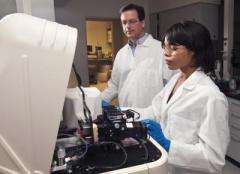
Using technology available through a local company, an Iowa State University researcher is working on a faster method to detect and genetically identify salmonella from contaminated foods.
Byron Brehm-Stecher, an assistant professor of food science and human nutrition, wants to replace the current system of salmonella detection with a new approach that can provide DNA sequencing-like results in hours rather than days.
Brehm-Stecher's collaborator, Advanced Analytical Technologies, Inc., from Ames, is providing advanced biomedical instruments and reagents for the research.
The recent results of the research, funded by the Grow Iowa Values Fund, will be presented at the August meeting of the International Association for Food Protection in Anaheim, Calif.
Currently, definitive genetic identification of food-borne pathogens is done using traditional DNA sequencing methods first developed in the 1980s.
"If you want (DNA) sequence information now, you first need to run a polymerase chain reaction (PCR) on total DNA extracted from a sample of contaminated food," said Brehm-Stecher. "This amplifies DNA from the pathogen you're looking for and will let you know if salmonella is present or not.
"However, further details about the pathogen are lacking, like what strain is present. To dig deeper, you need to run a cycle sequencing reaction - similar to a long PCR reaction - and send the output from this to a DNA sequencing core facility. Results are available about two days later," said Brehm-Stecher.
"This is not fast enough to keep up with the pace of today's food production and distribution networks. We are able to get foods from the farm to the table - really any table around the globe - in a remarkably short period of time," he added.
Faster detection of specific strains can mean recognizing an outbreak sooner and stopping tainted food from being delivered and consumed. The new method might be helpful for investigative agencies, Brehm-Stecher said.
"Especially for the type of investigation where things are still in motion. The food has been shipped and you may not know where it is. It may be in a truck, on a shelf or in some consumer's pantry, so time really is of the essence," he said.
"Next-generation sequencing tools are available, but these are still too complex and expensive for routine use in the food industry," Brehm-Stecher explained. "New approaches that are able to bridge the gap between the limitations of traditional PCR and next-generation sequencing could enhance food safety efforts by providing both rapid presence/absence testing and detailed genetic characterization of isolates."
You don't have to go further than the local newspaper to see the depth of the problem. Recent national outbreaks of salmonella in foods include peanut butter (2007 and 2009), alfalfa sprouts (2009), black pepper and hydrolyzed vegetable protein (HVP) (2010). Adding to the problem is the fact that peanut butter, black pepper and HVP are all base ingredients used in many other food products. Salmonella in these ingredients has led to thousands of product recalls, hundreds of illnesses and several deaths, Brehm-Stecher said.
The method being developed at Iowa State University starts with a rapid PCR reaction that amplifies a salmonella-specific gene, generating millions of fluorescently labeled copies of this DNA in about 20 minutes.
Next, instead of cycle sequencing, the PCR product is purified for five minutes, SNAP71 (a reagent developed by Advanced Analytical) is added, and the DNA is heated for 10 minutes at 100ºC.
This reaction chemically cuts the labeled salmonella DNA at all adenine and guanine sites (A's and G's) in the DNA chain.
The result is a complex soup of fluorescently labeled DNA fragments of all sizes.
These fragments are then separated in a high-voltage electric field by sieving them through a polymer matrix (a gel) contained in glass capillaries that are 50 microns -- not much thicker than a human hair. This process separates the DNA fragments according to their size, from smallest to largest, and each piece is detected as it passes in front of an intense light source. For a PCR product that's 300 bases long, this separation and detection process takes approximately 90 minutes.
Because the SNAP71 reagent cleaves the salmonella DNA only at adenine and guanine, and not at thymine and cytosine sites (T's and C's), the method is not a direct replacement for DNA sequencing. Instead, the process rapidly generates a reproducible pattern of DNA fragments, Brehm-Stecher said.
Salmonella strains having slightly different DNA sequences within a given gene will yield different patterns of fragments, allowing discrimination of different strains of salmonella.
From "food to finish," the whole process can be accomplished in about two and a half hours.
"We're very excited about this approach and about the rapid progress we've made since the project began," said Brehm-Stecher. "The funding for this project has enabled us to work very closely with Advanced Analytical and accelerate application of their instruments to solving important food safety problems."
The team at Iowa State University includes post doctoral researcher Hyun Jung Kim and master's student Brittany Porter. The group is also working with Cleveland Clinic in Ohio.
The ultimate goal of the project is faster detection and characterization of human pathogens from "farm to fork to physician."
Advanced Analytical's instruments are based on technology originally developed at Iowa State University in the lab of Ed Yeung, the Robert Allen Wright Professor and Distinguished Professor in Liberal Arts and Sciences and professor at the U.S. Department of Energy's Ames Lab.
Provided by Iowa State University


