Ultra-Sensitive Cocaine Detection
May 5, 2010
Ultra-Sensitive Cocaine Detection

Enlarge

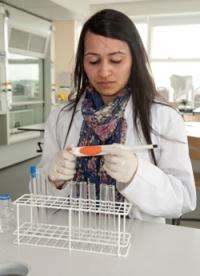
Sonica Devi testing collected samples in the lab.

(PhysOrg.com) -- Forensic science student Sonica Devi has found minute traces of cocaine at a number of public phone boxes in the city of Derby, UK - thanks to a new development in forensic analysis.

The development of an ultra sensitive Gas Chromatographic technique - enabled the University of Derby science team to detect at picogram levels - one million millionth of a gram from forensic swabs.

Gas Chromatography linked to a (GCMS) is an established technique for separating complex mixtures of compounds and detecting them down to very low amounts. This breakthrough at Derby makes the detection of cocaine possible even at a million millionth of a gram.

Sonica, a final year student at the University of Derby, developed this novel technique to help identify minute traces of cocaine at all six phone boxes she tested. A standard method would have easily missed the presence of this drug at these low levels.

Her study entitled: 'Real world detection of cocaine at the picogram (one trillionth of a gram) level in an urban environment' is now being presented at a number of conferences across the UK.

Sonica, 22, from Littleover, said: "I had no idea what I would find through this study as no trace of drugs could be seen in the phone booths with the naked eye - I was surprised at what the research found.

"I am keen to take this research forward and would be keen to work with other agencies or organisations to develop this further."

Using her novel approach, Sonica was able to see even the smallest of traces of cocaine within samples collected from around the city. The lowest amount Sonica was able to detect was fifty parts per million million - fifty picograms.

In terms of the size of matter, a picogram is one thousand times smaller than a nanogram and a thousand thousandth times smaller than a microgram (a millionth of a gram).

The study revealed that, in one phone box, cocaine was present at a much higher level of ten nanograms and in the other five phone boxes tested, cocaine was detected at varying levels approaching the limit of detection established using this approach - fifty picograms.

For the study, sterile swabs were used to collect samples from different areas of each phone box including: the dial; handset; key pad and coin slot.

Samples were taken using a variety of swabs: wetted with ethanol; wetted with water and dry swabs to maximise how much cocaine could be lifted from the surfaces of the phone box.

The swabs were taken back to the University's Kedleston Road laboratories for analysis and each of the swabs were placed in tubes containing a solvent called Dichloromethane (DCM). The solvent dissolves the cocaine and allows it to enter the Gas Chromatograph.

After separating the cocaine from other materials lifted by the swabs the mass spectrometer detector provides a means to detect the cocaine - using the method developed by Sonica this was performed with extremely high sensitivity.

Dr Alan-Shaun Wilkinson who is a senior lecturer at the University of Derby supervised Sonica during this project which was also aided by Joe Waldron who is an expert in the use of GCMS at the University.

Alan said: "Without the dedication and expertise of our technical staff like Joe who advises on and operates the GCMS, these exciting student projects would not be possible.

"By improving the sensitivity of our GCMS technique we can now see cocaine and other closely related materials down to incredibly low levels which would not have been possible previously. This important piece of work opens the door to analysing a whole range of different drug types with similar sensitivities."

Provided by University of Derby

Filter


Move the slider to adjust rank threshold, so that you can hide some of the comments.


Display comments: newest first

Husky
May 05, 2010

Rank: not rated yet
this gives a whole new meaning to the word crank caller
Rank not rated yet
Related Stories
Relevant PhysicsForums posts
  • Stoichiometry
    created21 hours ago
  • Boiling and melting point of impure substances
    created22 hours ago
  • Safe nitrogen compound to decompose a 500 deg C in a furnace?
    createdFeb 09, 2012
  • [ask]electron inside drinking water
    createdFeb 08, 2012
  • How to avoid formation of Lithium Chromate ???
    createdFeb 08, 2012
  • how to choose a reduced or oxidated form in a redox
    createdFeb 08, 2012
  • More from Physics Forums - Chemistry

More news stories

Fool's gold may prove an unlikely alternative to overexploited catalytic materials

Catalytic materials, which lower the energy barriers for chemical reactions, are used in everything from the commercial production of chemicals to catalytic converters in car engines. However, with current catalytic materials ...

Chemistry / Materials Science

created 13 hours ago | popularity 4.3 / 5 (7) | comments 5 | with audio podcast

Unpicking HIV’s invisibility cloak

Drug researchers hunting for alternative ways to treat human immunodeficiency virus (HIV) infections may soon have a novel target—its camouflage coat. HIV hides inside a cloak unusually rich in a sugar ...

Chemistry / Biochemistry

created 13 hours ago | popularity 5 / 5 (4) | comments 0

No entry without protein recycling: Researchers discover new coherence in enzyme transport

The group of Prof. Dr. Ralf Erdmann at the Ruhr-Universität Bochum, Germany, discovered a connection of peroxisomal protein import and receptor export. In the Journal of Biological Chemistry, they disclo ...

Chemistry / Biochemistry

created 13 hours ago | popularity not rated yet | comments 0

Hydrogen from acidic water: Researchers develop potential low cost alternative to platinum for splitting water

A technique for creating a new molecule that structurally and chemically replicates the active part of the widely used industrial catalyst molybdenite has been developed by researchers with the Lawrence Berkeley ...

Chemistry / Materials Science

created Feb 09, 2012 | popularity 5 / 5 (12) | comments 13 | with audio podcast

Under the microscope #7

In this video Dr Ingrid Graz shows us a thin layer of gold on top of rubber. Cracks in the gold allow it to stretch and we can use this for stretchable electronics.

Chemistry / Other

created 15 hours ago | popularity not rated yet | comments 0


Anonymous knocks CIA website offline (Update)

The website of the Central Intelligence Agency was inaccessible on Friday after the hacker group Anonymous claimed to have knocked it offline.

Google users warned of threat to smartphone wallets

Users of Google smartphone wallets were being warned on Friday that there is a way to crack pass codes intended to thwart thieves from going on illicit shopping sprees.

New error-correcting codes guarantee the fastest possible rate of data transmission

Error-correcting codes are one of the triumphs of the digital age. They’re a way of encoding information so that it can be transmitted across a communication channel — such as an optical fiber o ...

Complex wiring of the nervous system may rely on a just a handful of genes and proteins

Researchers at the Salk Institute have discovered a startling feature of early brain development that helps to explain how complex neuron wiring patterns are programmed using just a handful of critical genes. ...

Humans may have helped the decline of African rainforests 3000 years ago

(PhysOrg.com) -- Large areas of rainforests in Central Africa mysteriously disappeared over three thousand years ago, to be replaced by savannas. The prevailing theory has been that the cause was a change ...

The power of estrogen -- male snakes attract other males

A new study has shown that boosting the estrogen levels of male garter snakes causes them to secrete the same pheromones that females use to attract suitors, and turned the males into just about the sexiest ...