How world's smallest 'coffee ring' may help biosensors detect disease
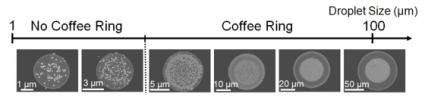
(PhysOrg.com) -- The field of biosensing has recently found an unlikely partner in the quest for increased sensitivity: coffee rings. The next time you spill your coffee on a table, look at the spot left after the liquid has evaporated, and you'll notice it has a darker ring around its perimeter that contains a much higher concentration of particles than the center.
Because this "coffee ring" phenomenon occurs with many liquids after they have evaporated, scientists have suggested that such rings can be used for examining blood or other fluids for disease markers by using biosensing devices. But a better understanding of how these rings behave at the micro- and nano-scale would probably be needed for practical bionsensors.
"Understanding micro- and nano-particle transportation within evaporating liquid droplets has great potential for several technological applications, including nanostructure self-assembly, lithography patterning, particle coating, and biomolecule concentration and separation," said Chih-Ming Ho, the Ben Rich-Lockheed Martin Professor at the UCLA Henry Samueli School of Engineering and Applied Science and director of the UCLA Center for Cell Control. "However, before we can engineer biosensing devices to do these applications, we need to know the definitive limits of this phenomenon. So our research turned to physical chemistry to find the lowest limits of coffee-ring formation."
A research group led by Ho, a member of the National Academy of Engineering, has now found the definitive microscopic minimal threshold of coffee-ring formation, which can be used to set standards for biosensor devices for multiple disease detection, as well as other uses. The research appears in the current issue of the Journal of Physical Chemistry B and is available online.
"If we consider human blood, or saliva, it has a lot of micro- and nano-scale molecules or particles that carry important health information," said Tak-Sing Wong, one of the researchers and a postdoctoral scholar in UCLA Engineering's department of mechanical and aerospace engineering. "If you put this blood or saliva on a surface, and then it dries, these particles will be collected in a very small region in the ring. By doing so, we can quantify these biomarkers by various sensing techniques, even if they are very small and in a small amount in the droplets."
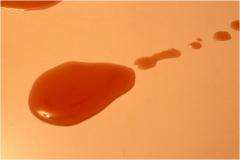
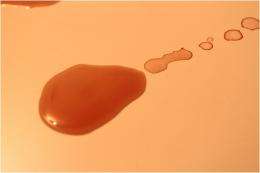
As water evaporates from a droplet, particles that are suspended inside the liquid move to the droplet's edges. Once all the water has evaporated, the particles are concentrated in a ring around the stain that is left behind. However, if a droplet is small enough, the water will evaporate faster than the particles move. Rather than a ring, there will be a relatively uniform concentration in the stain, as the particles have not had enough time to move to the edges while still in the liquid.
"It is the competition between the timescale of the evaporation of the droplet and the timescale of the movement of the particles that dictates coffee-ring formation," said Xiaoying Shen, the paper's lead author and a senior microelectronics major at Peking University in China, who worked on these experiments while at the UCLA Cross Disciplinary Scholars in Science and Technology (CSST) program last summer.
To determine the smallest droplet size that would still show a coffee ring after evaporation, the research team manufactured a special surface coated in a checkerboard pattern that featured alternating hydrophilic, or water-loving, material and hydrophobic, or water-repelling, material.
The group then placed latex particles, ranging in size from 100 nanometers to 20 nanometers, in water. The particles were similar in size to disease-marker proteins that biosensors would look for.
The group washed the new surface with the particle-infused water. The remaining water lined up as droplets on the hydrophilic spots, much like checkers on a checkerboard. The group repeated the experiments with smaller grid patterns until the coffee-ring phenomenon was no longer evident. For the 100-nanometer sized particles, this occurred at a droplet diameter of approximately 10 micrometers, or about 10 times smaller than the width of a human hair. At this point, the water evaporated before the particles had enough time to move to the perimeter.
"Knowing the minimum size of this so-called coffee ring will guide us in making the smallest biosensors possible," Wong said. "This means that we can pack thousands, even millions, of small micro-biosensors onto a lab-on-a-chip, allowing one to perform a large number of medical diagnostics on a single chip. This may also open the doors to potentially detecting multiple diseases in one sitting."
"There's another important advantage — this whole process is very natural, it's just evaporation," Wong added. "We don't need to use additional devices, such as an electrical power source or other sophisticated instruments to move the particles. Evaporation provides a very simple way of concentrating particles and has potential in medical diagnosis. For example, researchers at Vanderbilt University were recently awarded a Gates Foundation Research Fund for proposing the use of the coffee-ring phenomenon for malaria detection in developing countries."
The researchers are currently optimizing the ring formation parameters and will then explore the application of this approach toward biosensing technologies that are being developed in Ho's laboratory.
Provided by University of California - Los Angeles


