Complete Neanderthal genome yields insights into human evolution and evidence of interbreeding
May 6, 2010
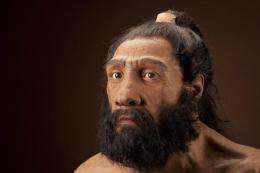
Homo neanderthalensis, adult male. Image Credit: John Gurche, artist / Chip Clark, photographer
After extracting ancient DNA from the 40,000-year-old bones of Neanderthals, scientists have obtained a draft sequence of the Neanderthal genome, yielding important new insights into the evolution of modern humans.
Among the findings, published in the May 7 issue of Science, is evidence that shortly after early modern humans migrated out of Africa, some of them interbred with Neanderthals, leaving bits of Neanderthal DNA sequences scattered through the genomes of present-day non-Africans.
"We can now say that, in all probability, there was gene flow from Neanderthals to modern humans," said the paper's first author, Richard E. (Ed) Green of the University of California, Santa Cruz.
Green, now an assistant professor of biomolecular engineering in the Baskin School of Engineering at UC Santa Cruz, began working on the Neanderthal genome as a postdoctoral researcher at the Max Planck Institute for Evolutionary Anthropology in Leipzig, Germany. Svante Pääbo, director of the institute's genetics department, leads the Neanderthal Genome Project, which involves an international consortium of researchers. David Reich, a population geneticist at the Broad Institute of MIT and Harvard, also played a leading role in the new study and the ongoing investigation of the Neanderthal genome.
"The Neanderthal genome sequence allows us to begin to define all those features in our genome where we differ from all other organisms on the planet, including our closest evolutionary relative, the Neanderthals," Pääbo said.
The researchers identified a catalog of genetic features unique to modern humans by comparing the Neanderthal, human, and chimpanzee genomes. Genes involved in cognitive development, skull structure, energy metabolism, and skin morphology and physiology are among those highlighted in the study as likely to have undergone important changes in recent human evolution.
"With this paper, we are just scratching the surface," Green said. "The Neanderthal genome is a goldmine of information about recent human evolution, and it will be put to use for years to come."
Neanderthals lived in much of Europe and western Asia before dying out 30,000 years ago. They coexisted with humans in Europe for thousands of years, and fossil evidence led some scientists to speculate that interbreeding may have occurred there. But the Neanderthal DNA signal shows up not only in the genomes of Europeans, but also in people from East Asia and Papua New Guinea, where Neanderthals never lived.
"The scenario is not what most people had envisioned," Green said. "We found the genetic signal of Neanderthals in all the non-African genomes, meaning that the admixture occurred early on, probably in the Middle East, and is shared with all descendants of the early humans who migrated out of Africa."
The study did not address the functional significance of the finding that between 1 and 4 percent of the genomes of non-Africans is derived from Neanderthals. But Green said there is no evidence that anything genetically important came over from Neanderthals. "The signal is sparsely distributed across the genome, just a 'bread crumbs' clue of what happened in the past," he said. "If there was something that conferred a fitness advantage, we probably would have found it already by comparing human genomes."
The draft sequence of the Neanderthal genome is composed of more than 3 billion nucleotides--the "letters" of the genetic code (A, C, T, and G) that are strung together in DNA. The sequence was derived from DNA extracted from three Neanderthal bones found in the Vindiga Cave in Croatia; smaller amounts of sequence data were also obtained from three bones from other sites. Two of the Vindiga bones could be dated by carbon-dating of collagen and were found to be about 38,000 and 44,000 years old.
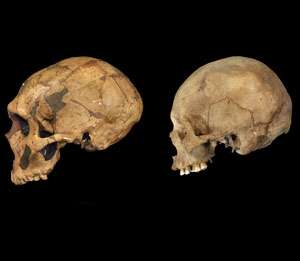
New genetic evidence shows that Neandertals (left) interbred with modern humans (right). Genetic exchange was limited to non-African modern humans. Image courtesy of Chris Stringer. Reproduced with permission of Chris Stringer/Musee de l'Homme Paris.
Deriving a genome sequence--representing the genetic code on all of an organism's chromosomes--from such ancient DNA is a remarkable technological feat. The Neanderthal bones were not well preserved, and more than 95 percent of the DNA extracted from them came from bacteria and other organisms that had colonized the bone. The DNA itself was degraded into small fragments and had been chemically modified in many places.The researchers had to develop special methods to extract the Neanderthal DNA and ensure that it was not contaminated with human DNA. They used new sequencing technology to obtain sequence data directly from the extracted DNA without amplifying it first. Although genome scientists like to sequence a genome at least four or five times to ensure accuracy, most of the Neanderthal genome has been covered only one to two times so far.
The draft Neanderthal sequence is probably riddled with errors, Green said, but having the human and chimpanzee genomes for comparison makes it extremely useful despite its limitations. Places where humans differ from chimps, while Neanderthals still have the ancestral chimp sequence, may represent uniquely human genetic traits. Such comparisons enabled the researchers to catalog the genetic changes that have become fixed or have risen to high frequency in modern humans during the past few hundred thousand years.
"It sheds light on a critical time in human evolution since we diverged from Neanderthals," Green said. "What adaptive changes occurred in the past 300,000 years as we were becoming fully modern humans? That's what I find most exciting. Right now we are still in the realm of identifying candidates for further study."
The ancestral lineages of humans and chimpanzees are thought to have diverged about 5 or 6 million years ago. By analyzing the Neanderthal genome and genomes of present-day humans, Green and his colleagues estimated that the ancestral populations of Neanderthals and modern humans separated between 270,000 and 440,000 years ago.
The evidence for more recent gene flow between Neanderthals and humans came from an analysis showing that Neanderthals are more closely related to some present-day humans than to others. The researchers looked at places where the DNA sequence is known to vary among individuals by a single "letter." Comparing different individuals with Neanderthals, they asked how frequently the Neanderthal sequence matches that of different humans.
The frequency of Neanderthal matches would be the same for all human populations if gene flow between Neanderthals and humans stopped before human populations began to develop genetic differences. But that's not what the study found. Looking at a diverse set of modern humans--including individuals from Southern Africa, West Africa, Papua New Guinea, China, and Western Europe--the researchers found that the frequency of Neanderthal matches is higher for non-Africans than for Africans.
According to Green, even a very small number of instances of interbreeding could account for these results. The researchers estimated that the gene flow from Neanderthals to humans occurred between 50,000 and 80,000 years ago. The best explanation is that the admixture occurred when early humans left Africa and encountered Neanderthals for the first time.
"How these peoples would have interacted culturally is not something we can speculate on in any meaningful way. But knowing there was gene flow is important, and it is fascinating to think about how that may have happened," Green said.
The researchers were not able to rule out one possible alternative explanation for their findings. In that scenario, the signal they detected could represent an ancient genetic substructure that existed within Africa, such that the ancestral population of present-day non-Africans was more closely related to Neanderthals than was the ancestral population of present-day Africans. "We think that's not the case, but we can't rule it out," Green said.
The researchers expect many new findings to emerge from ongoing investigations of the Neanderthal genome and other ancient genetic sequences. Pääbo's group recently found evidence of a previously unknown type of hominid after analyzing DNA extracted from what they had thought was a Neanderthal finger bone found in Siberia. Green is also taking part in that continuing investigation.
More information: "Timing of human protein evolution as revealed by massively parallel capture of Neandertal nuclear DNA sequences" appears online ahead of print in Science on Thursday, May 6, 2010. The full list of authors is: Hernán A. Burbano, Emily Hodges, Richard E. Green, Adrian W. Briggs, Johannes Krause, Matthias Meyer, Jeffrey M. Good, Tomislav Maricic, Philip L.F. Johnson, Zhenyu Xuan, Michelle Rooks, Arindam Bhattacharjee, Leonardo Brizuela, Frank W. Albert, Marco de la Rasilla, Javier Fortea, Antonio Rosas, Michael Lachmann, Gregory J. Hannon, and Svante Pääbo. The paper is available online at http://www.science … s/recent.dtl
Provided by University of California - Santa Cruz (news : web)
-
Researchers Probe Links Between Modern Humans and Neanderthals
Sep 19, 2009 |
not rated yet |
0
-
Could Neanderthals live again?
Feb 11, 2010 |
not rated yet |
0
-
Neanderthals may have interbred with humans twice
Apr 21, 2010 |
not rated yet |
0
-
Handsome by Chance
Aug 02, 2007 |
not rated yet |
0
-
Probing Question: What can we learn from Neanderthal DNA?
Apr 22, 2010 |
not rated yet |
0
-
Engineers build first sub-10-nm carbon nanotube transistor
Feb 01, 2012 |
4.9 / 5 (30) |
30
-
Something old, something new: Evolution and the structural divergence of duplicate genes
Jan 31, 2012 |
4.6 / 5 (7) |
1
-
The hidden nanoworld of ice crystals: Revealing the dynamic behavior of quasi-liquid layers
Jan 30, 2012 |
5 / 5 (3) |
1
-
Stock market network reveals investor clustering
Jan 27, 2012 |
3.9 / 5 (23) |
8
-
Of microchemistry and molecules: Electronic microfluidic device synthesizes biocompatible probes
Jan 26, 2012 |
5 / 5 (1) |
0
-
Pertubance in a model
3 hours ago
-
Cancer drugs and Alzheimer's, Oh my!
11 hours ago
-
Squishing cells
12 hours ago
-
Any books/articles for evolutionary stable strategy models in humans?
23 hours ago
-
Science behind the bore feeling?
Feb 09, 2012
-
Homo Sapien vs. Chimpanzee - Divergence Timeline
Feb 09, 2012
- More from Physics Forums - Biology
More news stories
The power of estrogen -- male snakes attract other males
A new study has shown that boosting the estrogen levels of male garter snakes causes them to secrete the same pheromones that females use to attract suitors, and turned the males into just about the sexiest ...
1 hour ago |
not rated yet |
0
|
Experts reveal how plants don't get sunburn
(PhysOrg.com) -- Experts at the University of Glasgow have discovered how plants survive the harmful rays of the sun.
1 hour ago |
5 / 5 (1) |
0
|
Miami battling invasion of giant African snails
No one knows how they got there. But an invasion of African giant snails has southern Florida in a panic over potential crop damage, disease and general yuckiness surrounding the slimy gastropods.
5 hours ago |
not rated yet |
2
Ultraviolet protection molecule in plants yields its secrets
Lying around in the sun all day is hazardous not just for humans but also for plants, which have no means of escape. Ultraviolet (UV) radiation from the sun can damage proteins and DNA inside cells, leading ...
20 hours ago |
5 / 5 (5) |
0
|
Fighting crimes against biodiversity: How to catch a killer weed
Invasive species which have the potential to destroy biodiversity and influence global change could be tracked and controlled in the same way as wanted criminals, according to new research from Queen Mary, University of London.
6 hours ago |
not rated yet |
0
Curry spice component may help slow prostate tumor growth
Curcumin, an active component of the Indian curry spice turmeric, may help slow down tumor growth in castration-resistant prostate cancer patients on androgen deprivation therapy (ADT), a study from researchers ...
Netflix light on flicks as viewers soak up TV shows
Like most fresh faces that arrive in Hollywood, Netflix wanted to be a movie star. But now it's learning what many in Tinseltown have known for decades: Movies are sexy, but the real money is in television.
Antidepressants and pregnancy: Women must consider the impact of drugs on baby, and of depression on baby, themselves
Upon learning they are pregnant, most women dutifully nix the alcohol, sushi and caffeine. But what about antidepressants?
Arthritic knees, but not hips, have robust repair response
Researchers at Duke University Medical Center used new tools they developed to analyze knees and hips and discovered that osteoarthritic knee joints are in a constant state of repair, while hip joints are not.
Fool's gold may prove an unlikely alternative to overexploited catalytic materials
Catalytic materials, which lower the energy barriers for chemical reactions, are used in everything from the commercial production of chemicals to catalytic converters in car engines. However, with current catalytic materials ...
Humans may have helped the decline of African rainforests 3000 years ago
(PhysOrg.com) -- Large areas of rainforests in Central Africa mysteriously disappeared over three thousand years ago, to be replaced by savannas. The prevailing theory has been that the cause was a change ...
May 06, 2010
Rank: 2.7 / 5 (3)
May 06, 2010
Rank: 3.6 / 5 (5)
May 06, 2010
Rank: not rated yet
Yes, that seems to be what they are saying. Is there something wrong with that?
May 06, 2010
Rank: 2 / 5 (3)
May 06, 2010
Rank: not rated yet
If you define "pure" to mean not having Neanderthal genes, then the answer to that question seems to be yes also.
May 06, 2010
Rank: 4 / 5 (1)
Eeesh, thats somewhat troubling, being as it was recently discovered that horizontal genetic transfer can occur between insects and humans...my thinking is the saem is probably true between the smaller organisms too...which leads me to think: are we sure we actually mapped the neaderthal genetic line, or did we inadvertantly map bacterial modification to those genes??
May 06, 2010
Rank: not rated yet
Parsec-neanderthals were primarily from africa, and some in northern africa from what I understand...with none of them going extinct until right around the same time (well ok, it was an eventual die off from what I understand, but occurring at the same time regardless)...
I could have misunderstood you, but I would think a more accurate statement would be "neanderthals only populated a very small area of africa, leaving less potential for interbreeding between species"..
either way, I do agree with the point you were making.
May 07, 2010
Rank: 3.7 / 5 (3)
All modern human populations across the globe have continued to evolve, prior, during, and following the dispersion out of Africa.
That's how come we have so-called "races" today, with distinctive facial traits, hair, pigmentation, etc. No human living today, matches the genetic makeup of the first modern human (i.e. the first identifiable representative of Homo Sapiens.)
And that's before one considers all the interbreeding (both with Neanderthals, apparently, and also across the "racial" lines.)
Indeed, "race" is a rather superficial concept, dealing only with readily observable phenotypes. But there's much more variation that isn't visible to the eye. The notion of "race" is more illusory than real, with there being just as much (if not more) genetic variation within "races", as between them.
May 07, 2010
Rank: 5 / 5 (2)
Neanderthals were mostly established throughout Europe, and to a somewhat more limited extent in the Middle East. They did not inhabit Africa: they were specifically adapted to cold climates. The expansion of modern humans out of Africa, gradually displaced the Neanderthals, pushing them out toward marginal lands, into mountains, and toward sea shores, and eventually squeezing them out of existence altogether.
May 07, 2010
Rank: not rated yet
OK, I'm no cultural anthropologist, but I'm sure there are better minds than mine that can handle my rough draft.
1. (H) Humans meet (N) Neanderthals
2. H gets to know N better. H "trades" with N.
3. H takes N's Resources
4. H takes N's Freedom
5. H exploits N into extinction
My second point is that no animal able to be subjected to sexual abuse has not been molested, in all likely hood, given "human nature" and time.
If H is able to crossbreed with N, genetic flow will occur wherever H goes. H has a "kinkyness" gene that is expressed in X% of the population.
It has long been my theory that the various "Races" most likely arose from the various exploitations of "lesser hominids" into extinction.
May 07, 2010
Rank: not rated yet
May 07, 2010
Rank: 5 / 5 (25)
Why are you getting so defensive :)
May 07, 2010
Rank: 1.8 / 5 (4)
If not, this would imply that the farther north and east you go, the more apparent the interbreeding should be. Therefore, Scandinavians, Asians, and other northern and eastern races should have the highest percentage of gene frequency matches between the two species.
Maybe that's why Scandinavians are so big and strong and hairy and adventurous and stoic and...
But on the other hand, it makes one wonder why a similarly (supposedly) interbred group came out so differently, that being the Asians - known more for being smaller and smooth skinned and socially more sophisticated and contemplative...
Perhaps human evolution is simply and largely driven by survival needs and societal interpretations of beauty and handsomeness?
May 07, 2010
Rank: 5 / 5 (25)
May 07, 2010
Rank: not rated yet
neanderthals were primarily from EUROPE, and some in northern africa and the middle east from what I understand...with none of them going extinct until right around the same time (well ok, it was an eventual die off from what I understand, but occurring at the same time regardless)...
my apologies guys :)
May 07, 2010
Rank: 3 / 5 (2)
May 07, 2010
Rank: 1 / 5 (1)
H and N have crosbread this is for shure, male H couldn't miss the chanse to rape the female no matter how furry they were, this explanes lots of facts, for example the features of the aborigen's faces(and their short neck), monobrow which is common in asia and the furr in common(if we have started out of africa without fur, why it appeared when it hasn't purpose at all).I think this is somethink good, no matter they were less developed, the different genetikal combinations have been created and then the natural selection have done its job(evolution cant go backword), lets dont forget the modern wheat
which is developed(naturally not by monsanto) by crossbreading with wild species.
May 07, 2010
Rank: not rated yet
May 08, 2010
Rank: not rated yet
May 08, 2010
Rank: not rated yet
well actually, the only way to find this is Y hromosome analis, but I think that when a tribe of humans attaced the N they killed the men and take the wimen it is common practis at least in recent human history. I thinc that the big question is if the crossbreading is posible, if it is then no doubts it has hapen, maybe an experiment should be done - to crosbread bonobo with chimp, I google this but didnt find info
May 08, 2010
Rank: 3 / 5 (2)
May 08, 2010
Rank: 3 / 5 (2)
May 08, 2010
Rank: 1 / 5 (1)
The question is, why the same gene should remain intact during last twenty thousands of years? Not saying about experimental errors.
http://www.bigfoo...eads.htm
http://news.bbc.c...2415.stm
May 08, 2010
Rank: 1 / 5 (1)
May 08, 2010
Rank: not rated yet
There is Neaderthal DNA in the human DNA. Another option is that male Neanderthals um.. "Injected" that DNA into a Homo Sapien females - with valid fetuses (not something that should easily happen). So, if your point is that Humans some how screwed over the Neanderthals, well, you may have got it backwards.
The extinction of the Neanderthals could be something as simple as their inability to survive a disease that was humanly survivable.
May 08, 2010
Rank: not rated yet
May 08, 2010
Rank: 2 / 5 (1)
Toba catastrophe theory which suggests that the human population was reduced to cca 15,000 individuals when the Toba supervolcano in Indonesia erupted cca 70,000 years ago, and triggered a major environmental change.
The theory is based on geological evidences of sudden climate change, and on coalescence evidences of some genes (including mitochondrial DNA, Y-chromosome and some nuclear genes) and the relatively low level of genetic variation with humans.
http://en.wikiped...ttleneck
May 09, 2010
Rank: 1 / 5 (3)
May 09, 2010
Rank: 1 / 5 (3)
May 09, 2010
Rank: 1 / 5 (2)
Perhaps our genetic researchers should more thoroughly check the genomes in these areas.
The other alternative is that the likeness is not an accurate representation.
May 09, 2010
Rank: 1 / 5 (3)
May 09, 2010
Rank: 5 / 5 (3)
May 09, 2010
Rank: not rated yet
May 09, 2010
Rank: 2 / 5 (4)
You're very quick to place low ratings on comments for posts other statistically neutral parties rate highly. It's rather obvious you're ratings are made in spite of the poster, rather than on the content of the post.
Now that's just funny, coming from you.
Oh brother. If anyone here is being abusive in this regard, it's you. I don't see that Alizee (or any of his aliases) has rated you poorly nearly so often. You are the one abusing the comment system and some users are fighting your abuse.
May 09, 2010
Rank: 1 / 5 (4)
May 09, 2010
Rank: 1 / 5 (1)
May 10, 2010
Rank: 4.9 / 5 (7)
May 10, 2010
Rank: 3 / 5 (2)
Sorry, two different people. We disagree and argue often.
May 10, 2010
Rank: 5 / 5 (2)
As an added bonus, I was told I abuse the ranking system by Ubavontuba, and above by alizee, but if you look at either of their activity logs, I've rarely commented or ranked their posts.
Wholly hilarious, scientists you are not.
May 11, 2010
Rank: 5 / 5 (2)
May 11, 2010
Rank: 5 / 5 (3)
As for constantly whining about whether or not I have sockpuppets is more of your own attempts to believe that you actually do have something worthwhile to add to the comments, or that your comments don't really rate as a 1. Face it, the truth is that multiple people think you have nothing to add and that your comments are specious.
May 11, 2010
Rank: not rated yet
that is true but if the Y hromosome is tested (I am not shure if it is done)I am pretty shure that the same thing will be obvious- no N in it....
May 12, 2010
Rank: 1 / 5 (3)
Coincidence? It seems unlikely.
May 12, 2010
Rank: 1 / 5 (2)
May 12, 2010
Rank: 4 / 5 (1)
May 12, 2010
Rank: 4 / 5 (1)
It is quite possible that H.S.Neanderthalensis/ H.S.S crossbreeds produced fertile females but male ofspring were mules which could be a reason why the evidence for interbreeding is sparse and only a tiny amount of H.S Neanderthalensis genes are present in some modern H.S.Sapiens.
May 12, 2010
Rank: not rated yet
This is the silliest thing you've ever said. We've established you're the king of suckpuppets and 3 simple clicks show that your statement that I downrank your posts is incorrect.
Go log on as your other 4 accoutns and feel free to downrank me into oblivion. Only an idiot cares what their post score is. Truth is self evident, and easy to determine if you're not subjectively blinded by your perception of reality.
If it appears that intelligent people think you're an idiot, you're probably an idiot. Occam's Razor.
May 12, 2010
Rank: 2 / 5 (1)
Not only is this comment offensive it is less than accurate.
It is far more likely that the H.S.Sapiens known as the Austaloid Caucasian race better known as the Australian Aboriginal is the original source of H.S.Sapiens species as a whole. The researchers made no mention of the genome of the Australoid Caucasian race. Not I suspect because it confirmed their theory of H.S.S/H.S.N interbreeding but because it contradicts it, and the whole 'Out of Africa' theory which is currently favoured.
May 12, 2010
Rank: not rated yet
May 12, 2010
Rank: not rated yet
I think it would be rather interesting if the origination of Caucasian specific traits originated through HSN and HSS interbreeding. The stark contrast in skin pigmentation in caucasians vs the rest of the Human race is difficult to fit into the natural world as it gives almost no benefit, making it an odd survivor amongst deleterious mutations, especially as being rather light skinned is not exaclty evident in it's benefit.
May 12, 2010
Rank: 1 / 5 (3)
the other posibility is that the furst wave which were mixed with N were killed by second wave out of Africa, and only Australians had survived....
May 13, 2010
Rank: 1 / 5 (1)
Not only did you not refute my observations, but you failed to back up your own contentions (again).
You lose.
Now grow up, and stop abusing the comments and ratings systems.
May 13, 2010
Rank: 1 / 5 (2)
May 13, 2010
Rank: 4 / 5 (1)
Because your observations are what would be considered a conspiracy theory, and as such I lent it all due respect, which is no respect.
May 13, 2010
Rank: 5 / 5 (4)
Skin exposure to UV is necessary for the body to produce vitamin D (which is vital, yet quite hard to obtain from typical food sources.) Melanin (the pigment that makes skin and hair dark) blocks UV. Thus, we have lighter skin the closer you get to the poles, until you get to people who spend most of the year on snow or ice -- with their UV exposure ratcheted up by reflection from the ground, and their diet incorporating fish (rich in D) -- which can afford them good health even with darker skin. At the same time, skin that's too light is a disadvantage once you go closer to the equator, as you're more susceptible to sunburn and UV-induced skin cancers.
May 14, 2010
Rank: 1 / 5 (1)
It seems your viewpoint is rather Euro-centric.
Plenty of Africans are indigenous to temperate regions. And, plenty of dark skinned people are indigenous to temperate and icy northern Asia (where fish is not a staple).
That white people are generally only indigenous to Europe is a telltale that white skin is more culturally selected, than natural.
Northern populations (dark or light) routinely cover their bodies to protect themselves from exposure. Therefore, skin color can have little to do with UV absorption in either case. And, Scandinavian diets have largely consisted of fish for millennia (ever hear of lutefisk? Bleah!).
Today, plenty of dark skinned people live in northern climates and do quite well. So too, plenty of light skinned people live along the equator. These migrations have been going on for centuries. I've never heard of any thusly transplanted populations dying out (en mass) from vitamin D deficiencies or sunburn, have you?
May 14, 2010
Rank: 5 / 5 (1)
Can you name one of these places?
After I read PE's response I started looking, it appears he is precisely correct according to our current understanding.
And I don't understand how he's being Eurocentric when he's speaking directly to what melanin does in a neutral manner outlining the environmental benefits of having more or less without bias.
May 14, 2010
Rank: 1 / 5 (1)
And not all of europians live near the sea to eat fish, think about that.Darker people do live(now not before 1000 years lets say) in northern countries but they eat varios food, and the strength of bones isnt tested now like in the past, people today is less phisically active.vit D is important and for lots of other things like imune sistem, not only the skin color is adaptation but the boldness of the europians it is linked I think, and the other adaptation is the less density of the hair in the northern countries, you can see a little bit of the skin under the hair.
May 15, 2010
Rank: not rated yet
May 15, 2010
Rank: not rated yet
May 15, 2010
Rank: not rated yet
Current hypotheses indicate Northern Eurasia, primarily the caucasus mountains.
May 15, 2010
Rank: not rated yet
And, sorry, but the Caucasus mountains are not exactly in Northern Eurasia. They share geographic latitudes with Italy and Spain.
May 15, 2010
Rank: not rated yet
You're correct. It appears I'm off the mark a bit.
Here's the article I'm going off of.
http://www.zmesci...quenced/
May 15, 2010
Rank: not rated yet
If we now assume that Homo Erectus spread from Africa still earlier (say, 2 million years ago), then we have a triple "Out of Africa" approach.
May 15, 2010
Rank: not rated yet
PreHSS/N migrates out of Africa and spreads throughout Europe as well as existing in Africa.
A group becomes isolated from pre-HSS/N and develops into HSN, meanwhile HSS begins through a genetic mutation within the rift valley and spreads throughout the preHSS/N progenitors thereby leaving Africa and spreading, later reuniting with HSN and eventually integrating.
At least that's how I think it went down from that read if I incorporate the convergence hypothesis.
May 18, 2010
Rank: 1 / 5 (2)
http://anthro.pal...pt_4.htm
This article has a map that shows pigmentation distribution around 1500 A.D.. Clearly, only indigenous Europeans were white. Everyone else is shown to be pigmented. Of particular interest, notice how far south dark pigmented peoples were. Some, well past 30 degrees from the equator.
So, are we to presume from this map that the southern hemisphere gets more sun?