Leaves of carnivorous plants emit flower scents to attract their prey
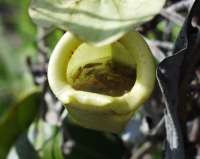
In South-East Asia, the leaves of the carnivorous plant Nepenthes rafflesiana mimic flowers biochemically in order to trap insects.
Attracted by a broad range of volatile compounds comparable to those classically emitted by flowers, the insects are trapped in the pitcher-shaped leaves of the plant. This discovery, published in the Journal of Ecology, was made by biologists and chemists in the Laboratoire Botanique et Bioinformatique de l'Architecture des Plantes (France) and at the University of Brunei in Borneo.
Carnivorous plants have adapted to their nutrient poor environment by trapping and digesting small animals, mainly insects. Of these plants, Nepenthes rafflesiana, which is abundant in northern Borneo, has pitcher-shaped leaves containing a sticky "saliva" that entraps the insects and prevents their escape. These leaves have developed a whole range of traits that are common to those of flowers: they produce nectar, their colors are often bright and they are covered with ultraviolet patterns that have long intrigued scientists, starting with Darwin.
By working with chemists, Bruno Di Giusto, Michaël Guéroult and Laurence Gaume-Vial, have shown that these leaves are also able to produce floral odors to attract their prey. This discovery was based on the observation that depending on their situation on the plant (at ground level or in the air), the pitchers did not capture the same prey. Indeed, the upper, or aerial, pitchers of the plant have a pleasant odor and trap a wide variety of insects, while pitchers at ground level emit little odor and mainly capture ants.
First of all, the researchers compared in the field the insects that visited these two types of pitcher. Aerial pitchers, even when they were placed on the ground, attracted more insects than ground pitchers, and notably a wide variety of the insects that normally consume flower nectar or pollen: flies, mosquitoes, butterflies, beetles, bees, wasps, etc. The team then performed olfactory experiments on the insects using olfactometers. Ants (normally visitors to leaves) and flies (normally visitors to flowers), had to choose between a control compartment containing only pulsed air, and another containing pulsed air and the scents of freshly cut pitchers. The researchers observed that in the absence of any visual stimulus, the insects preferred to visit the odorant compartment, and the flies were more attracted by the scent of aerial pitchers than that of ground pitchers.
In parallel, the scientists harvested the odors emitted by pitchers attached to their plants using an adsorption-desorption technique: they sealed the pitcher in an odorless plastic bag in which air was circulated and then recovered the odorant volatile compounds on filters. The latter where then exported to France for analysis by the Chemical Ecology Platform of the CEFE in Montpellier, and identified by the chemist Jean-Marie Bessičre.
Overall, the results showed that the aerial leaf traps of Nepenthes rafflesiana produce a variety of volatile compounds, fatty acid derivatives and particularly the benzene and terpene compounds that are commonly emitted by generalist pollinating flowers (pollinated by different types of insects) together with a large quantity of some rare compounds with sweet and sugary odors. Ground pitchers, produced by the plant during its juvenile phase, emitted far fewer aromatic compounds and mainly attracted ants. Aerial pitchers (produced when the plant had become adult and was climbing) emitted an abundance of these odors, enabling them to broaden their spectrum of prey to a range of flying insects, and typically those that visit flowers.
These scent traps may provide an inspiration for programs to control the pests that attack crops, or disease vectors such as mosquitoes. One of the many questions that are now being addressed by the scientists is to determine how the plant manages not to capture its own pollinators...
More information: Flower-scent mimicry masks a deadly trap in the carnivorous plant Nepenthes rafflesiana. Bruno Di Giusto, Jean-Marie Bessičre, Michael Guéroult, Linda B. L. Lim, David J. Marshall, Martine Hossaert-McKey and Laurence Gaume. Journal of Ecology.
Provided by CNRS


