Funnel vision: New info about how cells in the eye help guide light into the retina
May 9, 2010 By Phillip F. Schewe
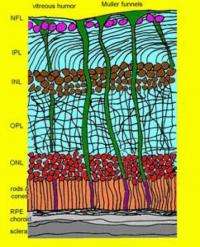
Diagram of the human retina. Outside light passes through the bulk of the eye, a material called the vitreous humor. Then it strikes the top of the retina and is channeled by glial cells (referred to in the diagram as “Muller funnels”) down to the rod and cone cells (orange color) at the bottom of the retina; there the light is absorbed. Credit: Erez Ribak
The eyes are marvelous instruments for converting outside reality into images lodged inside our brains. A new study of the retina, the light-sensitive region at the back of the eye, solves a mystery as to why the images we see are so sharp.
The light-sensitive cells in the retina -- rod-shaped cells, which can process very low levels of light, and cone-shaped cells, responsible for perceiving color -- pass their electrical signals along to neurons, lengthy cells which, when bundled together as the optic nerve, carry visual information deep into the brain.
Strangely, the neurons which govern this delicate process lie in front of -- not behind -- the receiving rod and cone cells. Even though these neurons are transparent to light, their wrinkled shape distorts the light as it passes through on its way toward the rods and cones. Why aren't the neurons underneath the light-sensitive cells, where they won’t distort the incoming image of the outside world?
The mystery has now been solved by explaining the role of glial cells. Glial cells perform a number of roles around the body, such as bringing nutrients to other cells or holding them in place. This is especially important for glial cells in the brain; they are sometimes referred to as the “glue" of the brain.
Glial cells are also present among the neurons lying above the cones and rods in the retina. A number of years ago experimenters showed that glial cells don’t serve as mere scaffolding for other cells, but can actually channel light and therefore help to facilitate human vision.
Now scientists in Israel have gone the next step by providing a detailed description of how glial cells produce sharp images. Erez N. Ribak and his student Amichai Labin at the Technion- Israel Institute of Technology in Haifa, have shown how the vertically-oriented glial cells -- extending from the top to the bottom of the retina -- can funnel light through the neurons and the other layers of the retina down to the photo-sensitive cells -- the rod and cone cells -- where the light is absorbed. In other words, the glial cells are acting as light pipes for delivering visual images of the outside world into the brain.
Furthermore, because of the geometry of the light-guiding glial cells, only light that comes in at pretty a straight-on direction will make it all the way down to where the photo-cells are waiting. Light arriving at oblique angles might enter a glial cell but will not be successfully guided downwards. Instead it will be scattered off to the side. This is origin of our sharp vision.
Ribak and Labin reported their explanation in a recent upcoming issue of the journal Physical Review Letters.
Source: Inside Science News Service
-
Post brain injury: New nerve cells originate from neural stem cells
Mar 11, 2008 |
not rated yet |
0
-
An 'eye catching' vision discovery
Jul 26, 2009 |
not rated yet |
0
-
Milestone in the regeneration of brain cells
Aug 20, 2007 |
not rated yet |
0
-
Double agent: Glial cells can protect or kill neurons, vision
Feb 01, 2010 |
not rated yet |
0
-
Fish eyes could hold clue to repairing damaged retinas in humans
Jul 31, 2007 |
not rated yet |
0
-
Engineers build first sub-10-nm carbon nanotube transistor
Feb 01, 2012 |
4.9 / 5 (30) |
30
-
Something old, something new: Evolution and the structural divergence of duplicate genes
Jan 31, 2012 |
4.6 / 5 (7) |
1
-
The hidden nanoworld of ice crystals: Revealing the dynamic behavior of quasi-liquid layers
Jan 30, 2012 |
5 / 5 (3) |
1
-
Stock market network reveals investor clustering
Jan 27, 2012 |
3.9 / 5 (23) |
8
-
Of microchemistry and molecules: Electronic microfluidic device synthesizes biocompatible probes
Jan 26, 2012 |
5 / 5 (1) |
0
-
A grandfather pulls his granddaughter, whose mass is 20.5 kg
2 hours ago
-
what is significance of torque
2 hours ago
-
Difference between volume displaced fluid and volume of the object
3 hours ago
-
Questions about Galileo statement?
3 hours ago
-
Question on Kirchoff's Laws
7 hours ago
-
Changes in Water Weight
9 hours ago
- More from Physics Forums - General Physics
More news stories
Borexino Collaboration succeeds in spotting pep neutrinos emitted from the sun
(PhysOrg.com) -- To learn more about how the sun works, scientists study particles that are emitted from it into space due to thermonuclear reactions that occur inside; by applying known physics principles, ...
Explained: Sigma
It's a question that arises with virtually every major new finding in science or medicine: What makes a result reliable enough to be taken seriously? The answer has to do with statistical significance -- but ...
16 hours ago |
5 / 5 (10) |
29
Physics research suggests new pathways for cancer progression
Observing that certain cancer cells may exhibit greater flexibility than normal cells, some scientists believe that this capability promotes rapid tumor growth. Now computer simulations developed by Boston University Biomedical ...
14 hours ago |
5 / 5 (1) |
0
Quantum physicist explains $100K offer for proof scaled-up quantum computing is impossible
(PhysOrg.com) -- MIT researcher Scott Aaronson has certainly riled the physics community with his offer this past Friday, of $100,000 to anyone who can prove that scaled-up quantum computing is impossible. ...
Physicists 'record' magnetic breakthrough
An international team of scientists has demonstrated a revolutionary new way of magnetic recording which will allow information to be processed hundreds of times faster than by current hard drive technology.
Feb 07, 2012 |
4.5 / 5 (39) |
14
|
'Dark plasmons' transmit energy
Microscopic channels of gold nanoparticles have the ability to transmit electromagnetic energy that starts as light and propagates via "dark plasmons," according to researchers at Rice University.
FDA-approved drug rapidly clears amyloid from the brain, reverses Alzheimer's symptoms in mice
Neuroscientists at Case Western Reserve University School of Medicine have made a dramatic breakthrough in their efforts to find a cure for Alzheimer's disease. The researchers' findings, published in the journal Science, show t ...
Hydrogen from acidic water: Researchers develop potential low cost alternative to platinum for splitting water
A technique for creating a new molecule that structurally and chemically replicates the active part of the widely used industrial catalyst molybdenite has been developed by researchers with the Lawrence Berkeley ...
Ultraviolet protection molecule in plants yields its secrets
Lying around in the sun all day is hazardous not just for humans but also for plants, which have no means of escape. Ultraviolet (UV) radiation from the sun can damage proteins and DNA inside cells, leading ...
Anyone can learn to be more inventive, cognitive researcher says
There will always be a wild and unpredictable quality to creativity and invention, says Anthony McCaffrey, a cognitive psychology researcher at the University of Massachusetts Amherst, because an "Aha moment" is rare and ...
New method makes culture of complex tissue possible in any lab
Scientists at the University of California, San Diego have developed a new method for making scaffolds for culturing tissue in three-dimensional arrangements that mimic those in the body. This advance, published online in ...
May 09, 2010
Rank: 2 / 5 (2)
In fact, this seemingly mistaken arrangement is a construction feature, because it enables light ray to pass twice-times the single place at retina, thus increasing its light efficiency in 50%. It "just" requires to solve additional construction problems, one of which is discussed in the above article.
May 09, 2010
Rank: 4.3 / 5 (3)
May 10, 2010
Rank: 1 / 5 (1)
May 16, 2010
Rank: not rated yet
Since then, an accumulation of mutations has left us weaker, sicker and shorter lived. We have been able to compensate somewhat with civilization and technology, but we still age and die.
"...through one man sin entered the world, and death through sin, and thus death spread to all men, because all sinned." This isn't the entire story; that's too far off topic to write here. You can read more of it at http://www.bibleg...h=romans 5&version=NKJ