Researchers study knife-wielding robots (w/ Video)
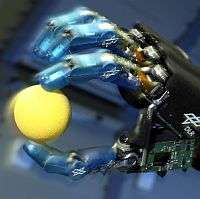
May 10, 2010 by Lin Edwards
Image credit: German Aerospace Center
(PhysOrg.com) -- Many people have dreamed of robots helping around the house, vacuuming the carpets, making the beds, and chopping vegetables in the kitchen. Now a new study has found such robots could pose a danger to humans if they use sharp implements such as steak knives.
The researchers were from the Institute of Robotics and Mechatronics, which is a branch of DLR, the German Aerospace Center at Wessling. They used a 14 kg DLR Lightweight Robot III robot arm capable of holding a range of knives, scissors, a scalpel, and a screwdriver. The articulated arm has a reach of 1.1 meters, and is moderately flexible, and unlike other robots is fitted with position sensors and torque sensors in every joint.
The aims of the experiments were to determine what would happen if domestic robots were trained to use bladed tools commonly found in the home and accidentally struck human soft tissue, and to develop a collision detection system to limit injuries. The results showed in some scenarios when the safety system was turned off the robots inflicted wounds that could have been lethal.
This video is not supported by your browser at this time.
The robot arm was programmed to use the tools to cut, puncture, and stab at different speeds. Tests were carried out on a leg of pork and a lump of silicone, materials simulating human soft tissue. The robot used different maneuvers to strike the materials. Limited tests were also carried out on the arm of a human volunteer (leader of the research team, Sami Haddadin), and in this case a safety system including a prototype collision detector developed by the research team was turned on to limit injuries.When the robot was used with the silicone and pork leg the safety system was turned off and the puncture and stab wounds produced by the robot arm were deep and in some cases would have been serious enough to be lethal if made on a living subject. With the safety system turned on the depth of cuts was reduced and sometimes were prevented altogether.
The research is believed to be the first to study injuries from bladed tools, although there have been studies of injuries that could be inflicted by robots bumping into people. The paper was presented last week by scientists Sami Haddadin, Gerd Hirzinger and Alin Albu-Schaffer at the IEEE International Conference on Robotics and Automation (ICRA 2010) in Alaska.
This video is not supported by your browser at this time.
The scientists say they have reservations about ever training robots to use knives and other bladed tools in the home, but their research and the safety system they developed will help researchers to develop safer robots.© 2010 PhysOrg.com
-
Scientists study robot-human interactions
Aug 30, 2006 |
not rated yet |
0
-
Care-O-bot 3: Always at your service
Jul 01, 2008 |
not rated yet |
0
-
Can you trust a robot to work safely with you in the kitchen?
May 14, 2008 |
not rated yet |
0
-
Futuristic robots, friend or foe?
Apr 22, 2008 |
not rated yet |
0
-
Japanese professor creates baseball-playing robots
Jul 24, 2009 |
not rated yet |
0
-
Engineers build first sub-10-nm carbon nanotube transistor
Feb 01, 2012 |
4.9 / 5 (31) |
30
-
Something old, something new: Evolution and the structural divergence of duplicate genes
Jan 31, 2012 |
4.6 / 5 (7) |
1
-
The hidden nanoworld of ice crystals: Revealing the dynamic behavior of quasi-liquid layers
Jan 30, 2012 |
5 / 5 (3) |
1
-
Stock market network reveals investor clustering
Jan 27, 2012 |
3.9 / 5 (23) |
8
-
Of microchemistry and molecules: Electronic microfluidic device synthesizes biocompatible probes
Jan 26, 2012 |
5 / 5 (1) |
0
-
Calling function with no input argument
14 hours ago
-
Force free body diagram problem on gym equipment
15 hours ago
-
Empirical data regarding shower heads and water
23 hours ago
-
feed hold button on CNC lathe
Feb 09, 2012
-
RFAC in Fortran
Feb 09, 2012
-
dynamics 2/32
Feb 08, 2012
- More from Physics Forums - General Engineering
More news stories
Japan scientist makes 'Avatar' robot
A Japanese-developed robot that mimics the movements of its human controller is bringing the Hollywood blockbuster "Avatar" one step closer to reality.
20 hours ago |
5 / 5 (6) |
8
Intel packs performance and reliability into its latest SSD 520 series
Intel Corporation announced today its fastest, most robust client/consumer solid-state drive (SSD) to date, the Intel Solid-State Drive 520 Series (Intel SSD 520), a 6 gigabit-per-second (gbps) SATA III SSD ...
Feb 07, 2012 |
5 / 5 (1) |
4
Google rumored to have built Heads-Up-Display glasses prototype
(PhysOrg.com) -- 9to5Google is reporting that they have received a tip from someone they believe to be a reliable source saying that Google is working on a Heads-Up-Display (HUD) pair of eye-glasses. The per ...
Apple to debut 'iPad 3' in March: report
Apple will unveil a new version of its market-ruling iPad table computer in March, according to a report in Dow Jones-owned technology blog All Things D.
Electronics / Consumer & Gadgets
Feb 09, 2012 |
1.9 / 5 (21) |
0
New Kindle Touch is an impressive e-reader
When it comes to reading digital books, tablets are all the rage. But there's a lot to like about simple e-readers, which over the past year have become both a lot cheaper and a lot less clunky.
Electronics / Consumer & Gadgets
Feb 09, 2012 |
5 / 5 (3) |
1
Anonymous knocks CIA website offline (Update)
The website of the Central Intelligence Agency was inaccessible on Friday after the hacker group Anonymous claimed to have knocked it offline.
Google users warned of threat to smartphone wallets
Users of Google smartphone wallets were being warned on Friday that there is a way to crack pass codes intended to thwart thieves from going on illicit shopping sprees.
New error-correcting codes guarantee the fastest possible rate of data transmission
Error-correcting codes are one of the triumphs of the digital age. Theyre a way of encoding information so that it can be transmitted across a communication channel such as an optical fiber o ...
Humans may have helped the decline of African rainforests 3000 years ago
(PhysOrg.com) -- Large areas of rainforests in Central Africa mysteriously disappeared over three thousand years ago, to be replaced by savannas. The prevailing theory has been that the cause was a change ...
New power source discovered
(PhysOrg.com) -- Researchers at the Massachusetts Institute of Technology (MIT) and RMIT University have made a breakthrough in energy storage and power generation.
The power of estrogen -- male snakes attract other males
A new study has shown that boosting the estrogen levels of male garter snakes causes them to secrete the same pheromones that females use to attract suitors, and turned the males into just about the sexiest ...
May 10, 2010
Rank: not rated yet
May 10, 2010
Rank: not rated yet
May 10, 2010
Rank: 5 / 5 (2)
1.)Researchers study knife wielding monkeys.
2.)Researchers study knife wielding babies.
3.)etc.
Anything is dangerous with a knife, robots shouldn't be any different. There are plenty of non-knife activities that a robot could do that could kill you. Teaching them to use sharp objects is necessary and no more dangerous than teaching them to turn on a stove.
And to all soon to come terminator comments. Robots will be used to murder and for evil, we already know that. As long as there are technologies and criminals, somebody will use them for evil. This is just something we need to accept if we want robots to improve our lives. If someone can hack a computer browser, they can disable safety protocols on robots.