Next generation hard drives may store 10 terabits per sq inch: research
May 10, 2010 by Lin Edwards
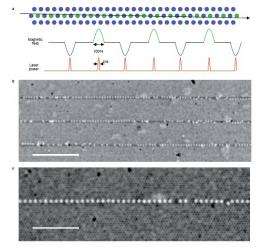
Bit addressing during TAR writing on bit patterned media. a, Schematic of the head path and write waveforms during experiment. Both up and down orientations were written. The head path is purposefully misaligned to the track direction by a fraction of a degree. Initial phase is random with each track. Write frequency was incremented by 1% between tracks. b, Large area HR-MFM image of resulting tracks. Scale bar, 1um. Single tone tracks at the highest data frequency are written properly with no adjacent track writing when the head is centered on the track and in phase with the island positions. Nebulous light regions are due to reversal of the soft magnetic material in the trenches between islands. c, Close-up HR-MFM image of a single track. 60 islands are written correctly before the write phase and track centering drift too far. Scale bar, 500nm. Image credit Nature Photonics, doi:10.1038/nphoton.2010.90.
(PhysOrg.com) -- The majority of today's hard disks use perpendicular recording, which means their storage densities are limited to a few hundred gigabytes per square inch. Scientists have for some time been trying to find ways of increasing the limit, and a new method has been proposed that could stretch the limit as high as ten terabits (Tb) per square inch.
The research, published in this week’s Nature Photonics, has found a method that combines two writing procedures to store data on hard drives. Each procedure writes tightly packed data without affecting data on the bits surrounding it and avoiding the usual challenge with tightly packing data, which is that the heat generated in the write head can create superparamagnetisim that can interfere with surrounding bits and jumble the data on them (by flipping a 0 state to 1 or vice versa).
One of the procedures used is bit-patterned recording (BPR), which writes to “magnetic islands” lithographed into the surface, which isolate the write events and prevent superparamagnetic effects occurring. The other is thermally-assisted magnetic recording (TAR), in which a tiny region of the surface is heated when data are being written and then cooled. The heat allows the surface to magnetize quickly, and this, the small-grained design of the surface, and the distance between bits all help to prevent superparamagnetisim.
The two methods both present difficulties: BPR is limited by the need for a write head that exactly matches the size of the magnetic islands, while TAR is limited by its need for small grain media that can tolerate heating and cooling, and the difficulty of controlling the area heated. It turns out that combining the two methods solves all the problems. BPR’s magnetic islands remove the need for small grain media, and TAR writes only to the heated bit, so the size of the write head is less important. Using the two methods in combination means surrounding bits are unaffected, and data can be tightly packed on less expensive surfaces.
The new system, developed by Barry C. Stipe and colleagues from Hitachi research groups in California and Japan, uses a plasmonic nano-antenna to write the data, with laser light guided via a waveguide to the antenna, where it is transformed into a charge. The “E-shaped” antenna has a 20-25 nanometer (nm) wide middle prong that concentrates the charge on an area as tiny as 15 nm in diameter, rather like a lightning rod, with the outer prongs acting as grounds.
The write speed obtained by the researchers was 250 megabits per second and the error rate was low. Data tracks were separated by 24 nm, and the researchers obtained a data storage density of one terabit per square inch of high-quality data quite easily. The researchers believe 10 terabits per square inch is theoretically possible.
More information: Magnetic recording at 1.5 Pb m^(−2) using an integrated plasmonic antenna, Barry C. Stipe et al., Nature Photonics, Published online: 2 May 2010. doi:10.1038/nphoton.2010.90
© 2010 PhysOrg.com
-
InPhase Demos 515 Gigabits Per Square Inch Data Density
Mar 27, 2006 |
not rated yet |
0
-
Perpendicular Magnetic Recording Beyond 1 Tbit/in<sup>2</sup>
Apr 27, 2004 |
not rated yet |
0
-
Fujitsu Develops Optical Element for Thermal Assisted Magnetic Recording
Nov 28, 2006 |
not rated yet |
0
-
IBM Research Sets New Record in Magnetic Tape Data Density (w/ Video)
Jan 22, 2010 |
not rated yet |
0
-
Scientists post a lower speed limit for magnetic recording
May 17, 2004 |
not rated yet |
0
-
Engineers build first sub-10-nm carbon nanotube transistor
Feb 01, 2012 |
4.9 / 5 (31) |
30
-
Something old, something new: Evolution and the structural divergence of duplicate genes
Jan 31, 2012 |
4.6 / 5 (7) |
1
-
The hidden nanoworld of ice crystals: Revealing the dynamic behavior of quasi-liquid layers
Jan 30, 2012 |
5 / 5 (3) |
1
-
Stock market network reveals investor clustering
Jan 27, 2012 |
3.9 / 5 (23) |
8
-
Of microchemistry and molecules: Electronic microfluidic device synthesizes biocompatible probes
Jan 26, 2012 |
5 / 5 (1) |
0
-
Simple Torque from Gravity Problem
1 hour ago
-
Books To Inspire a Beginnig Physics Student
2 hours ago
-
Pith balls problem
3 hours ago
-
Electrostatics
3 hours ago
-
what is phase constant
3 hours ago
-
Basics In electromagnetic wave
3 hours ago
- More from Physics Forums - General Physics
More news stories
Putting the squeeze on planets outside our solar system
(PhysOrg.com) -- Using high-powered lasers, scientists at Lawrence Livermore National Laboratory and collaborators discovered that molten magnesium silicate undergoes a phase change in the liquid state, abruptly ...
14 hours ago |
4.3 / 5 (7) |
0
|
Hovering not hard if you're top-heavy, researchers find
Top-heavy structures are more likely to maintain their balance while hovering in the air than are those that bear a lower center of gravity, researchers at New York University's Courant Institute of Mathematical Sciences ...
15 hours ago |
5 / 5 (1) |
1
|
SLAC, Stanford team focuses on high-energy electrons to treat cancer
Accelerator physicists at SLAC and cancer specialists from Stanford are working on a new technology that could dramatically reduce the time needed for cancer radiation treatments. The team ran an initial experiment ...
18 hours ago |
5 / 5 (2) |
0
Measurements from high-energy collisions lead to better understanding of why meson particles disappear
For several years, physicists at the Relativistic Heavy Ion Collider (RHIC) at Brookhaven National Laboratory (BNL), USA, have studied an unusual state of matter called the quarkgluon plasma, which they ...
18 hours ago |
4.5 / 5 (4) |
0
Explained: Sigma
It's a question that arises with virtually every major new finding in science or medicine: What makes a result reliable enough to be taken seriously? The answer has to do with statistical significance -- but ...
Feb 09, 2012 |
5 / 5 (16) |
53
Anonymous knocks CIA website offline (Update)
The website of the Central Intelligence Agency was inaccessible on Friday after the hacker group Anonymous claimed to have knocked it offline.
New error-correcting codes guarantee the fastest possible rate of data transmission
Error-correcting codes are one of the triumphs of the digital age. Theyre a way of encoding information so that it can be transmitted across a communication channel such as an optical fiber o ...
Humans may have helped the decline of African rainforests 3000 years ago
(PhysOrg.com) -- Large areas of rainforests in Central Africa mysteriously disappeared over three thousand years ago, to be replaced by savannas. The prevailing theory has been that the cause was a change ...
New power source discovered
(PhysOrg.com) -- Researchers at the Massachusetts Institute of Technology (MIT) and RMIT University have made a breakthrough in energy storage and power generation.
Google users warned of threat to smartphone wallets
Users of Google smartphone wallets were being warned on Friday that there is a way to crack pass codes intended to thwart thieves from going on illicit shopping sprees.
Small modular reactor design could be a 'SUPERSTAR'
(PhysOrg.com) -- Though most of today's nuclear reactors are cooled by water, we've long known that there are alternatives; in fact, the world's first nuclear-powered electricity in 1951 came from a reactor ...
May 10, 2010
Rank: 1.6 / 5 (7)
What in the world are we going to do with that much information? They just quintupled the data density, and theorize another order of magnitude increase, and I don't even remotely use the 300GB Hard Drive I have now...
I can see uses for this regarding security camera data storage and as well stellar cartography, since there are more stars "out there" than there are grains of sand on the earth, but eventually there just isn't going to be any need for any more data storage except in space exploration and colonizing other planets.
May 10, 2010
Rank: 5 / 5 (2)
May 10, 2010
Rank: not rated yet
Ferroelectric/multiferroics can already
write and read at 3-5nm so what's the big deal.
May 10, 2010
Rank: 5 / 5 (5)
May 10, 2010
Rank: 5 / 5 (5)
May 10, 2010
Rank: not rated yet
May 10, 2010
Rank: not rated yet
I've thought of that, but the computer technology will likely be waiting around for decades before such a device is invented, if it ever is invented.
One could calculate how much "3d video RAM" you would need to project a holographic environment into a 10ftx10ftx10ft room(1000 cubic feet).
The highest screen resolution I know of for video today is 2400x1600, which I think is on a 21 inch monitor. That comes to about 17.5x11 inches, which is close to 140 pixels in a line an inch long. So to figure how much stronger the "video card" would need to be for a hologram you could just do some divisions and conversions.
140 per inch
140^2 per inch^2 (Existing, across ~192.5inches^2)
140^3 per inch^3 (across 10ft^3)
So the total number of "pixels" would be:
140^3 * 10^3 * 12^3 = 4.741632*10^12 pixels.
Now to find out how many moore's laws cycles before a video card can do that...see next post...
May 10, 2010
Rank: 5 / 5 (1)
The LHC produces 20 petabytes of information each year. Currently sensors are *limited* by storage capacity/speed. Increase capacity and speed and we'll get more sensors and more data to analyze.
May 10, 2010
Rank: not rated yet
divide needed pixels for a 10ft^3 room by the existing pixels for an existing monitor at max resolution on the best video card.
4.741632*10^12 / ((140^2 * 192.5)) = 1256727
So a 10ft cubed holodeck would need 1,256,727 times as much processor power and RAM as the best existing video card in order to have the same pixel density and color depth.
Moore's law will tell us how many years it would take to have a video card capable of doing this:
2^X = N
N = 1,256,727
Then X ~ 20.26
X is the number of doublings given the same area, and Moore's law predicts a doubling every 1.5 to 2 years, so you are looking at 30-40 years before a computer could run a holodeck program...
However, it would take several hundred years for any software company to actually make an interactive holodeck gaming program, other than something simple like 3d pong, or just pure "3d-video".
May 10, 2010
Rank: not rated yet
140^2 * 10^2 * 6 * 12^2 = 1.69344*10^9 pixels.
Which is significantly less pixels than a "true" holodeck (~3000 times less).
1.69344*10^9 / (140^2 * 192.5) = 448.83
2^X = N
N = 448.83
so X ~ 8.81
or 8.81 doublings.
so...
Making a video card capable of running this "fake holodeck" would be doable in approximately 13.22-17.6 years...and "should" sell for approximately the same price as the existing top of the line video card.
May 10, 2010
Rank: 1 / 5 (2)
May 10, 2010
Rank: not rated yet
May 10, 2010
Rank: 5 / 5 (1)
May 11, 2010
Rank: not rated yet
May 11, 2010
Rank: not rated yet
May 11, 2010
Rank: not rated yet
holodeck is for people w/o brain chips... too scary for some people. not me
May 11, 2010
Rank: 1 / 5 (1)
Backing stuff up.
May 12, 2010
Rank: not rated yet
May 15, 2010
Rank: not rated yet
People said the same thing when RAM was measured by the kilobyte. It's not a matter of applying current applications, it's a matter of future applications that will be enabled that we do not know of yet. Otherwise you're comparing apples to oranges.
May 15, 2010
Rank: not rated yet
May 16, 2010
Rank: not rated yet
1tbit density was the limit of the experiment and the write performance of 250mbit/sec (31.25MB/sec).
This may well signal significant improvements in storage densities but the wording and use of terms is either a typo or exceedingly dishonest in my opinion.
May 17, 2010
Rank: 1 / 5 (1)