X-rays reveal chemical link between birds and dinosaurs
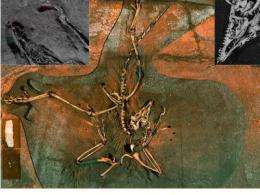
Researchers have found that a 150 million year old "dinobird" fossil, long thought to contain nothing but fossilized bone and rock, has been hiding remnants of the animal's original chemistry. Using the bright X-ray beam of the Stanford Synchrotron Radiation Lightsource, located at the Department of Energy's SLAC National Accelerator Laboratory, an international team of paleontologists, geochemists and physicists has revealed this transformative glimpse into one of the most important fossils ever discovered: the Archaeopteryx, a half-dinosaur/half-bird species.
"Archaeopteryx is to paleontology what Tutankhamen is to archaeology. It's simply one of the icons of our field," said University of Manchester paleontologist Phil Manning. "You would think after 150 years of study, we'd know everything we need to know about this animal. But guess what—we were wrong."
When the first Archaeopteryx specimen was uncovered a century and a half ago, just a year after Charles Darwin published On the Origin of Species, the discovery provided the strongest evidence yet for the theory of evolution. In the intervening years, nine additional specimens have been found, including the Thermopolis specimen that the researchers studied at SSRL. Like the other Archaeopteryx specimens, this fossil has undergone extensive visual analyses and even CT scans in the past, none of which revealed that beneath the surface hid the dinobird's chemical remains. But that was before researchers placed it under the X-ray beam at SSRL.
Using light source technology primarily utilized for advanced energy-related research in materials science, biology, and other fields, the scientists traced SSRL's hair-thin X-ray beam across the Thermopolis Archaeopteryx fossil. By recording how the X-rays interacted with the fossil, the researchers were able to identify very precisely the locations of chemical elements hidden within. From this, they created the first maps of the dinobird's chemistry, revealing half a dozen chemical elements that were actually part of the living animal itself. In almost every element studied, the researchers found significantly different concentrations in the fossil than in the rock that surrounds it, confirming that the observed elements are indeed remnants of the dinobird and not merely chemicals that leached from the surrounding rock into the fossil.
"People have never used a technique this sensitive on Archaeopteryx before," said SLAC physicist Uwe Bergmann, who led the X-ray scanning experiment. "Because the SSRL beam is so bright, we were able to see the teeniest chemical traces that nobody thought were there."
The chemical maps, published today in Proceedings of National Academy of Science, show that portions of the feathers are not merely impressions of long-decomposed organic material—as was previously believed—but actual fossilized feathers that contain phosphorous and sulfur, elements that comprise modern bird feathers. Trace amounts of copper and zinc were also found in the dinobird's bones; like birds today, the Archaeopteryx may have required these elements to stay healthy.
"We talk about the physical link between birds and dinosaurs, and now we have found a chemical link between them," said University of Manchester geochemist Roy Wogelius, corresponding author on the paper. "In the fields of paleontology and geology, people have studied bones for decades. But this whole idea of the preservation of trace metals and the chemical remains of soft tissue is quite exciting."
"The discovery that certain fossils retain the detailed chemistry of the original organisms offers scientists a new avenue for learning about long-extinct creatures", said CMW Institute researcher Bob Morton.
As a result, the research has the potential to change the way a paleontologist views a fossil. "We're able to read so much more into these organisms now using this technology—we're literally touching ghosts," said Wogelius. "Chemistry is the real key in the future of paleontology. It's a paradigm shift."
However, only bones and fossils that have not been removed from the surrounding rock and soil—as with the Thermopolis Archaeopteryx—are best suited for this type of analysis. That's because it's necessary for researchers to compare the elements found within the specimen to those found within the neighboring rock or soil in order to be able to account for transfer from one to the other.
As a result of this work, Manning said, he wouldn't be surprised if "future excavations look more like CSI investigations where people look for clues at a scene of a crime. There's info that's still there that can't be seen with the naked eye. We can only see these really quite valuable pieces of data with the synchrotron eye."
Provided by SLAC National Accelerator Laboratory


.jpg)


