Astronomers plan second look at mega star birthing grounds
May 10, 2010
Astronomers plan second look at mega star birthing grounds

Enlarge

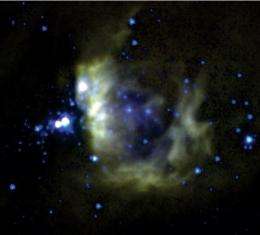
This is a mid-infrared image of a giant cloud obtained by NASA’s Spitzer Space Telescope. The yellowish wisps to the right are remnants of gas that have been heated and are being driven off by the massive young stars within them, seen in blue. The large-scale collapse of colder gas to form a massive cluster is centered around the bright stars just to the left of the heated wisps. An international team of astronomers used an Australian radio telescope to find the cloud of gas and dust 8,000 light years away in the Southern sky constellation Carina. The cloud is in the early stages of collapsing in on itself, offering astronomers an unusual vista on the first contractions of behemoth star birth. (NASA/JPL-Caltech)

(PhysOrg.com) -- Astronomers this summer will take a close look at a rare cosmic cradle for the universe's largest stars, baby bruisers that grow up to have 50 times the sun's mass.

The international team of headed by University of Florida scientist Peter Barnes used an Australian radio telescope to find the cloud of gas and dust 8,000 away in the Southern sky constellation Carina. The cloud is in the early stages of collapsing in on itself, offering astronomers an unusual vista on the first contractions of behemoth .

"We understand some of it, but we really don't have a clear picture of what's important," Barnes said. "This should help us learn a lot more about the process."

Although our sun has far less mass than the incipient in the , studying their formation could help astronomers understand how our solar system formed, Barnes said. That is because many stars the size of our sun are thought to have formed in clusters that dispersed into space over millions of years. It's possible, Barnes said, that our sun traces its origin to such a cluster, and in fact chemical anomalies on meteorites suggest that's the case.

The latest findings, which appeared in the monthly journal Notices of the Royal Astronomical Society, have spurred the team to plan a closer look with another Australian telescope in August. The team will also use the Gemini South telescope, equipped with a mid-infrared camera designed and built at UF, to observe the cloud from the telescope's location in Chile.

Stars at least 10 times the mass of our sun are rare, comprising only about 4 percent of those in the universe. Most are also at least 1,000 light years away and hard to study. It's exceptionally rare for astronomers to encounter clouds of gas and dust early in the process of collapsing into large stars because the stars tend to destroy their natal origins.

"They're rather nasty tykes," Barnes said. "They make a big mess."

The astronomers discovered the gas cloud as part of a survey of 300 large gas clouds using the Australia Telescope National Facility's 22-meter Mopra radio telescope in southeastern Australia. The telescope's world-class spectrometer allows astronomers to identify and image carbon monoxide and other molecules in large gas clouds. Even with that technology, the mega star birthing cloud was the only one of its kind among the 300 surveyed.

The cloud is also unusual in its rapid pace of collapse and the amount of dust and gas, an amount so large it eclipsed the large stars that had already coalesced inside the cloud. "It is a few light years across, and it has maybe 20,000 times the sun's mass worth of gas and dust, and most of that is participating in the collapse," Barnes said.

Provided by University of Florida (news : web)

4.8 /5 (6 votes)  

Rank 4.8 /5 (6 votes)
Related Stories
Relevant PhysicsForums posts
  • Titan's lack of impact craters
    createdFeb 09, 2012
  • Real pictures of black hole eating a star?
    createdFeb 08, 2012
  • Hypothetical way to travel faster than light, but not technically exceed lightspeed
    createdFeb 06, 2012
  • How do scientists monitor the Sun's activity?
    createdFeb 05, 2012
  • Search patterns in observational studies
    createdFeb 05, 2012
  • Derivation of Pogson's law
    createdFeb 03, 2012
  • More from Physics Forums - General Astronomy

More news stories

Humans may have helped the decline of African rainforests 3000 years ago

(PhysOrg.com) -- Large areas of rainforests in Central Africa mysteriously disappeared over three thousand years ago, to be replaced by savannas. The prevailing theory has been that the cause was a change ...

Space & Earth / Environment

created 11 hours ago | popularity 4.2 / 5 (5) | comments 10 | with audio podcast report

Could Venus be shifting gear?

(PhysOrg.com) -- ESA’s Venus Express spacecraft has discovered that our cloud-covered neighbour spins a little slower than previously measured. Peering through the dense atmosphere in the infrared, the ...

Space & Earth / Space Exploration

created 7 hours ago | popularity 5 / 5 (5) | comments 7 | with audio podcast

Mars Science Laboratory computer issue resolved

(PhysOrg.com) -- Engineers have found the root cause of a computer reset that occurred two months ago on NASA's Mars Science Laboratory and have determined how to correct it.

Space & Earth / Space Exploration

created 8 hours ago | popularity 5 / 5 (5) | comments 3 | with audio podcast

Clam fields found at deep, low-temperature Mariana vents

(PhysOrg.com) -- Scientists have marveled at the unusual life forms thriving at high temperature hydrothermal vents of the deep ocean.

Space & Earth / Earth Sciences

created 8 hours ago | popularity not rated yet | comments 0 | with audio podcast

NASA budget will axe Mars deal with Europe: scientists

US President Barack Obama's budget proposal to be submitted next week for 2013 will cut NASA's budget by 20 percent and eliminate a major partnership with Europe on Mars exploration, scientists said Thursday.

Space & Earth / Space Exploration

created 10 hours ago | popularity 5 / 5 (1) | comments 15


CIA website offline, Anonymous takes credit

The website of the Central Intelligence Agency was unresponsive on Friday after the hacker group Anonymous claimed to have knocked it offline.

Q&A: Obama and the birth control controversy

(AP) -- What birth control debate? A half-century after the introduction of the pill, acceptance of birth control by American women is virtually universal.

Complex wiring of the nervous system may rely on a just a handful of genes and proteins

Researchers at the Salk Institute have discovered a startling feature of early brain development that helps to explain how complex neuron wiring patterns are programmed using just a handful of critical genes. ...

The power of estrogen -- male snakes attract other males

A new study has shown that boosting the estrogen levels of male garter snakes causes them to secrete the same pheromones that females use to attract suitors, and turned the males into just about the sexiest ...

New error-correcting codes guarantee the fastest possible rate of data transmission

Error-correcting codes are one of the triumphs of the digital age. They’re a way of encoding information so that it can be transmitted across a communication channel — such as an optical fiber o ...

Curry spice component may help slow prostate tumor growth

Curcumin, an active component of the Indian curry spice turmeric, may help slow down tumor growth in castration-resistant prostate cancer patients on androgen deprivation therapy (ADT), a study from researchers ...