Untangling the quantum entanglement behind photosynthesis
May 10, 2010
Untangling the quantum entanglement behind photosynthesis

Enlarge

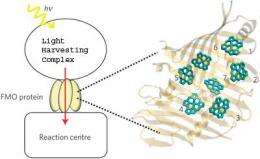
The schematic on the left shows the absorption of light by a light harvesting complex and the transport of the resulting excitation energy to the reaction center through the FMO protein. On the right is a monomer of the FMO protein, showing also its orientation relative to the antenna and the reaction center. The numbers label FMO's seven pigment molecules. Image from Mohan Sarovar

The future of clean green solar power may well hinge on scientists being able to unravel the mysteries of photosynthesis, the process by which green plants convert sunlight into electrochemical energy. To this end, researchers with the U.S. Department of Energy (DOE)'s Lawrence Berkeley National Laboratory (Berkeley Lab) and the University of California (UC), Berkeley have recorded the first observation and characterization of a critical physical phenomenon behind photosynthesis known as quantum entanglement.

Previous experiments led by Graham Fleming, a physical chemist holding joint appointments with Berkeley Lab and UC Berkeley, pointed to quantum mechanical effects as the key to the ability of green plants, through photosynthesis, to almost instantaneously transfer solar energy from molecules in light harvesting complexes to molecules in centers. Now a new collaborative team that includes Fleming have identified entanglement as a natural feature of these quantum effects. When two quantum-sized particles, for example a pair of electrons, are "entangled," any change to one will be instantly reflected in the other, no matter how far apart they might be. Though physically separated, the two particles act as a single entity.

"This is the first study to show that entanglement, perhaps the most distinctive property of quantum mechanical systems, is present across an entire light harvesting complex," says Mohan Sarovar, a post-doctoral researcher under UC Berkeley chemistry professor Birgitta Whaley at the Berkeley Center for Quantum Information and Computation. "While there have been prior investigations of entanglement in toy systems that were motivated by biology, this is the first instance in which entanglement has been examined and quantified in a real biological system."

The results of this study hold implications not only for the development of systems as a renewable non-polluting source of electrical energy, but also for the future development of quantum-based technologies in areas such as computing - a quantum computer could perform certain operations thousands of times faster than any conventional computer.

"The lessons we're learning about the quantum aspects of light harvesting in natural systems can be applied to the design of artificial photosynthetic systems that are even better," Sarovar says. "The organic structures in light harvesting complexes and their synthetic mimics could also serve as useful components of quantum computers or other quantum-enhanced devices, such as wires for the transfer of information."

What may prove to be this study's most significant revelation is that contrary to the popular scientific notion that entanglement is a fragile and exotic property, difficult to engineer and maintain, the Berkeley researchers have demonstrated that entanglement can exist and persist in the chaotic chemical complexity of a biological system.

"We present strong evidence for quantum entanglement in noisy non-equilibrium systems at high temperatures by determining the timescales and temperatures for which entanglement is observable in a protein structure that is central to photosynthesis in certain bacteria," Sarovar says.

Sarovar is a co-author with Fleming and Whaley of a paper describing this research that appears on-line in the journal Nature Physics titled "Quantum entanglement in photosynthetic light-harvesting complexes." Also co-authoring this paper was Akihito Ishizaki in Fleming's research group.

Green plants and certain bacteria are able to transfer the energy harvested from sunlight through a network of light harvesting pigment-protein complexes and into reaction centers with nearly 100-percent efficiency. Speed is the key - the transfer of the solar energy takes place so fast that little energy is wasted as heat. In 2007, Fleming and his research group reported the first direct evidence that this essentially instantaneous energy transfer was made possible by a remarkably long-lived, wavelike electronic quantum coherence.

Using electronic spectroscopy measurements made on a femtosecond (millionths of a billionth of a second) time-scale, Fleming and his group discovered the existence of "quantum beating" signals, coherent electronic oscillations in both donor and acceptor molecules. These oscillations are generated by the excitation energy from captured solar photons, like the waves formed when stones are tossed into a pond. The wavelike quality of the oscillations enables them to simultaneously sample all the potential energy transfer pathways in the photosynthetic system and choose the most efficient. Subsequent studies by Fleming and his group identified a closely packed pigment-protein complex in the light harvesting portion of the photosynthetic system as the source of coherent oscillations.

"Our results suggested that correlated protein environments surrounding pigment molecules (such as chlorophyll) preserve quantum coherence in photosynthetic complexes, allowing the excitation energy to move coherently in space, which in turn enables highly efficient energy harvesting and trapping in photosynthesis," Fleming says.

In this new study, a reliable model of light harvesting dynamics developed by Ishizaki and Fleming was combined with the quantum information research of Whaley and Sarovar to show that emerges as the quantum coherence in systems evolves. The focus of their study was the Fenna-Matthews-Olson (FMO) photosynthetic light-harvesting protein, a molecular complex found in green sulfur bacteria that is considered a model system for studying photosynthetic energy transfer because it consists of only seven pigment molecules whose chemistry has been well characterized.

"We found numerical evidence for the existence of entanglement in the FMO complex that persisted over picosecond timescales, essentially until the excitation energy was trapped by the reaction center," Sarovar says.

"This is remarkable in a biological or disordered system at physiological temperatures, and illustrates that non-equilibrium multipartite entanglement can exist for relatively long times, even in highly decoherent environments."

The research team also found that entanglement persisted across distances of about 30 angstroms (one angstrom is the diameter of a hydrogen atom), but this length-scale was viewed as a product of the relatively small size of the FMO complex, rather than a limitation of the effect itself.

"We expect that long-lived, non-equilibrium entanglement will also be present in larger light harvesting antenna complexes, such as LH1 and LH2, and that in such larger light harvesting complexes it may also be possible to create and support multiple excitations in order to access a richer variety of entangled states," says Sarovar.

The research team was surprised to see that significant entanglement persisted between molecules in the light harvesting complex that were not strongly coupled (connected) through their electronic and vibrational states. They were also surprised to see how little impact temperature had on the degree of entanglement.

"In the field of , temperature is usually considered very deleterious to quantum properties such as entanglement," Sarovar says. "But in systems such as light harvesting complexes, we see that can be relatively immune to the effects of increased temperature."

Provided by Lawrence Berkeley National Laboratory (news : web)

4.7 /5 (26 votes)  

Filter


Move the slider to adjust rank threshold, so that you can hide some of the comments.


Display comments: newest first

Alizee
May 10, 2010

Rank: 2.3 / 5 (4)
The pigment array in thylakoid lamellas i.e. quantasomes appear pretty similar to quantum dots arrays. Each quantasome contains about 230 to 300 chlorophyll molecules. They're regularly spaced in 150 x 180 A lattice, like quantum vortices in superconductors. All the molecules in each of these photo-synthetic units are spaced and oriented in such a way, captured photons are transferred from molecule to molecule by inductive resonance and the energy absorbed is transferred to as exciton.

Experiments have demonstrated, that the presence of the quantasome particles in chloroplast membrane is not a necessary condition for photoreduction activity of chloroplasts [J. Mol. Biol., 27, 323 (1967)] In prokaryotes pigments are distributed uniformly on or in the thylakoid lamellae.
VEERUNCLE
May 10, 2010

Rank: 1 / 5 (7)
In this Quantum World Of Beingness in the Cellular existence of Humankind, the allied and varied extant are distinctively in pleroma & plerosis (fullness) to create all of GENOME, not only the genes (1 lac) unto nucleosomes (30 millions) and nucleotides ( 3 to 4 billions). But even much beyond epigenome and epigenetics unto an imponderable state of Piezophotonics where Photons & Positrons are at Work in the subtlety of Quantum-myriad configured by the exquistie Permutation & Combination of TITHONS -which are the building constituents for all of Quantum Beingness.

These TITHONs rules the Orderliness of the NEURONS unto the NEURO-TRANSMITTERs to enable their catering of 'Cosmic Efficacy & Tithonicity', building inherency and intrinsicity of the QUALITATIVITY of A Beingness of a particular Being. Corroboratively, the entire delves, elucubrations and empiric processes are herald of a positive call to Light Harvesting Dyanamics…

Greetings...
CHARANJEET SINGH LAMBA (astral'scientist)
kevinrtrs
May 11, 2010

Rank: 2.3 / 5 (3)
[VEERUNCLE and oioi] What are these strange characters doing on this column?
But then again, what am I doing on this column? ;-))
I'm glad to see someone is actually homing in on the mechanisms behind photosynthesis. It'll be a great day when we as humanity can actually replicate and use synthetic light harvesting technology.

There are certainly great challenges ahead for some enterprising scientists: developing a theory to explain how these marvellous structures first arose and then evolved in living entities [perhaps from bacteria to the most common place they are now found in leaves].

VEERUNCLE
May 11, 2010

Rank: 1 / 5 (3)
An imponderable state beyond Photosynthesis, Electrochemical-energy & Quantum-entanglement is Piezophotonics -a dynamic-mechanism of Photons & Positrons at Work, a quantum-myriad configured by the exquisite Permutation & Combination of TITHONS

TITHONs -which are the building constituents for all of Quantum Beingness, design and dominate the Orderliness of the Cellular-world within Genomic-domain unto enzymes, peptides & all of amino acids, propagating their catering of 'Cosmic Efficacy & Tithonicity' for building inherent, intrinsic & innate quatitativity of a beingness for a particular Being. Corroboratively, what many call it as a Light Harvesting Dyanamics… untangling the Quantum-entanglements

This encouraging pathway is a new-physics “Para-Physics” in nascency, which is indeed a distinct presents of ASTRAL SCIENCE postulated by a theory called "Cosmic Efficacy & Tithonicity" …and the same is an ELIXIR to Humankind.

Greetings
CHARANJEET SINGH LAMBA
gnosiologist : astral scientist
out7x
May 13, 2010

Rank: 5 / 5 (1)
Correlated proteins have not been show to have entanglement.
Alizee
May 16, 2010

Rank: not rated yet
Can the photosynthesis first step quantum mechanism be explained?

http://arxiv.org/...1337.pdf
Rank 4.7 /5 (26 votes)
Related Stories
Relevant PhysicsForums posts
  • slit width order of wavelength
    created3 hours ago
  • Non-Uniform Charge Distribution of a Metal Cone
    created7 hours ago
  • velocity from acceleration if acceleration is a function of space...
    created10 hours ago
  • Electrohydroconvection Engine?
    created12 hours ago
  • Question about entropy=0 in an irreversible process
    created12 hours ago
  • Question about Firing tank shell in freefall
    created14 hours ago
  • More from Physics Forums - Classical Physics

More news stories

Researchers build first physical 'metatronic' circuit

(PhysOrg.com) -- The technological world of the 21st century owes a tremendous amount to advances in electrical engineering, specifically, the ability to finely control the flow of electrical charges using ...

Physics / General Physics

created 10 hours ago | popularity 4.7 / 5 (17) | comments 5 | with audio podcast

Faster than light neutrinos? More like faulty wiring

You can shelf your designs for a warp drive engine (for now) and put the DeLorean back in the garage; it turns out neutrinos may not have broken any cosmic speed limits after all.

Physics / General Physics

created 9 hours ago | popularity 4.2 / 5 (22) | comments 23 | with audio podcast

Physicists surprised by disappearing and reappearing superconductivity in iron selenium chalcogenides

Superconductivity is a rare physical state in which matter is able to conduct electricity -- maintain a flow of electrons -- without any resistance. This phenomenon can only be found in certain materials at low temperatures, ...

Physics / Superconductivity

created 13 hours ago | popularity 5 / 5 (5) | comments 2 | with audio podcast

Less is more: Study of tiny droplets could have big impact on industrial applications

(PhysOrg.com) -- Under a microscope, a tiny droplet slides between two fine hairs like a roller coaster on a set of rails until — poof — it suddenly spreads along them, a droplet no more.

Physics / General Physics

created 10 hours ago | popularity 3.7 / 5 (3) | comments 0 | with audio podcast

Study reveals switching mechanism in promising computer memory device

(PhysOrg.com) -- Sometimes knowing that a new technology works is not enough. You also must know why it works to get marketplace acceptance. New information from the National Institute of Standards and Technology ...

Physics / General Physics

created 17 hours ago | popularity 4 / 5 (4) | comments 0 | with audio podcast


Spitzer finds solid buckyballs in space

(PhysOrg.com) -- Astronomers using data from NASA's Spitzer Space Telescope have, for the first time, discovered buckyballs in a solid form in space. Prior to this discovery, the microscopic carbon spheres ...

Stanford research team cracks animated NuCaptcha

(PhysOrg.com) -- The research team from Stanford University, led by Elie Bursztein, that previously had cracked regular CAPTCHAs and then audio CAPTCHAs, now has also successfully cracked the animated version called NuCapt ...

CT colonography shown to be comparable to standard colonoscopy

Computerized tomographic (CT) colonography (CTC), also known as virtual colonoscopy, is comparable to standard colonoscopy in its ability to accurately detect cancer and precancerous polyps in people ages 65 and older, according ...

Going up: Japan builder eyes space elevator

A Japanese construction firm claimed Wednesday it could execute an out-of-this-world plan to put tourists in space within 40 years by building an elevator that stretches a quarter of the way to the moon.

Scientists create potent molecules aimed at treating muscular dystrophy

While RNA is an appealing drug target, small molecules that can actually affect its function have rarely been found. But now scientists from the Florida campus of The Scripps Research Institute have for the first time designed ...

Flesh-eating bacteria inspire superglue

(PhysOrg.com) -- A bio-inspired superglue has been developed by Oxford University researchers that can’t be matched for sticking molecules together and not letting go.