New project aims for fusion ignition
May 10, 2010 by David L. Chandler
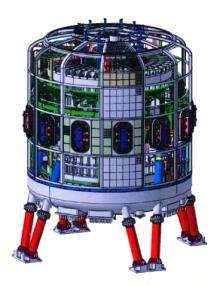
Exterior view of the Ignitor fusion reactor, whose core will be built in Italy and external housing built outside Moscow, where it will be installed. Image courtesy of Bruno Coppi
Russia and Italy have entered into an agreement to build a new fusion reactor outside Moscow that could become the first such reactor to achieve ignition, the point where a fusion reaction becomes self-sustaining instead of requiring a constant input of energy. The design for the reactor, called Ignitor, originated with MIT physics professor Bruno Coppi, who will be the project's principal investigator.
The concept for the new reactor builds on decades of experience with MIT’s Alcator fusion research program, also initiated by Coppi, which in its present version (called Alcator C-Mod) has the highest magnetic field and highest plasma pressure (two of the most important measures of performance in magnetic fusion) of any fusion reactor, and is the largest university-based fusion reactor in the world.
The key ingredient in all fusion experiments is plasma, a kind of hot gas made up of charged particles such as atomic nuclei and electrons. In fusion reactors, atomic nuclei — usually of isotopes of hydrogen called deuterium and tritium — are forced together through a combination of heat and pressure to overcome their natural electrostatic repulsion. When the nuclei join together, or fuse, they release prodigious amounts of energy.
Ignitor would be about twice the size of Alcator C-Mod, with a main donut-shaped chamber 1.3 meters across, and have an even stronger magnetic field. It will be much smaller and less expensive than the major international fusion project called ITER (with a chamber 6.2 meters across), currently under construction in France. Though originally designed to achieve ignition, the ITER reactor has been scaled back and is now not expected to reach that milestone.
The Ignitor reactor, Coppi says, will be “a very compact, inexpensive type of machine,” and unlike the larger ITER could be ready to begin operations within a few years. Its design is based on a particularly effective combination of factors that researchers unexpectedly discovered during the many years of running the Alcator program, and that were later confirmed in experiments at other reactors. Together, these factors produce especially good confinement of the plasma and a high degree of purity (impurities in the hot gases can be a major source of inefficiency). The new design aims to preserve these features to produce the highest plasma current densities — the amount of electric current in a given area of plasma. The design also has additional structures needed to produce and confine burning fusion plasmas in order to create the conditions needed for ignition, Coppi says.
Coppi plans to work with the Italian ministry of research and Evgeny Velikhov, president of the Kurchatov Institute in Moscow, to finalize the distribution of tasks for the machine, the core of which is to be built in Italy and then installed in Troitsk, near Moscow, on the site of that institute’s present Triniti reactor. Velikhov, as it happens, is also the chair of the ITER council. Coppi says of these two different programs, “there’s no competition, we are complementary.”
Although seen as a possible significant contributor to the world’s energy needs because it would be free of greenhouse-gas emissions, practical fusion power remains at least two decades away, most scientists in the field agree. But the initial impetus for setting up the Alcator reactor in the 1970s had more to do with pure science: “It was set up to simulate the X-ray stars that we knew at that time,” says Coppi, whose research work has as much to do with astrophysics as with energy. Stars are themselves made of plasma and powered by fusion, and the only way to study their atomic-level behavior in detail is through experiments inside fusion reactors.
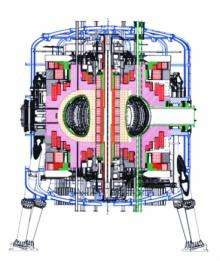
Internal cutaway view of the reactor, showing the donut-shaped cavity that houses the hot plasma where fusion will take place. Image courtesy of Bruno Coppi
Once the reactor was in operation, he says, “we found we were producing plasmas with unusual properties,” and realized this might represent a path to the long-sought goal of fusion ignition.Roscoe White, a distinguished research fellow at the Princeton Plasma Physics Laboratory, says that “the whole point of Ignitor is to find out how a burning plasma behaves, and there could be pleasant or unpleasant results coming from it. Whatever is learned is a gain. Nobody knows exactly how it will perform, that is the point of the experiment.” But while its exact results are unknown, White says it is important to pursue this project in addition to other approaches to fusion. “With our present knowledge it is very risky to commit the program to a single track reactor development — our knowledge is still in flux,” he says.
In addition, he says, “the completion of ITER, the only currently projected burning plasma experiment, is decades off. Experimental data concerning a burning plasma would be very welcome, and could lead to important results helping the cause of practical fusion power.” Furthermore, the Ignitor approach, if all goes well, could lead to more compact and economical future reactors: Some recent results from existing reactors, plus new information to be gained from Ignitor, “could lead to reactor designs much smaller and simpler than ITER,” he says.
Coppi remains especially interested in the potential of the new reactor to make new discoveries about fundamental physics. Quoting the late MIT physicist and Institute Professor Bruno Rossi, Coppi says, “whenever you do experiments in an unknown regime, you will find something new.” The new machine’s findings, he suggests, “will have a strong impact on astrophysics.”
More information: http://www.frascat … .it/ignitor/
Provided by Massachusetts Institute of Technology (news : web)
-
Fusion technology: from ANU to the world
Jun 30, 2005 |
not rated yet |
0
-
Nuclear fusion power project to start in 2018: official
Jun 18, 2009 |
not rated yet |
0
-
Tests show 'artificial sun' is reliable
Jan 15, 2007 |
not rated yet |
0
-
Nuclear fusion power project to start in slimmed-down version
Jun 08, 2009 |
not rated yet |
0
-
Controls engineer wins NSF CAREER Award to advance the viability of nuclear fusion
Mar 21, 2007 |
not rated yet |
0
-
Engineers build first sub-10-nm carbon nanotube transistor
Feb 01, 2012 |
4.9 / 5 (30) |
30
-
Something old, something new: Evolution and the structural divergence of duplicate genes
Jan 31, 2012 |
4.6 / 5 (7) |
1
-
The hidden nanoworld of ice crystals: Revealing the dynamic behavior of quasi-liquid layers
Jan 30, 2012 |
5 / 5 (3) |
1
-
Stock market network reveals investor clustering
Jan 27, 2012 |
3.9 / 5 (23) |
8
-
Of microchemistry and molecules: Electronic microfluidic device synthesizes biocompatible probes
Jan 26, 2012 |
5 / 5 (1) |
0
-
electrostatic induction in a conductor should be immpossible
3 hours ago
-
Help! Physics Momentum/Impulse problem!
6 hours ago
-
Gauss' law cubes, how to prove
7 hours ago
-
what is significance of torque
9 hours ago
-
Difference between volume displaced fluid and volume of the object
10 hours ago
-
Questions about Galileo statement?
10 hours ago
- More from Physics Forums - General Physics
More news stories
Explained: Sigma
It's a question that arises with virtually every major new finding in science or medicine: What makes a result reliable enough to be taken seriously? The answer has to do with statistical significance -- but ...
23 hours ago |
5 / 5 (13) |
32
Borexino Collaboration succeeds in spotting pep neutrinos emitted from the sun
(PhysOrg.com) -- To learn more about how the sun works, scientists study particles that are emitted from it into space due to thermonuclear reactions that occur inside; by applying known physics principles, ...
Physics research suggests new pathways for cancer progression
Observing that certain cancer cells may exhibit greater flexibility than normal cells, some scientists believe that this capability promotes rapid tumor growth. Now computer simulations developed by Boston University Biomedical ...
20 hours ago |
5 / 5 (1) |
0
Quantum physicist explains $100K offer for proof scaled-up quantum computing is impossible
(PhysOrg.com) -- MIT researcher Scott Aaronson has certainly riled the physics community with his offer this past Friday, of $100,000 to anyone who can prove that scaled-up quantum computing is impossible. ...
Physicists 'record' magnetic breakthrough
An international team of scientists has demonstrated a revolutionary new way of magnetic recording which will allow information to be processed hundreds of times faster than by current hard drive technology.
Feb 07, 2012 |
4.5 / 5 (39) |
14
|
Protein libraries in a snap
(PhysOrg.com) -- A Rice University undergraduate will depart with not only a degree but also a possible patent for his invention of an efficient way to create protein libraries, an important component of biomolecular ...
Sleep breathing machine shows clear benefits in children with sleep apnea
Children and adolescents with obstructive sleep apnea had substantial improvements in attention, anxiety and quality of life after treatment with positive airway pressure (PAP)a nighttime therapy in which a machine ...
Neurologic improvement detected in rats receiving stem cell transplant
In a study to be presented today at the Society for Maternal-Fetal Medicine's annual meeting, The Pregnancy Meeting, in Dallas, Texas, researchers will report that early transplantation of human placenta-derived mesenchymal ...
NASA budget will axe Mars deal with Europe: scientists
US President Barack Obama's budget proposal to be submitted next week for 2013 will cut NASA's budget by 20 percent and eliminate a major partnership with Europe on Mars exploration, scientists said Thursday.
Breastfeeding protects against asthma up to six years of age
(Medical Xpress) -- Research by the University of Otago in Christchurch and Wellington has shown that breastfeeding of infants has a clear protective effect against children developing asthma or wheezing up to six years of ...
Study finds stress hormones fluctuate with mood during pregnancy
(Medical Xpress) -- While pregnant, women pay particular attention to factors such as diet and exercise to ensure their babies are born healthy and develop normally. New research from the University of Calgarys Faculty ...

May 10, 2010
Rank: 3.2 / 5 (5)
This would represent maybe the greatest technological discovery in the history of humanity.
With fusion power mining comets for hydrogen from water-ice and methane ice (we don't want to deplete Earth's oceans,) would become the basis of a new world economy.
I wonder how many people in fossil fuels and "alternative" energy fields, as well as "paper work" jobs this would instantly put out of work if this reactor is successful?
Bring on the future "semi-utopian" economy, where Fusion powered robots do 99.99% of work, and humans pretty much just invent new robots and new jobs for robots to do...
C'mon baby be successful!
I hope to God they get this to work very soon!
May 10, 2010
Rank: 3 / 5 (2)
I guess you've never heard of the ITER project then ??? http://www.iter.org
--- get some more info
May 10, 2010
Rank: 3 / 5 (4)
ITER, Tokamacs, a dozen other fusion projects have been under way. Personally, I'll buy into it when someone comes up with one that doesn't involve power scales on the order of the entire US Grid (admitted, on short time frames) to ignite things.
May 10, 2010
Rank: 3.7 / 5 (3)
http://www.focusfusion.org/
May 10, 2010
Rank: 2 / 5 (6)
May 10, 2010
Rank: 4 / 5 (2)
May 10, 2010
Rank: 2 / 5 (1)
It is unclear to me what the difference in approaches to achieving ignition are between the Ignitor and ITER. Anyone?
Thanks
May 10, 2010
Rank: 4 / 5 (1)
May 11, 2010
Rank: 4.3 / 5 (3)
It's great to see more effort being put in fusion power though.
May 11, 2010
Rank: 1.2 / 5 (5)
I sincerely hope they make some [very safe] progress with this work - we certainly can do with a clean-burning[well relatively speaking, compared to nuclear fission] power generation technology.
May 11, 2010
Rank: 4.3 / 5 (4)
gravity started the fusion reaction in stars...
and while fusion will be cleaner than fision it is by no means perfectly clean. The housing of tokamacs become serious environmental concerns as does anything within close proximity of the plasma generated. While overall this is significantly less radioactive matter than that generated from spent nuclear fuel the technology does create some radioactive waste. -- Just not very much.
May 11, 2010
Rank: not rated yet
May 11, 2010
Rank: 2 / 5 (4)
http://video.goog...8847503#
http://esciencene...ceptance
May 12, 2010
Rank: 5 / 5 (2)
You commented on another article that you can't see an application for faster computers and yet you want a utopian world where robots do all the work. There's your application right there -- robots can easily benefit from computers orders of magnitude faster than what we have now...
May 15, 2010
Rank: not rated yet
May 16, 2010
Rank: not rated yet
Energy density of hydrogen (in fusion): 645,000,000 MJ/kg [source: http://en.wikiped..._density]
Total world energy consumption in 2008: 474 EJ = 474,000,000,000,000 MJ [http://en.wikiped...sumption]
Therefore, the amount of hydrogen needed to meet total world energy demand is: 734,884 kg
The total amount of hydrogen in the world's oceans is: 1.65 x 10^20 kg = 165,000,000,000,000,000,000 kg [http://answers.go...696.html]
Therefore, at current rates of energy use, the hydrogen in the oceans would last: 224,525,231,192,950 = 224.5 trillion years
Put another way, it would be 2.25 trillion years before mankind used even 1% of the hydrogen in the oceans for fusion power. Hence, there would be no need to mine water on asteroids to avoid depleting the oceans.
May 16, 2010
Rank: 4 / 5 (1)
Yes I am excited about Focus Fusion, but Lawrenceville still has a couple of things they still need to prove before their theory is validated. The nice thing is that they are looking at proving it this year or early next year, rather than a nebulous "50 years away" from many of the other fusion projects.
May 16, 2010
Rank: 5 / 5 (2)
May 17, 2010
Rank: 4 / 5 (1)
May 17, 2010
Rank: not rated yet
May 17, 2010
Rank: not rated yet
http://www.crossf...iew.html
May 17, 2010
Rank: not rated yet
http://powerandco...ood.html
Very interesting read and the Google Technology Video (several years old now) is still an interesting presentation.
May 17, 2010
Rank: not rated yet
Google ted talk bill gates and you'll find it without too much trouble...