Transforming waste plastic into an alternative fuel
May 10, 2010
Transforming waste plastic into an alternative fuel

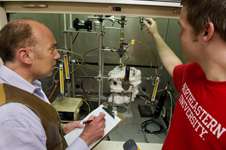
Professor Levendis and David Laskowski working with the apparatus. Photo by Mary Knox Merrill.

(PhysOrg.com) -- Northeastern engineering students and faculty researcher collaborate on prototype of apparatus that could drive electric power plants without fossil fuels.

Student researchers at Northeastern University have designed an apparatus to convert plastic waste into clean energy without releasing harmful emissions.

Under the leadership of Yiannis Levendis, distinguished professor of mechanical and industrial engineering, a team of undergraduate and graduate engineering students developed a waste combustor, which breaks down non-biodegradable plastics to create an alternative source of fuel.

Their prototype was featured at the fifth annual MIT Energy Conference this past March. The team worked for nine months on the research, which, for the undergraduates, was their senior capstone project.

Self-sustainability is the key to the double-tank combustor design. Plastic waste is first processed in an upper tank through pyrolysis, which converts solid plastic into gas. Next, the gas flows to a lower tank, where it is burned with oxidants to generate heat and steam. The heat sustains the combustor while the steam can be used to generate electric power.

“The prototype can be scaled up to drive a large power plant, which could connect to a plastic recycling center for a constant flow of fuel,” said David Laskowski, an undergraduate student working on the team.

Levendis, who has pursued research on the combustion of plastics and other post-consumer wastes for the past 20 years, is currently focusing on the concept of vaporizing solid plastic waste, which would reduce levels of during the combustion process.

“The inspiration behind my research is the quest to develop clean, cost-efficient power sources in the face of dwindling fossil fuel reserves,” Levendis said. “It will also help get rid of unsightly, non-biodegradable plastic waste that cannot be recycled.”

According to Laskowski, calculations show that the new technology has the potential of replacing up to 462 million gallons of petroleum in the United States alone, if all recycled plastics were to be processed.

“We are currently consuming highly-priced conventional premium fuels (to produce electricity). The fuel developed using this system will lower the cost of electricity for future generations,” Levendis said.

The team members included Jeff Young, Shane McElroy, Jason Lee and Paul Conroy, all senior undergraduate students; and Brendan Hall and Chuanwei Zhuo, who are graduate students.

With the success of their prototype, Hall and Zhuo plan to continue working with Levendis on further development of the project.

Provided by Northeastern University (news : web)

3.7 /5 (6 votes)  

Rank 3.7 /5 (6 votes)
Relevant PhysicsForums posts
  • Calling function with no input argument
    created10 hours ago
  • Force free body diagram problem on gym equipment
    created11 hours ago
  • Empirical data regarding shower heads and water
    created19 hours ago
  • feed hold button on CNC lathe
    createdFeb 09, 2012
  • RFAC in Fortran
    createdFeb 09, 2012
  • dynamics 2/32
    createdFeb 08, 2012
  • More from Physics Forums - General Engineering

More news stories

Google users warned of threat to smartphone wallets

Users of Google smartphone wallets were being warned on Friday that there is a way to crack pass codes intended to thwart thieves from going on illicit shopping sprees.

Technology / Internet

created 3 hours ago | popularity 5 / 5 (1) | comments 0

Anonymous knocks CIA website offline (Update)

The website of the Central Intelligence Agency was inaccessible on Friday after the hacker group Anonymous claimed to have knocked it offline.

Technology / Internet

created 4 hours ago | popularity 5 / 5 (6) | comments 10

New error-correcting codes guarantee the fastest possible rate of data transmission

Error-correcting codes are one of the triumphs of the digital age. They’re a way of encoding information so that it can be transmitted across a communication channel — such as an optical fiber o ...

Technology / Computer Sciences

created 13 hours ago | popularity 5 / 5 (4) | comments 5 | with audio podcast

New power source discovered

(PhysOrg.com) -- Researchers at the Massachusetts Institute of Technology (MIT) and RMIT University have made a breakthrough in energy storage and power generation.

Technology / Energy & Green Tech

created 12 hours ago | popularity 4.8 / 5 (19) | comments 7 | with audio podcast

Small modular reactor design could be a 'SUPERSTAR'

(PhysOrg.com) -- Though most of today's nuclear reactors are cooled by water, we've long known that there are alternatives; in fact, the world's first nuclear-powered electricity in 1951 came from a reactor ...

Technology / Energy & Green Tech

created 12 hours ago | popularity 4.3 / 5 (11) | comments 20 | with audio podcast


Complex wiring of the nervous system may rely on a just a handful of genes and proteins

Researchers at the Salk Institute have discovered a startling feature of early brain development that helps to explain how complex neuron wiring patterns are programmed using just a handful of critical genes. ...

Putting the squeeze on planets outside our solar system

(PhysOrg.com) -- Using high-powered lasers, scientists at Lawrence Livermore National Laboratory and collaborators discovered that molten magnesium silicate undergoes a phase change in the liquid state, abruptly ...

The power of estrogen -- male snakes attract other males

A new study has shown that boosting the estrogen levels of male garter snakes causes them to secrete the same pheromones that females use to attract suitors, and turned the males into just about the sexiest ...

NASA sees wide-eyed cyclone Jasmine

Cyclone Jasmine's eye has opened wider on NASA satellite imagery, as it moves through the Southern Pacific Ocean.

Humans may have helped the decline of African rainforests 3000 years ago

(PhysOrg.com) -- Large areas of rainforests in Central Africa mysteriously disappeared over three thousand years ago, to be replaced by savannas. The prevailing theory has been that the cause was a change ...

NASA sees Giovanna reach cyclone strength, threaten Madagascar

Tropical Storm 12S built up steam and became a cyclone on February 10, 2012 as NASA's Terra satellite passed overhead. Residents of east-central Madagascar should prepare for this cyclone to make landfall ...