Junior, the robotic car, learns to slide park (w/ Video)
May 11, 2010 by Lin Edwards report
Junior, the robotic car, learns to slide park

Enlarge

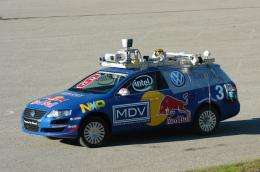
Stanford Racing Team's "Junior"

(PhysOrg.com) -- "Junior," an autonomous car developed by the Stanford Racing Team, has been taught how to park itself -- by putting itself into reverse, accelerating up to 25 miles per hour, and then suddenly braking while turning the wheel sharply, which starts it on a 180-degree spinning slide right into the parking spot.

Video of the robotic ’s procedure was shown at the 2010 International Conference on Robotics and Automation (ICRA) in Anchorage, Alaska last week. The car can reliably and repeatedly park itself in this way.

This video is not supported by your browser at this time.

Junior was introduced to the world in the Defense Advanced Research Projects Agency (DARPA) Urban Challenge in 2007, where the car drove almost flawlessly and came second. Since then the team have been working on teaching Junior to do more complex maneuvers. In normal driving along a straight line the car’s computer adjusts the car’s brakes, steering and fuel systems with a closed-loop system using data from sensors built into the car, but the dynamics are much harder to predict and model in a complex maneuver such as spinning and sliding into a parking spot.

The team then tried an open-loop process in which they simply repeated the control inputs from the slide parking section of the demonstration to try to end up with the car in the same place each time. The problem with this method was there was no correction of errors when the car was traveling in a straight line, and this could change the car’s final position.

This video is not supported by your browser at this time.

To teach Junior the stunt the team then combined the two methods, using the closed-loop control while the car was approaching, and then smoothly switching to open-loop control for the spin and slide into position. The decision about when to switch between the two modes of operation was made by the car’s software, based on observation, and the final result impressively and reliably places the car exactly where it is supposed to be.

The parking stunt has a serious side, since it aims to give the robotic car more flexibility in emergencies or unexpected situations. The annual aims to help developers design autonomous vehicles for military uses. It features robotic vehicles executing various maneuvers in a simulated city environment.

More information: Stanford Racing Team page: http://cs.stanford … p/roadrunner

© 2010 PhysOrg.com

4.8 /5 (16 votes)  

Filter


Move the slider to adjust rank threshold, so that you can hide some of the comments.


Display comments: newest first

jsovine
May 11, 2010

Rank: 5 / 5 (7)
I can't wait until driving is taken care of by computers, or public transportation becomes the definitive standard everywhere.
DozerIAm
May 11, 2010

Rank: 5 / 5 (4)
"Welcome to AutoDrive. Please choose your AutoDrive style: "Granny Mode", "Model Citizen Mode", "Drunk Yahoo Mode"."
Aaron_Carmody
May 11, 2010

Rank: not rated yet
yeah, but can the computer do it as funny as ace ventura pet detective?
JCincy
May 11, 2010

Rank: not rated yet
No, officer, I was not driving my car the wrong way. The computer of this autonomous vehicle was forced to drive the car the wrong way. It is the only way the computer guidance system on this car can parallel park.

Eric_B
May 12, 2010

Rank: 1 / 5 (2)
now the only thing they have left to do is to use voice analysis software to teach engineering students how to speak without a lisp.
MikeLisanke
May 14, 2010

Rank: not rated yet
And what do they do when the coefficient of friction in the area of a parking space changes enough to cause a really nice 3-car accident? Please, somebody argue why anybody would have their robot car auto-park in this manner?
MadPutz
May 15, 2010

Rank: not rated yet
@MikeLisanke

Hollywood may want such technology for dangerous stunts. Wheeled service or warehouse robots may use the same method when a certain movement requires agility. It may have an application totally outside of consumer vehicles, you can never know.
Buyck
May 17, 2010

Rank: not rated yet
Thats the future of the car on the road by 2030! Autonomous vehicle see link...

http://www.core77...3908.asp

Rank 4.8 /5 (16 votes)
Relevant PhysicsForums posts
  • Calling function with no input argument
    created4 hours ago
  • Force free body diagram problem on gym equipment
    created5 hours ago
  • Empirical data regarding shower heads and water
    created13 hours ago
  • feed hold button on CNC lathe
    createdFeb 09, 2012
  • RFAC in Fortran
    createdFeb 09, 2012
  • dynamics 2/32
    createdFeb 08, 2012
  • More from Physics Forums - General Engineering

More news stories

New error-correcting codes guarantee the fastest possible rate of data transmission

Error-correcting codes are one of the triumphs of the digital age. They’re a way of encoding information so that it can be transmitted across a communication channel — such as an optical fiber o ...

Technology / Computer Sciences

created 7 hours ago | popularity 5 / 5 (3) | comments 4 | with audio podcast

Small modular reactor design could be a 'SUPERSTAR'

(PhysOrg.com) -- Though most of today's nuclear reactors are cooled by water, we've long known that there are alternatives; in fact, the world's first nuclear-powered electricity in 1951 came from a reactor ...

Technology / Energy & Green Tech

created 7 hours ago | popularity 4.2 / 5 (10) | comments 16 | with audio podcast

New power source discovered

(PhysOrg.com) -- Researchers at the Massachusetts Institute of Technology (MIT) and RMIT University have made a breakthrough in energy storage and power generation.

Technology / Energy & Green Tech

created 6 hours ago | popularity 5 / 5 (5) | comments 2 | with audio podcast

Advanced power-grid model finds low-cost, low-carbon future in West

(PhysOrg.com) -- The least expensive way for the Western U.S. to reduce greenhouse gas emissions enough to help prevent the worst consequences of global warming is to replace coal with renewable and other ...

Technology / Energy & Green Tech

created 7 hours ago | popularity 5 / 5 (2) | comments 7 | with audio podcast

Zuckerberg's focus drives Facebook's ascent

When Mark Zuckerberg showed up to rent Judy Fusco's Los Altos, Calif., house in the fall of 2004, soon after he'd arrived in Silicon Valley, the landlord was immediately struck by his confidence.

Technology / Internet

created 3 hours ago | popularity 1 / 5 (1) | comments 0


Human cognitive performance suffers following natural disasters, researchers find

Not surprisingly, victims of a natural disaster can experience stress and anxiety, but a new study indicates that it might also cause them to make more errors - some serious - in their daily lives. In their upcoming Human Fa ...

The power of estrogen -- male snakes attract other males

A new study has shown that boosting the estrogen levels of male garter snakes causes them to secrete the same pheromones that females use to attract suitors, and turned the males into just about the sexiest ...

Putting the squeeze on planets outside our solar system

(PhysOrg.com) -- Using high-powered lasers, scientists at Lawrence Livermore National Laboratory and collaborators discovered that molten magnesium silicate undergoes a phase change in the liquid state, abruptly ...

Both maternal and paternal age linked to autism

Older maternal and paternal age are jointly associated with having a child with autism, according to a recently published study led by researchers at The University of Texas Health Science Center at Houston (UTHealth).

Curry spice component may help slow prostate tumor growth

Curcumin, an active component of the Indian curry spice turmeric, may help slow down tumor growth in castration-resistant prostate cancer patients on androgen deprivation therapy (ADT), a study from researchers ...

Humans may have helped the decline of African rainforests 3000 years ago

(PhysOrg.com) -- Large areas of rainforests in Central Africa mysteriously disappeared over three thousand years ago, to be replaced by savannas. The prevailing theory has been that the cause was a change ...