DNA could be backbone of next generation logic chips
May 11, 2010
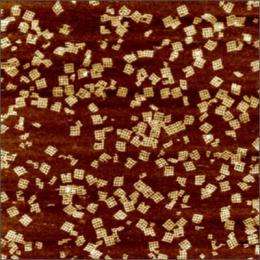
These are many waffles. Credit: Chris Dwyer
(PhysOrg.com) -- In a single day, a solitary grad student at a lab bench can produce more simple logic circuits than the world's entire output of silicon chips in a month.
So says a Duke University engineer, who believes that the next generation of these logic circuits at the heart of computers will be produced inexpensively in almost limitless quantities. The secret is that instead of silicon chips serving as the platform for electric circuits, computer engineers will take advantage of the unique properties of DNA, that double-helix carrier of all life's information.
In his latest set of experiments, Chris Dwyer, assistant professor of electrical and computer engineering at Duke's Pratt School of Engineering, demonstrated that by simply mixing customized snippets of DNA and other molecules, he could create literally billions of identical, tiny, waffle-looking structures.
Dwyer has shown that these nanostructures will efficiently self-assemble, and when different light-sensitive molecules are added to the mixture, the waffles exhibit unique and "programmable" properties that can be readily tapped. Using light to excite these molecules, known as chromophores, he can create simple logic gates, or switches.
These nanostructures can then be used as the building blocks for a variety of applications, ranging from the biomedical to the computational.
"When light is shined on the chromophores, they absorb it, exciting the electrons," Dwyer said. "The energy released passes to a different type of chromophore nearby that absorbs the energy and then emits light of a different wavelength. That difference means this output light can be easily differentiated from the input light, using a detector."
Instead of conventional circuits using electrical current to rapidly switch between zeros or ones, or to yes and no, light can be used to stimulate similar responses from the DNA-based switches - and much faster.
"This is the first demonstration of such an active and rapid processing and sensing capacity at the molecular level," Dwyer said. The results of his experiments were published online in the journal Small. "Conventional technology has reached its physical limits. The ability to cheaply produce virtually unlimited supplies of these tiny circuits seems to me to be the next logical step."
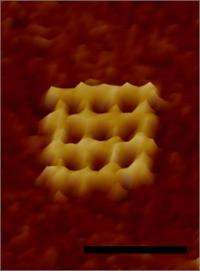
This is a closeup of a waffle. Credit: Chris Dwyer
DNA is a well-understood molecule made up of pairs of complimentary nucleotide bases that have an affinity for each other. Customized snippets of DNA can cheaply be synthesized by putting the pairs in any order. In their experiments, the researchers took advantage of DNA's natural ability to latch onto corresponding and specific areas of other DNA snippets.Dwyer used a jigsaw puzzle analogy to describe the process of what happens when all the waffle ingredients are mixed together in a container.
"It's like taking pieces of a puzzle, throwing them in a box and as you shake the box, the pieces gradually find their neighbors to form the puzzle," he said. "What we did was to take billions of these puzzle pieces, throwing them together, to form billions of copies of the same puzzle."
In the current experiments, the waffle puzzle had 16 pieces, with the chromophores located atop the waffle's ridges. More complex circuits can be created by building structures composed of many of these small components, or by building larger waffles. The possibilities are limitless, Dwyer said.
In addition to their use in computing, Dwyer said that since these nanostructures are basically sensors, many biomedical applications are possible. Tiny nanostructures could be built that could respond to different proteins that are markers for disease in a single drop of blood.
-
Physicists create first robust DNA building blocks
Dec 09, 2005 |
not rated yet |
0
-
Self-assembling nanostructures of DNA -- a biotechnologist's dream
Feb 05, 2007 |
not rated yet |
0
-
Light-driven plasmonic nanoswitch may pave way for new computers, tech
Jan 16, 2009 |
not rated yet |
0
-
Molecular machines drive plasmonic nanoswitches
Feb 11, 2009 |
not rated yet |
0
-
UCLA scientists working to create smaller, faster integrated circuits
Dec 19, 2007 |
not rated yet |
0
-
Stars containing dark matter should look different from other stars
Feb 20, 2012 |
4.5 / 5 (17) |
11
-
Physicists discover evidence of rare hypernucleus, a component of strange matter
Feb 17, 2012 |
4.7 / 5 (38) |
22
-
Fast photon control brings quantum photonic technologies closer
Feb 13, 2012 |
5 / 5 (8) |
1
-
Engineers build first sub-10-nm carbon nanotube transistor
Feb 01, 2012 |
4.9 / 5 (36) |
32
-
Something old, something new: Evolution and the structural divergence of duplicate genes
Jan 31, 2012 |
4.6 / 5 (7) |
1
-
Eye biology videos
4 hours ago
-
Flowering Plant Revived After 30,000 Years in Permafrost
Feb 21, 2012
-
Toba volcano eruptions - 1.000 - 10,000 breeding pairsunb
Feb 20, 2012
-
How is a specific gene removed from DNA
Feb 20, 2012
-
Reproduction and Human evolution
Feb 19, 2012
-
Viruses: Living or Non-living organisms
Feb 19, 2012
- More from Physics Forums - Biology
More news stories
New nanotechnology converts heat into power when it's needed most
Never get stranded with a dead cell phone again. A promising new technology called Power Felt, a thermoelectric device that converts body heat into an electrical current, soon could create enough juice to make another call ...
17 hours ago |
4 / 5 (8) |
6
|
New technique produces free-standing piezoelectric ferroelectric nanostructures from PZT material
(PhysOrg.com) -- Researchers have developed a soft template infiltration technique for fabricating free-standing piezoelectrically active ferroelectric nanotubes and other nanostructures from PZT ...
18 hours ago |
5 / 5 (5) |
4
|
Graphene is thinnest known anti-corrosion coating
New research has established the "miracle material" called graphene as the world's thinnest known coating for protecting metals against corrosion. Their study on this potential new use of graphene appears ...
Nanotechnology / Nanomaterials
14 hours ago |
4.6 / 5 (7) |
2
|
Researchers discover how different nanomaterial surfaces affect proteins
A new study led by nanotechnology and biotechnology experts at Rensselaer Polytechnic Institute is providing important details on how proteins in our bodies interact with nanomaterials. In their new study, published in the ...
Nanotechnology / Bio & Medicine
11 hours ago |
5 / 5 (2) |
1
|
A new twist on nanowires
Nanowires — microscopic fibers that can be “grown” in the lab — are a hot research topic today, with a variety of potential applications including light-emitting diodes (LEDs) and sensors. ...
20 hours ago |
4.8 / 5 (4) |
0
|
Researchers build first physical 'metatronic' circuit
(PhysOrg.com) -- The technological world of the 21st century owes a tremendous amount to advances in electrical engineering, specifically, the ability to finely control the flow of electrical charges using ...
Spitzer finds solid buckyballs in space
(PhysOrg.com) -- Astronomers using data from NASA's Spitzer Space Telescope have, for the first time, discovered buckyballs in a solid form in space. Prior to this discovery, the microscopic carbon spheres ...
Faster than light neutrinos? More like faulty wiring
You can shelf your designs for a warp drive engine (for now) and put the DeLorean back in the garage; it turns out neutrinos may not have broken any cosmic speed limits after all.
Physicists surprised by disappearing and reappearing superconductivity in iron selenium chalcogenides
Superconductivity is a rare physical state in which matter is able to conduct electricity -- maintain a flow of electrons -- without any resistance. This phenomenon can only be found in certain materials at low temperatures, ...
Stanford research team cracks animated NuCaptcha
(PhysOrg.com) -- The research team from Stanford University, led by Elie Bursztein, that previously had cracked regular CAPTCHAs and then audio CAPTCHAs, now has also successfully cracked the animated version called NuCapt ...
Going up: Japan builder eyes space elevator
A Japanese construction firm claimed Wednesday it could execute an out-of-this-world plan to put tourists in space within 40 years by building an elevator that stretches a quarter of the way to the moon.

May 11, 2010
Rank: 1 / 5 (1)
http://en.wikiped...chnology
May 11, 2010
Rank: 5 / 5 (2)
May 12, 2010
Rank: 5 / 5 (1)