Plant and animal in direct competition for food
May 13, 2010 by Lin Edwards report
Plant and animal in direct competition for food

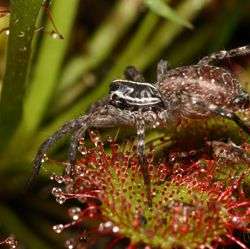
USF researchers have discovered that in Florida, wolf spiders and pink sundews, a carnivorous plant, compete when food is scarce in their shared habitat. Photo: Christopher V. Anderson.

(PhysOrg.com) -- Animals often compete aggressively with each other for food or other resources, and plants often compete with each other for light, water, or other resources. Now scientists in the U.S. have found an animal that competes directly for food with a plant.

The insect-eating wolf (Sosippus floridanus) lives close to the ground in wetland regions of southern Florida, where it builds dense webs to catch its prey, which consists of a variety of flies, crickets, , and other insects. The insect-eating pink sundew (Drosera capillaris) lives in the same bogs and catches insects by trapping them in a sticky mucous it secretes on its leaves, and then consumes hapless insects with .

University of South Florida ecologist, Jason Rohr, decided to find out if the two very different species competed directly for exactly the same prey species. Rohr and colleagues surveyed sites where both species lived and observed the placement and numbers of each species. They also collected insects to determine what resources were available to the spider and plant. As a result of their observations they discovered when sundews were present the webs built by the spiders were larger than if there were no sundews in the vicinity.

The researchers then collected samples of the spiders and sundews and transported them back to the laboratory, where they placed them in 40 glass tanks and gave them crickets to eat. They planted six sundews in boggy soil in each tank, and then divided the tanks into five groups: spider/no spider with high insect food supply, spider/no spider with low insect , and no spider with no insect food.

They found the sundews produced more leaves and seeds when spiders were absent than when they were present. When spiders and sundews were placed in the same tank the spiders ate most of the before the plants could grab them. In this case the plants produced fewer leaves, seeds and flowers. The results clearly demonstrate the presence of spiders reduced sundew fitness. The scientists said the study was the first to demonstrate a land plant and animal competing directly for food.

Rohr said animals and plants are not usually thought to compete for the same food sources, but there may be many more instances. His team plan to further their research by studying the effect on the sundew of the oak toad, a tiny insect-eating amphibian inhabiting the same boggy regions.

The paper is published online in the Proceedings of the Royal Society B.

More information: David E. Jennings et al.: Evidence for competition between carnivorous plants and spiders, Published online before print May 12, 2010, doi:10.1098/rspb.2010.0465

© 2010 PhysOrg.com

4.3 /5 (6 votes)  

Rank 4.3 /5 (6 votes)
Related Stories
Relevant PhysicsForums posts
  • Stem cell question.
    created1 hour ago
  • Protease cleavage
    created7 hours ago
  • Pertubance in a model
    created14 hours ago
  • Cancer drugs and Alzheimer's, Oh my!
    created22 hours ago
  • Squishing cells
    created23 hours ago
  • Any books/articles for evolutionary stable strategy models in humans?
    createdFeb 09, 2012
  • More from Physics Forums - Biology

More news stories

The power of estrogen -- male snakes attract other males

A new study has shown that boosting the estrogen levels of male garter snakes causes them to secrete the same pheromones that females use to attract suitors, and turned the males into just about the sexiest ...

Biology / Plants & Animals

created 12 hours ago | popularity 4.8 / 5 (5) | comments 0 | with audio podcast

Grass to gas: Researchers' genome map speeds biofuel development

Researchers at the University of Georgia have taken a major step in the ongoing effort to find sources of cleaner, renewable energy by mapping the genomes of two originator cells of Miscanthus x giganteus, a large perenn ...

Biology / Biotechnology

created 9 hours ago | popularity 3.8 / 5 (5) | comments 0 | with audio podcast

Experts reveal how plants don't get sunburn

(PhysOrg.com) -- Experts at the University of Glasgow have discovered how plants survive the harmful rays of the sun.

Biology / Cell & Microbiology

created 12 hours ago | popularity 4.7 / 5 (3) | comments 0 | with audio podcast

Miami battling invasion of giant African snails

No one knows how they got there. But an invasion of African giant snails has southern Florida in a panic over potential crop damage, disease and general yuckiness surrounding the slimy gastropods.

Biology / Ecology

created 16 hours ago | popularity 4 / 5 (1) | comments 4

Protein libraries in a snap

(PhysOrg.com) -- A Rice University undergraduate will depart with not only a degree but also a possible patent for his invention of an efficient way to create protein libraries, an important component of biomolecular ...

Biology / Cell & Microbiology

created 15 hours ago | popularity 4.8 / 5 (4) | comments 0 | with audio podcast


Google users warned of threat to smartphone wallets

Users of Google smartphone wallets were being warned on Friday that there is a way to crack pass codes intended to thwart thieves from going on illicit shopping sprees.

Anonymous knocks CIA website offline (Update)

The website of the Central Intelligence Agency was inaccessible on Friday after the hacker group Anonymous claimed to have knocked it offline.

Complex wiring of the nervous system may rely on a just a handful of genes and proteins

Researchers at the Salk Institute have discovered a startling feature of early brain development that helps to explain how complex neuron wiring patterns are programmed using just a handful of critical genes. ...

New error-correcting codes guarantee the fastest possible rate of data transmission

Error-correcting codes are one of the triumphs of the digital age. They’re a way of encoding information so that it can be transmitted across a communication channel — such as an optical fiber o ...

Humans may have helped the decline of African rainforests 3000 years ago

(PhysOrg.com) -- Large areas of rainforests in Central Africa mysteriously disappeared over three thousand years ago, to be replaced by savannas. The prevailing theory has been that the cause was a change ...

Putting the squeeze on planets outside our solar system

(PhysOrg.com) -- Using high-powered lasers, scientists at Lawrence Livermore National Laboratory and collaborators discovered that molten magnesium silicate undergoes a phase change in the liquid state, abruptly ...