Building organs block by block: Tissue engineers create a new way to assemble artificial tissues
May 13, 2010 by Anne Trafton
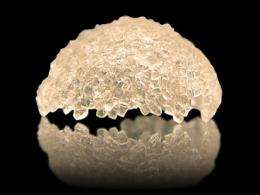
A half sphere of polymer cubes built by researchers at the MIT-Harvard Division of Health Sciences and Technology. Image: Javier Gomez Fernandez
(PhysOrg.com) -- Tissue engineering has long held promise for building new organs to replace damaged livers, blood vessels and other body parts. However, one major obstacle is getting cells grown in a lab dish to form 3-D shapes instead of flat layers.
Researchers at the MIT-Harvard Division of Health Sciences and Technology (HST) have come up with a new way to overcome that challenge, by encapsulating living cells in cubes and arranging them into 3-D structures, just as a child would construct buildings out of blocks.
The new technique, dubbed "micromasonry," employs a gel-like material that acts like concrete, binding the cell "bricks" together as it hardens. Ali Khademhosseini, assistant professor of HST, and former HST postdoctoral associate Javier Gomez Fernandez describe the work in a paper published online in the journal Advanced Materials.
The tiny cell bricks hold potential for building artificial tissue or other types of medical devices, says Jennifer Elisseeff, associate professor of biomedical engineering at Johns Hopkins University, who was not involved in the research. "They're very elegant and have a lot of flexibility in how you grow them," she says. "It's very creative."
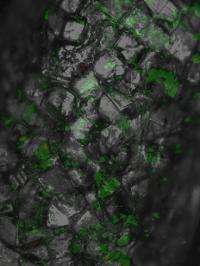
Researchers at the MIT-Harvard Division of Health Sciences and Technology built this tubular tissue by encasing cells in polymer "bricks" and attaching them to a tube-shaped template. Image: Javier Gomez Fernandez
Controlled structureTo obtain single cells for tissue engineering, researchers have to first break tissue apart, using enzymes that digest the extracellular material that normally holds cells together. However, once the cells are free, it's difficult to assemble them into structures that mimic natural tissue microarchitecture.
Some scientists have successfully built simple tissues such as skin, cartilage or bladder on biodegradable foam scaffolds. "That works, but it often lacks a controlled microarchitecture," says Khademhosseini, who is also an assistant professor at Brigham and Women's Hospital. "You don't get tissues with the same complexity as normal tissues."
The HST researchers built their "biological Legos" by encapsulating cells within a polymer called polyethylene glycol (PEG), which has many medical uses. Their version of the polymer is a liquid that becomes a gel when illuminated, so when the PEG-coated cells are exposed to light, the polymer hardens and encases the cells in cubes with side lengths ranging from 100 to 500 millionths of a meter.
Once the cells are in cube form, they can be arranged in specific shapes using templates made of PDMS, a silicon-based polymer used in many medical devices. Both template and cell cubes are coated again with the PEG polymer, which acts as a glue that holds the cubes together as they pack themselves tightly onto the scaffold surface.
After the cubes are arranged properly, they are illuminated again, and the liquid holding the cubes together solidifies. When the template is removed, the cubes hold their new structure.
Gomez Fernandez and Khademhosseini used this method to build tubes that could function as capillaries, potentially helping to overcome one of the most persistent problems with engineered organs — lack of an immediate blood supply. "If you build an organ, but you can't provide nutrients, it is going to die," says Gomez Fernandez, now a postdoctoral fellow at Harvard. They hope their work could also lead to a new way to make artificial liver or cardiac tissue.
Other researchers have developed a technique called organ printing to create complex 3-D tissues, but that process requires a robotic machine that is not in widespread use. The new technique does not require any special equipment. "You can reproduce this in any lab," says Gomez Fernandez. "It's very simple."
To get to the point where these engineered tissues could become clinically useful, "the short-term next step is really looking at different cell types and the viability of tissue growth," says Elisseeff. The researchers are now doing that, and they are also exploring the use of different polymers that could replace PEG and offer more control over cell placement.
More information: Paper: http://www3.inters … 503/abstract
Provided by Massachusetts Institute of Technology (news : web)
-
MIT method allows 3-D study of cells
Apr 24, 2006 |
not rated yet |
0
-
3D printing for new tissues and organs
Jun 18, 2009 |
not rated yet |
0
-
Scientists progress in successful tissue engineering
Mar 23, 2007 |
not rated yet |
0
-
Tissue engineered scaffolding allows reproduction of cartilage tissue
May 09, 2007 |
not rated yet |
0
-
Researchers find novel way to repair airway injuries
May 06, 2008 |
not rated yet |
0
-
Stock market network reveals investor clustering
Jan 27, 2012 |
4.1 / 5 (18) |
4
-
Of microchemistry and molecules: Electronic microfluidic device synthesizes biocompatible probes
Jan 26, 2012 |
not rated yet |
0
-
Study supports role of quantum effects in photosynthesis
Jan 25, 2012 |
4.9 / 5 (10) |
7
-
Blunt nanostructures could make high-efficiency solar cells easier to fabricate
Jan 24, 2012 |
4.8 / 5 (6) |
9
-
DNA as invisible ink can reversibly hide patterns
Jan 23, 2012 |
4.3 / 5 (8) |
0
-
Can this electrochemical reaction be explained? Steel, copper and electricity
2 hours ago
-
Why does manganese... ?
6 hours ago
-
Which complex is easier to oxidize and why?
6 hours ago
-
Why can't there be a metal-metal multiple bond in .... ?
8 hours ago
-
Toxicity in reactions between liquid paraffin and polyurethane/polyethylene
9 hours ago
-
Doubts regarding Atomic mass,relative atomic mass and mass number.
10 hours ago
- More from Physics Forums - Chemistry
More news stories
Scientists rediscover self-healing silicone mechanism from the 1950s
(PhysOrg.com) -- Research in self-healing organic polymers has grown recently, but one simple self-healing mechanism from more than 60 years ago has been nearly forgotten until now. Using this mechanism, which ...
Scientists discover new clue to the chemical origins of life
Organic chemists at the University of York have made a significant advance towards establishing the origin of the carbohydrates (sugars) that form the building blocks of life.
Jan 24, 2012 |
5 / 5 (19) |
264
|
Envelope for an artificial cell
(PhysOrg.com) -- Chemists have taken an important step in making artificial life forms from scratch. Using a novel chemical reaction, they have created self-assembling cell membranes, the structural envelopes ...
Jan 25, 2012 |
4.8 / 5 (17) |
11
|
Scorpions inspire scientists in making tougher surfaces for machinery
Taking inspiration from the yellow fattail scorpion, which uses a bionic shield to protect itself against scratches from desert sandstorms, scientists have developed a new way to protect the moving parts of ...
Jan 25, 2012 |
4.6 / 5 (8) |
3
|
Chemists to develop new materials for hydrogen storage in vehicles
(PhysOrg.com) -- The biggest challenge with hydrogen-powered fuel cells lies in the storage of hydrogen: how to store enough of it, in a safe and cost-effective manner, to power a vehicle for 300 miles? ...
Jan 27, 2012 |
4 / 5 (3) |
2
North Carolina becomes home of White Spaces network
(PhysOrg.com) -- Americas first commercial TV White Spaces Network was launched this week in Wilmington, New Hanover County, North Carolina. Wilmington, as the first U.S. city to shift from ...
Davos wowed by device that reads 'code of life' in hours
It was the talk of Davos, grabbing the imagination of a forum otherwise shrouded in gloom: a miracle machine that cracks the code of life within hours and could revolutionise healthcare.
Fireworks send Beijing air pollution soaring
(AP) -- Clouds of smoke from Lunar New Year fireworks sent air pollution in Beijing soaring under a new more sensitive measurement system, reports said Sunday.
Zimbabwe doctors report 800 typhoid cases
(AP) -- An independent doctors' group in Zimbabwe is reporting 800 cases of the bacterial disease typhoid in a recent outbreak.
British police arrest 5 in tabloid bribery probe
(AP) -- The criminal investigation into British tabloid skullduggery turned full force on a second Rupert Murdoch publication Saturday, with the arrest of four current and former journalists from The Sun ...
Very good experiences don't just happen for patients
A new training program for emergency department staff at Rhode Island Hospital teaches communication skills by having staff take part in simulations of real patient experiences. The goal is to improve the patient experience ...

May 13, 2010
Rank: not rated yet
May 13, 2010
Rank: not rated yet
http://www.ndep.u...dy-Parts
May 14, 2010
Rank: not rated yet
May 17, 2010
Rank: not rated yet
Sign up for cryonics if you're feeling adventurous.