How the brain decides what to eat

May 13, 2010
How the brain decides what to eat

Enlarge

This is a cartoon of a picking fly. Credit: Hannes Tkadletz (graphic department of the IMP)

Having a balanced diet is a vital concern to all living organisms, not only humans. Animals choose between different food sources according to their nutritional needs. In a study just published in the journal Current Biology, Carlos Ribeiro, group leader in the Champalimaud Neuroscience Programme at the Instituto Gulbenkian de Ciencia (Portugal), and Barry Dickson, at the Institute of Molecular Pathology (Austria), provide the first indication of the genes and brain circuits involved in this decision process, in the fruit fly Drosophila melanogaster, opening the way for understanding feeding decisions in other organisms, from the malaria-carrying mosquito to humans.

Carlos Ribeiro followed Drosophila foraging habits for several weeks and found that choose between different food sources according to their nutritional requirements, gender and mating status. Carlos describes their findings, 'Normally when kept on "complete food" (with sugar and yeast) and given the choice, flies do not eat food with proteins (yeast-enriched). However, after a few days on a protein-poor diet, flies preferred a yeast-rich diet. Female flies switch diets more quickly than males, and mated females quicker than virgin females.

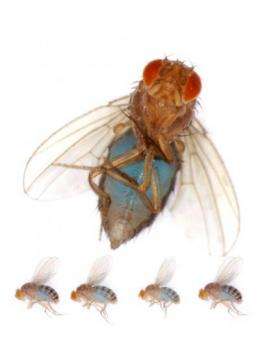
The researchers used a simple and clever assay to follow the type of food flies preferred: they added a blue dye to the yeast-enriched food and a red dye to the 'sugar rich food', and then looked at the bellies of the flies, to know which food they had eaten.

Carlos says, 'This assay, and the powerful genetics of the fruit fly, allowed us to take the next step, and describe the molecules and neurons which make mated females react faster than virgin females, as well as the molecules which act in the brain of flies to detect a lack proteins and make the flies change their decisions - the sensor, so to speak'.
How the brain decides what to eat
Enlarge

Flies get blue bellies after ingestion of the yeast-enriched food colored with a blue dye. Credit: Carlos Ribeiro, group leader in the Champalimaud Neuroscience Programme at the Instituto Gulbenkian de Ciência (Portugal)

The sensor turns out to be the same that might regulate feeding habits of both female mosquitoes and vertebrates. In humans, regulation of protein and carbohydrate uptake could be an important component of eating disorders - a major health problem in western societies. Amongst mosquitoes, it is the female who stings to get the proteins needed to make eggs. The urge to sting and ingest blood could be regulated by the same molecular brain sensor that Carlos Ribeiro now identified in Drosophila.

Carlos again, 'Maybe if we could understand how the sensor works in the Drosophila brain to control the urge to eat protein-rich , we might be able to alter the urge of mosquito females to ingest blood and, thus, interfere with the transfer of the malaria parasite between hosts.'

Research in the fruit fly has helped unravel several mechanisms which proved to be relevant in humans, too. This study appears to be on the same track.

Provided by Instituto Gulbenkian de Ciencia (news : web)


Rank 5 /5 (2 votes)
Relevant PhysicsForums posts
  • Mitosis
    created8 hours ago
  • Stem cell question.
    created9 hours ago
  • Protease cleavage
    created15 hours ago
  • Pertubance in a model
    created22 hours ago
  • Cancer drugs and Alzheimer's, Oh my!
    createdFeb 09, 2012
  • Squishing cells
    createdFeb 09, 2012
  • More from Physics Forums - Biology

More news stories

The power of estrogen -- male snakes attract other males

A new study has shown that boosting the estrogen levels of male garter snakes causes them to secrete the same pheromones that females use to attract suitors, and turned the males into just about the sexiest ...

Biology / Plants & Animals

created 20 hours ago | popularity 4.8 / 5 (6) | comments 2 | with audio podcast

Grass to gas: Researchers' genome map speeds biofuel development

Researchers at the University of Georgia have taken a major step in the ongoing effort to find sources of cleaner, renewable energy by mapping the genomes of two originator cells of Miscanthus x giganteus, a large perenn ...

Biology / Biotechnology

created 17 hours ago | popularity 3.8 / 5 (5) | comments 0 | with audio podcast

Experts reveal how plants don't get sunburn

(PhysOrg.com) -- Experts at the University of Glasgow have discovered how plants survive the harmful rays of the sun.

Biology / Cell & Microbiology

created 20 hours ago | popularity 4.8 / 5 (5) | comments 0 | with audio podcast

Entire genome of extinct human decoded from fossil

(PhysOrg.com) -- In 2010, Svante Pääbo and his colleagues presented a draft version of the genome from a small fragment of a human finger bone discovered in Denisova Cave in southern Siberia. The ...

Biology / Biotechnology

created Feb 07, 2012 | popularity 4.7 / 5 (56) | comments 42 | with audio podcast

Why are there so few fish in the Earth's oceans?

(PhysOrg.com) -- A Stony Brook University researcher has found that, contrary to popular belief, there are not plenty of fish in the sea.

Biology / Plants & Animals

created Feb 08, 2012 | popularity 4.3 / 5 (14) | comments 25 | with audio podcast


Anonymous knocks CIA website offline (Update)

The website of the Central Intelligence Agency was inaccessible on Friday after the hacker group Anonymous claimed to have knocked it offline.

New error-correcting codes guarantee the fastest possible rate of data transmission

Error-correcting codes are one of the triumphs of the digital age. They’re a way of encoding information so that it can be transmitted across a communication channel — such as an optical fiber o ...

Small modular reactor design could be a 'SUPERSTAR'

(PhysOrg.com) -- Though most of today's nuclear reactors are cooled by water, we've long known that there are alternatives; in fact, the world's first nuclear-powered electricity in 1951 came from a reactor ...

New power source discovered

(PhysOrg.com) -- Researchers at the Massachusetts Institute of Technology (MIT) and RMIT University have made a breakthrough in energy storage and power generation.

Advanced power-grid model finds low-cost, low-carbon future in West

(PhysOrg.com) -- The least expensive way for the Western U.S. to reduce greenhouse gas emissions enough to help prevent the worst consequences of global warming is to replace coal with renewable and other ...

Fool's gold may prove an unlikely alternative to overexploited catalytic materials

Catalytic materials, which lower the energy barriers for chemical reactions, are used in everything from the commercial production of chemicals to catalytic converters in car engines. However, with current catalytic materials ...