Spitting cobras track first, predict later
May 14, 2010
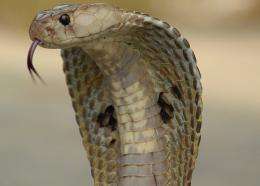
Indian Spectacled Cobra. Image credit: Wikipedia.
Most venomous snakes are legendary for their lethal bites, but not all. Some spit defensively. Bruce Young, from the University of Massachusetts Lowell, explains that some cobras defend themselves by spraying debilitating venom into the eyes of an aggressor.
Getting the chance to work with spitting cobras in South Africa, Young took the opportunity to record the venom spray tracks aimed at his eyes. Protected by a sheet of Perspex, Young caught the trails of venom and two things struck him: how accurately the snakes aimed and that each track was unique. This puzzled Young. For a start the cobra's fangs are fixed and they can't change the size of the venom orifice, 'so basic fluid dynamics would lead you to think that the pattern of the fluid should be fixed,' explains Young. But Young had also noticed that the snakes 'wiggled' their heads just before letting fly. 'The question became how do we reconcile those two things,' says Young, who publishes his discovery that the snakes initially track their victim's movement and then switch to predicting where the victim is going to be 200ms in the future in the Journal of Experimental Biology on 14 May 2010.
Young remembers that Guido Westhoff had also noticed the spitting cobra's 'head wiggle', so he and his research assistant, Melissa Boetig, travelled to Horst Bleckmann's lab in the University of Bonn, Germany, to find out how spitting cobras fine-tune their venom spray. The team had to find out how a target provokes a cobra to spit, and Young was the man for that job, 'I just put on the goggles and the cobras start spitting all over,' laughs Young.
Wearing a visor fitted with accelerometers to track his own head movements while Boetig and Westhoff filmed the cobra's movements at 500 frames/s, Young stood in front of the animals and taunted them by weaving his head about. Over a period of 6 weeks, the team filmed over 100 spits before trying to discover why Young was so successful at provoking the snakes.
Analysing Young's movements, only one thing stood out; 200 ms before the snake spat, Young suddenly jerked his head. The team realised that Young's head jerk was the spitting trigger. They reasoned that the snake must be tracking Young's movements right up to the instant that he jerked his head and that it took a further 200 ms for the snake to react and fire off the venom.
But Young was still moving after triggering the snake into spitting and the snake can't steer the stream of venom, so how was the cobra able to successfully hit Young's eyes if it was aiming at a point where the target had been 200 ms previously? Realigning the data to the instant when Young jerked his head, the team compared all of the snakes' head movements and noticed that the cobras were all moving in a similar way. They accelerated their heads in the same direction that Young's eyes were moving. 'Not only does it speed up but it predicts where I am going to be and then it patterns its venom in that area,' explains Young.
So spitting cobras defend themselves by initially tracking an aggressor's movements. However, at the instant that an attacker triggers the cobra into spitting, the reptile switches to predicting where the attacker's eyes will be 200 ms in the future and aims there to be sure that it hits its target.
More information: Westhoff, G., Boetig, M., Bleckmann, H. and Young, B. A. (2010). Target tracking during venom 'spitting' by cobras. J. Exp. Biol. 213, 1797-1802. http://jeb.biologists.org
-
Here's venom in your eye: Spitting cobras hit their mark
Jan 22, 2009 |
not rated yet |
0
-
How cobras form hood flares
Apr 20, 2010 |
not rated yet |
0
-
Research identifies importance of diet in snake venom evolution
Apr 08, 2009 |
not rated yet |
0
-
Study of isolated snakes could help shed light on venom composition
Sep 16, 2009 |
not rated yet |
0
-
Snake venoms share similar ingredients
Dec 20, 2007 |
not rated yet |
0
-
Engineers build first sub-10-nm carbon nanotube transistor
Feb 01, 2012 |
4.9 / 5 (31) |
30
-
Something old, something new: Evolution and the structural divergence of duplicate genes
Jan 31, 2012 |
4.6 / 5 (7) |
1
-
The hidden nanoworld of ice crystals: Revealing the dynamic behavior of quasi-liquid layers
Jan 30, 2012 |
5 / 5 (3) |
1
-
Stock market network reveals investor clustering
Jan 27, 2012 |
3.9 / 5 (23) |
8
-
Of microchemistry and molecules: Electronic microfluidic device synthesizes biocompatible probes
Jan 26, 2012 |
5 / 5 (1) |
0
-
Protease cleavage
3 hours ago
-
Pertubance in a model
10 hours ago
-
Cancer drugs and Alzheimer's, Oh my!
18 hours ago
-
Squishing cells
18 hours ago
-
Any books/articles for evolutionary stable strategy models in humans?
Feb 09, 2012
-
Science behind the bore feeling?
Feb 09, 2012
- More from Physics Forums - Biology
More news stories
The power of estrogen -- male snakes attract other males
A new study has shown that boosting the estrogen levels of male garter snakes causes them to secrete the same pheromones that females use to attract suitors, and turned the males into just about the sexiest ...
8 hours ago |
5 / 5 (3) |
0
|
Grass to gas: Researchers' genome map speeds biofuel development
Researchers at the University of Georgia have taken a major step in the ongoing effort to find sources of cleaner, renewable energy by mapping the genomes of two originator cells of Miscanthus x giganteus, a large perenn ...
5 hours ago |
3.7 / 5 (3) |
0
|
Experts reveal how plants don't get sunburn
(PhysOrg.com) -- Experts at the University of Glasgow have discovered how plants survive the harmful rays of the sun.
8 hours ago |
5 / 5 (2) |
0
|
Protein libraries in a snap
(PhysOrg.com) -- A Rice University undergraduate will depart with not only a degree but also a possible patent for his invention of an efficient way to create protein libraries, an important component of biomolecular ...
11 hours ago |
5 / 5 (2) |
0
|
Miami battling invasion of giant African snails
No one knows how they got there. But an invasion of African giant snails has southern Florida in a panic over potential crop damage, disease and general yuckiness surrounding the slimy gastropods.
12 hours ago |
not rated yet |
2
Google users warned of threat to smartphone wallets
Users of Google smartphone wallets were being warned on Friday that there is a way to crack pass codes intended to thwart thieves from going on illicit shopping sprees.
NASA sees wide-eyed cyclone Jasmine
Cyclone Jasmine's eye has opened wider on NASA satellite imagery, as it moves through the Southern Pacific Ocean.
NASA sees Giovanna reach cyclone strength, threaten Madagascar
Tropical Storm 12S built up steam and became a cyclone on February 10, 2012 as NASA's Terra satellite passed overhead. Residents of east-central Madagascar should prepare for this cyclone to make landfall ...
CIA website offline, Anonymous takes credit
The website of the Central Intelligence Agency was unresponsive on Friday after the hacker group Anonymous claimed to have knocked it offline.
Complex wiring of the nervous system may rely on a just a handful of genes and proteins
Researchers at the Salk Institute have discovered a startling feature of early brain development that helps to explain how complex neuron wiring patterns are programmed using just a handful of critical genes. ...
Putting the squeeze on planets outside our solar system
(PhysOrg.com) -- Using high-powered lasers, scientists at Lawrence Livermore National Laboratory and collaborators discovered that molten magnesium silicate undergoes a phase change in the liquid state, abruptly ...