Engineering Bacteria to Clean Up Pesticide (w/ Video)
May 14, 2010
Engineering Bacteria to Clean Up Pesticide

(PhysOrg.com) -- Can we get bugs to do our bidding? Emory chemist Justin Gallivan has moved science another step closer to that possibility. His lab reprogrammed an innocuous strain of the bacterium Escherichia coli to "seek and destroy" the molecules of an herbicide called atrazine.

"Rather than just altering a single gene and getting a cell to do one task, we can start thinking of a cell almost like a computer that we can reprogram to do a series of things," says Gallivan.

His lab’s latest findings were published in a recent issue of Nature .

Gallivan is working at the forefront of an area known as synthetic biology. A major goal of this field is to reprogram bacteria to carry out complex tasks, such as synthesizing and delivering drugs, and tracking and cleaning up environmental pollutants.

"The E. coli swims toward things it likes and away from things it doesn’t," Gallivan says. "It communicates with other cells. It synthesizes complicated compounds and replicates itself every 20 minutes. Put another way, E. coli tastes, thinks, talks, listens and makes things."

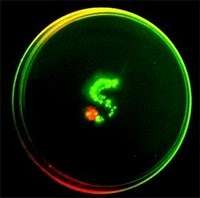
The program for all of these activities is packed into the of the bacterium, and is in part regulated by switches, known as riboswitches. By hacking into the E. coli program and inserting a synthetic riboswitch, Gallivan's team reprogrammed the E. coli cell's chemical navigation system. The presence of atrazine flips the synthetic riboswitch, causing the bacterium to move toward high concentrations of the .

This video is not supported by your browser at this time.

In addition, the researchers incorporated from atrazine-eating bacteria into the E. coli, so the bacterium performs a second task - consumption. "The E. coli essentially use the atrazine as food, breaking them down into something less harmful," Gallivan explains.

Atrazine has been banned in the European Union, but remains one of the most widely used herbicides in the United States, with millions of pounds of it applied annually. "Anytime you use that much of something, some of it is bound to end up in the groundwater," Gallivan says, explaining why his lab chose to explore methods of cleaning it up.

Gallivan focuses on fundamental research at the interface of chemistry, biology and materials science. "My interest is reprogramming simple organisms to get them to do new things, in a rational and predictable way," he says. "A revolution is going on in biology. We're really starting to understand the systems of living things at the molecular scale. Instead of asking, 'What is the nature of this organism?' We can begin asking, 'What can we do with this organism?'"

More information: Paper: http://www.nature. … o.369.html#/
Listen to a talk by Gallivan for the National Academy of Sciences on reprogramming bacteria.

Provided by Emory University (news : web)

4.8 /5 (10 votes)  

Rank 4.8 /5 (10 votes)
Related Stories
Relevant PhysicsForums posts
  • Stoichiometry
    createdFeb 10, 2012
  • Boiling and melting point of impure substances
    createdFeb 10, 2012
  • Safe nitrogen compound to decompose a 500 deg C in a furnace?
    createdFeb 09, 2012
  • [ask]electron inside drinking water
    createdFeb 08, 2012
  • How to avoid formation of Lithium Chromate ???
    createdFeb 08, 2012
  • how to choose a reduced or oxidated form in a redox
    createdFeb 08, 2012
  • More from Physics Forums - Chemistry

More news stories

Fool's gold may prove an unlikely alternative to overexploited catalytic materials

Catalytic materials, which lower the energy barriers for chemical reactions, are used in everything from the commercial production of chemicals to catalytic converters in car engines. However, with current catalytic materials ...

Chemistry / Materials Science

created 17 hours ago | popularity 4.4 / 5 (8) | comments 5 | with audio podcast

Unpicking HIV’s invisibility cloak

Drug researchers hunting for alternative ways to treat human immunodeficiency virus (HIV) infections may soon have a novel target—its camouflage coat. HIV hides inside a cloak unusually rich in a sugar ...

Chemistry / Biochemistry

created 17 hours ago | popularity 5 / 5 (5) | comments 0

Hydrogen from acidic water: Researchers develop potential low cost alternative to platinum for splitting water

A technique for creating a new molecule that structurally and chemically replicates the active part of the widely used industrial catalyst molybdenite has been developed by researchers with the Lawrence Berkeley ...

Chemistry / Materials Science

created Feb 09, 2012 | popularity 4.8 / 5 (14) | comments 15 | with audio podcast

No entry without protein recycling: Researchers discover new coherence in enzyme transport

The group of Prof. Dr. Ralf Erdmann at the Ruhr-Universität Bochum, Germany, discovered a connection of peroxisomal protein import and receptor export. In the Journal of Biological Chemistry, they disclo ...

Chemistry / Biochemistry

created 17 hours ago | popularity not rated yet | comments 0

Under the microscope #7

In this video Dr Ingrid Graz shows us a thin layer of gold on top of rubber. Cracks in the gold allow it to stretch and we can use this for stretchable electronics.

Chemistry / Other

created 19 hours ago | popularity not rated yet | comments 0


Anonymous knocks CIA website offline (Update)

The website of the Central Intelligence Agency was inaccessible on Friday after the hacker group Anonymous claimed to have knocked it offline.

New error-correcting codes guarantee the fastest possible rate of data transmission

Error-correcting codes are one of the triumphs of the digital age. They’re a way of encoding information so that it can be transmitted across a communication channel — such as an optical fiber o ...

Humans may have helped the decline of African rainforests 3000 years ago

(PhysOrg.com) -- Large areas of rainforests in Central Africa mysteriously disappeared over three thousand years ago, to be replaced by savannas. The prevailing theory has been that the cause was a change ...

Google users warned of threat to smartphone wallets

Users of Google smartphone wallets were being warned on Friday that there is a way to crack pass codes intended to thwart thieves from going on illicit shopping sprees.

New power source discovered

(PhysOrg.com) -- Researchers at the Massachusetts Institute of Technology (MIT) and RMIT University have made a breakthrough in energy storage and power generation.

The power of estrogen -- male snakes attract other males

A new study has shown that boosting the estrogen levels of male garter snakes causes them to secrete the same pheromones that females use to attract suitors, and turned the males into just about the sexiest ...