Scientists find huge oil plumes deep in Gulf of Mexico: report
May 16, 2010
Oil spill in the Gulf of Mexico nears the coast

Enlarge

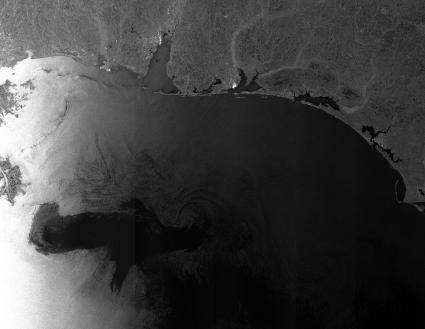
In this image, acquired by Envisat's Advanced Synthetic Aperture Radar instrument on 28 April 2010 at 03:45 UTC, the oil spill is visible as a lighter grey whirl on the left side of the large black pattern stretching across the Gulf. Credits: ESA

Scientists have discovered enormous plumes of oil in the deep waters of the Gulf of Mexico, in an indication that the leak from an underwater well could be far worse than previously estimated, The New York Times reported late Saturday.

One of the plumes was 10 miles (16 kilometers) long, three miles wide and 300 feet (91 meters) thick, according to the newspaper.

The BP-leased Deepwater Horizon rig exploded and sank in the gulf last month, rupturing a riser pipe that has been spewing hundreds of thousands of gallons of crude into the sea each day.

"There's a shocking amount of oil in the , relative to what you see in the surface water," the Times quoted University of Georgia researcher Samantha Joye as saying.

"There's a tremendous amount of oil in multiple layers, three or four or five layers deep in the water column."

Joye is involved in one of the first scientific missions to gather details about the environmental disaster.

The plumes are depleting the oxygen in the gulf, prompting fears that the process could eventually kill much of the sea life near the plumes, the report said.

Joye said the oxygen had already dropped 30 percent near some of the plumes.

"If you keep those kinds of rates up, you could draw the oxygen down to very low levels that are dangerous to animals in a couple of months," she is quoted as saying. "That is alarming."

The oil plumes were discovered by scientists from several universities working aboard the Pelican, which sailed from Cocodrie, Louisiana, on May 3, the Times said.

Studying video of the gushing oil well, the scientists have tentatively calculated that it could be flowing at a rate of 25,000 to 80,000 barrels of oil a day, the paper noted, up to 16 times the rate of 5,000 barrels a day estimated earlier by US officials and BP.

(c) 2010 AFP

4.8 /5 (41 votes)  

Filter


Move the slider to adjust rank threshold, so that you can hide some of the comments.


Display comments: newest first

frackingawesome
May 16, 2010

Rank: 4 / 5 (8)
Glad to have someone confirm this, I had my suspicions this could be the case.

At this point BP should be held 100% responsible for all costs. Including the costs to restore the wildlife, oceans, lost jobs, and any other impacted entity from this. That is the only way to handle "PR" right now without making millions of people even more angry.
magpies
May 16, 2010

Rank: 3.2 / 5 (10)
You act like they could ever afford the cost in damage this will do to the world. They arnt that rich.
Kedas
May 16, 2010

Rank: 3.7 / 5 (7)
Making them 100% responsible doesn't change the problem.
We have to work together to find a solution as fast as possible to make the problem stop growing and afterward we can give them the death sentence.(preferable a slow one like 'oilboarding')
Because they gambled with our planet for money and we all lost.

Bob_Kob
May 16, 2010

Rank: 2 / 5 (4)
cant they just pump it out?
resinoth
May 16, 2010

Rank: 4.2 / 5 (5)
these riser pipes should have automatic shutoffs.

this is truly outrageous.
shawnev
May 16, 2010

Rank: 3.7 / 5 (6)
BP will only make a loan of money to clean up this horrible mess. The loan will be repaid by everyone on this planet. BP will drive up the price of oil,increase there profits to cover there loss of the mighty Dollar.
BP's responsibility to conduct business on this planet has failed! The loss of life and damage can not be repaid! Good bye BP we can not afford you anymore.
marjon
May 16, 2010

Rank: 2.2 / 5 (9)
So let's stop off shore drilling in the USA and let Venezuela and China (countries well known for their protection of the environment) drill oil off the US coast while we import oil from around the world in huge, fragile tankers subject to sinking and leaking.
Any corporation needs to seriously reconsider their political donations. BP was actively working with the US government pushing cap and trade just as Enron's Ken Lay was promoting Kyoto for economic advantage.
Alizee
May 16, 2010

Rank: 4.4 / 5 (8)
BP is dumping over one million gallons of toxic chemicals into the ocean to break up the oil before it hits the shoreline - with the EPA's approval. 12 less toxic and more effective chemical solutions are available, so why did BP go with the most toxic brew? Yup – they have ties to the manufacturer.

http://www.nytime...183.html
otto1923
May 16, 2010

Rank: 2.2 / 5 (11)
We have to work together to find a solution as fast as possible
Nuke.
marjon
May 16, 2010

Rank: 2.5 / 5 (11)
Depleted O2 around the oil is caused by oil eating bacteria.
Nature is doing its thing.
Fisherman
May 16, 2010

Rank: 1 / 5 (2)
Can't we just implode the well from the sides and stop the flow? I would think the Navy has weaponry that could drill into the sea floor then impart a charge to collapse the well from the sides.
Thrasymachus
May 16, 2010

Rank: 1 / 5 (1)
I'm sure the Navy's been itching to try out some of their special new-fangled torpedoes they haven't been able to find real targets for yet. Might as well give blowing the damn thing up a try, can't make it much worse, and it might even work.
otto1923
May 16, 2010

Rank: 2 / 5 (9)
Can't we just implode the well from the sides and stop the flow? I would think the Navy has weaponry that could drill into the sea floor then impart a charge to collapse the well from the sides.
Nuke.
otto1923
May 16, 2010

Rank: 2.1 / 5 (7)
Can't we just implode the well from the sides and stop the flow? I would think the Navy has weaponry that could drill into the sea floor then impart a charge to collapse the well from the sides.
Nuke.
Nuke frajo. For one-ing otto.
Thrasymachus
May 16, 2010

Rank: not rated yet
Meh, there's no need to use a nuke. Conventional explosives are more than capable of collapsing enough of the drill well to seal it. Think of the international negotiation that would have to be involved with deploying a nuke like that.
Jaeson_Cardiff
May 16, 2010

Rank: 5 / 5 (3)
As reckless as it sounds, I believe we need a catastrophe of this proportion in order for us to take notice and make the necessary changes in our current behavior. If this spill was contained in a short period of time we would soon forget it had happened (who among you would have thought about EXXON if this hadn't happened.) Without trying to sound "preachy" we all (including myself) need to have something of this scale or perhaps even larger before any kind of change will occur. My two bits.
frajo
May 16, 2010

Rank: 5 / 5 (2)
Can't we just implode the well from the sides and stop the flow? I would think the Navy has weaponry that could drill into the sea floor then impart a charge to collapse the well from the sides.
Nuke.
Nuke frajo. For one-ing otto.
You are confusing items. I'm not voting on otto1923; I'm voting on nuking.
otto1923
May 16, 2010

Rank: 1.8 / 5 (6)
Meh, there's no need to use a nuke. Conventional explosives are more than capable of collapsing enough of the drill well to seal it. Think of the international negotiation that would have to be involved with deploying a nuke like that.
Im just guessing, but deep penetrators or barometrics wouldnt work here and conventional explosives would have to be dropped down adjacent drill holes. No time to waste! The gulf is dying! Nuke it already. Cauterize the black wound.
marjon
May 16, 2010

Rank: 2.8 / 5 (4)
Meh, there's no need to use a nuke. Conventional explosives are more than capable of collapsing enough of the drill well to seal it. Think of the international negotiation that would have to be involved with deploying a nuke like that.
Im just guessing, but deep penetrators or barometrics wouldnt work here and conventional explosives would have to be dropped down adjacent drill holes. No time to waste! The gulf is dying! Nuke it already. Cauterize the black wound.

I doubt a conventional nuclear weapon can handle the depth in its standard package. Even a convention depth charge would probably crushed. Either weapon would have to be placed in pressure vessel, steered to tgt and remotely detonated. Not saying it could not be done, but I don't think it is easy as it sounds at 160 atms per sq in pressure.
otto1923
May 16, 2010

Rank: 2.3 / 5 (6)
I doubt a conventional nuclear weapon can handle the depth in its standard package.
And you say that as an expert in... what was it? Bullshit and trolling? And baking pies and eating them?

"A drone mini-sub is standing by, which could easily deploy "a B83 (Mk-83) strategic thermonuclear bomb having a variable yield (Low Kiloton Range to 1,200 Kilotons) which with its 12 foot length and 18 inch diameter, and weighing just over 2,400 pounds" could instantly seal the leak, "the only known and proven means" to do so."
jt81ma
May 16, 2010

Rank: 5 / 5 (3)
Correct me if I'm wrong, but BP was just buying the oil from the rig, it was another company that was running it and responsible for the proper maintenance of said rig (OCEAN-something). Why have we not heard more on this Methane Burst that caused the problem and the manufacturer of the emergency shut-off valve that failed after the rig sank?
marjon
May 16, 2010

Rank: 4 / 5 (5)
I doubt a conventional nuclear weapon can handle the depth in its standard package.
And you say that as an expert in... what was it? Bullshit and trolling? And baking pies and eating them?

"A drone mini-sub is standing by, which could easily deploy "a B83 (Mk-83) strategic thermonuclear bomb having a variable yield (Low Kiloton Range to 1,200 Kilotons) which with its 12 foot length and 18 inch diameter, and weighing just over 2,400 pounds" could instantly seal the leak, "the only known and proven means" to do so."

I say that as an engineer that works with pressure vessels and as a diver.
Does the Navy have a drone submarine that can readily fit any nuclear weapon? Nuclear weapons are controlled by DOE and significant processes and procedures must be followed to even look at one not to mention retrofit one into a submarine. What happens if the drone sub is lost?
I don't say it is not impossible, just not as easy as you suggest.
marjon
May 16, 2010

Rank: 4 / 5 (4)
Correct me if I'm wrong, but BP was just buying the oil from the rig, it was another company that was running it and responsible for the proper maintenance of said rig (OCEAN-something). Why have we not heard more on this Methane Burst that caused the problem and the manufacturer of the emergency shut-off valve that failed after the rig sank?

The legal term is 'deep pockets'.
frajo
May 16, 2010

Rank: 5 / 5 (1)
I doubt a conventional nuclear weapon can handle the depth in its standard package.
And you say that as an expert in... what was it? Bullshit and trolling? And baking pies and eating them?
Seems you can't answer the pressure problem. I'm a bit disappointed.
thermodynamics
May 16, 2010

Rank: 4.1 / 5 (9)
Marjon: You said:

Depleted O2 around the oil is caused by oil eating bacteria.
Nature is doing its thing.


Just in case anyone took that as being true, let me explain. The oil and gas that is floating through the water column reacts directly with the oxygen in the water. The result is carbon dioxide and water vapor. The reason that you still have oil left is that it overwhelms the small partial pressure of oxygen at those depths. The result is that all life that relies on oxygen (including some of the bacteria (some do not need oxygen) you think are metabolizing the oil) dies. In lower concentrations the bacteria would be able to feast on the oil. However, in the plumes from this spill the oil overwhelms the oxygen and the biota. The result is suffocating marine life.
marjon
May 16, 2010

Rank: 1 / 5 (4)
"Scientists Find That Tons Of Oil Seep Into The Gulf Of Mexico Each Year"
"ScienceDaily (Jan. 27, 2000) — Twice an Exxon Valdez spill worth of oil seeps into the Gulf of Mexico every year, "
http://www.scienc...2228.htm
Some perspective.
thermodynamics
May 16, 2010

Rank: 3.9 / 5 (8)
marjon: Did you read the article you cite? Note that they point out that the oil is attacked at the surface and that it is very dilute. The situation above is very different. It is concentrated and is being spread throughout the column of water (partially due to the dispersant that is being used). When oil and gas are concentrated in the water they absorb the oxygen to form CO2 and water. The result is depletion of the oxygen. Note that in your citation there is no mention of the bacteria depleting the oxygen - because they do not. As they say in the article:

"Oil that finds its way to the surface from natural seeps gets broken down by bacteria and ends up as carbon dioxide, a greenhouse gas."

These are slow seeps that release small amounts per seep and cannot be compared with a gusher that has been opened up in a specific isolated location.
Truth
May 16, 2010

Rank: 1.5 / 5 (4)
With new oil rigs effectively stopped for the foreseeable future, Big Oil doesn't have to spend any money on more rigs and therefore can raise oil prices catastrophically, using the excuse that they have to rely on the rigs they do have. This whole thing sounds very suspicious. I wonder if the explosion was really accidental.
otto1923
May 16, 2010

Rank: 3 / 5 (4)
I say that as an engineer that works with pressure vessels and as a diver

"That is the biggest fool thing we have ever done. The [atomic] bomb will never go off, and I speak as an expert in explosives."
[A skeptical comment on the U.S. Atomic Bomb Project, to President Harry S. Truman in 1945.] - Admiral William D. Leahy
-Do you understand the comparison?
Seems you can't answer the pressure problem. I'm a bit disappointed.
As I'm not an expert and am not dense enough to think I'm one, I can only assume that the US Navy which routinely carries nuclear-tipped torpedos for instance, would know how to undertake this sort of thing. Or perhaps one of the less well-known branches of the US govt.
hard2grep
May 16, 2010

Rank: 3.7 / 5 (3)
I am going to as a silly question. Why did they drill a hole if they did not plan a way to cap it if something happened. Are you telling me that they are making all of that money, and did not set aside for this kind of event?
mattytheory
May 16, 2010

Rank: 3 / 5 (2)
Glad to have someone confirm this, I had my suspicions this could be the case.

At this point BP should be held 100% responsible for all costs. Including the costs to restore the wildlife, oceans, lost jobs, and any other impacted entity from this. That is the only way to handle "PR" right now without making millions of people even more angry.


Oh yes. Although I believe you have neglected to consider the possibility that some things cannot be restored. Play the blame game all you wish but it is blame that matters least when something priceless is destroyed.
neiorah
May 17, 2010

Rank: 5 / 5 (3)
Isn't this why we restricted off shore drilling in the first place?
I think about the Exxon Valdez very time I see an oil tanker or a a shore bird or a sea otter or a penguin. It saddens me that others in "higher" places do not
antialias_physorg
May 17, 2010

Rank: 5 / 5 (5)
[q}You act like they could ever afford the cost in damage this will do to the world. They arnt that rich.

With an annual profit of around 50bn dollars I think they can.
neiorah
May 17, 2010

Rank: 4.3 / 5 (3)
It really bothers me when the pres talked about off shore oil drilling. Did he just crawl out from underneath a rock or something? I though we were supposed to be getting away from oil and all it's hazards.
Skepticus
May 17, 2010

Rank: 4 / 5 (4)
From the way capitalism works, all that come out of this mess are that the lawyers are getting richer, the giant corporations will get a wink wink nod and a slap on the hand, and the tax payers as always get shafted to the bone to clean up the damage through taxes and increased fuel costs. Expect appeals from BP and the like to make the damage shrink from catastrophic to serious then negligible and then swept under the carpet in time. Unless you OUTLAW ALL KINDS OF LOBBYISTS IN WASHINGTON and has it written in to the Constitution. Fat chance of that.
Donna12283
May 17, 2010

Rank: 4.3 / 5 (3)
What's going to happen in a hurricane? Would that get sucked up and spilled over land??? Does anyone know?
marjon
May 17, 2010

Rank: 2.3 / 5 (3)
It really bothers me when the pres talked about off shore oil drilling. Did he just crawl out from underneath a rock or something? I though we were supposed to be getting away from oil and all it's hazards.

How?
marjon
May 17, 2010

Rank: 1.3 / 5 (3)
I am going to as a silly question. Why did they drill a hole if they did not plan a way to cap it if something happened. Are you telling me that they are making all of that money, and did not set aside for this kind of event?

The device failed. Stuff happens. Hindenburg explodes, Titanic sinks, Apollo capsules catch on fire, space shuttle explodes, planes crash. What is perfect?
marjon
May 17, 2010

Rank: 2.3 / 5 (4)
I say that as an engineer that works with pressure vessels and as a diver

"That is the biggest fool thing we have ever done. The [atomic] bomb will never go off, and I speak as an expert in explosives."
[A skeptical comment on the U.S. Atomic Bomb Project, to President Harry S. Truman in 1945.] - Admiral William D. Leahy
-Do you understand the comparison?
Seems you can't answer the pressure problem. I'm a bit disappointed.
As I'm not an expert and am not dense enough to think I'm one, I can only assume that the US Navy which routinely carries nuclear-tipped torpedos for instance, would know how to undertake this sort of thing. Or perhaps one of the less well-known branches of the US govt.

There is quite a pressure difference between 1000 feet and 5000 feet. Each 10 meters of water adds 1 bar pressure per sq in. Just saying it is not as easy as you want to believe.
otto1923
May 17, 2010

Rank: 2 / 5 (4)
-And that's really frackingawsome that you know that sort of thing. Let's see, let me check my arsenal... Ok, I think this ought to do the trick:
http://en.wikiped...Munition
-I'll put one of these on an RC deep submersible, in a suitable container as need be, and steer it down to the site. But if I was the president, who has ultimate authority in deploying these things, I would contact the appropriate agency (Rahm would know who to call) full of appropriate engineers who would be able to engineer the operation in order to get the job done correctly- that is with minimal collateral damage, residual radiation, and etc. For that is what appropriate engineers do isn't it?

Rest assured, since this has been a potential scenario for all the decades we have been drilling at 1000s of locations around the globe, and that accidents like this have the potential to affect national security, that studies by the appropriate people have already been prepared.
otto1923
May 17, 2010

Rank: 1.8 / 5 (5)
And I'm sure that the responsible agency has already staged whatever equipment and manpower would be needed in the event the pres or the People he works for should deem it necessary to quit futzing around and CLOSE THE HOLE.

Consideration of the portability of these demolitions devices led many to conclude that genuine adversaries would have no problems in locating them at strategic locations in large cities and near military locations, within their enemys' borders. This would provide genuine mutual assured destruction and deterrance, and sheds further doubt on there being any real threat of nuclear engagement during the 'cold war'. Why build all those missiles when you both had these things stashed, secure and undetectable, in the heart of enemy territory?

We can conclude that there were no 'enemies' other than the great mass of humanity itself at the time, and that this adversarial arrangement was used to enable the orderly division of this mass for the Purpose of managing them.
frajo
May 17, 2010

Rank: 2.3 / 5 (3)
Sorry, I don't believe your Grand Scheme conspiracy theories. I believe that sysiphos rules.
Yellowdart
May 17, 2010

Rank: 5 / 5 (2)
In response to thermo and marjon:

To help clarify, the main difference is whether or not it is in essence free product/NAPL or a dissolved plume. If the concentration is to the point of free product, bacteria will be ineffective. If it is in essence a dissolved plume, like your usual seafloor releases, bacteria handle it pretty well. The more concentrated, the longer it takes bacteria to break it down as well, so its not a quick fix and in either case you will be removing oxygen.

Once the source is removed, it'll still be a massive work to disperse/break down/remove the oil, and hopefully well enough that damage to the ecology is minimized.
otto1923
May 17, 2010

Rank: 2 / 5 (2)
Sorry, I don't believe your Grand Scheme conspiracy theories. I believe that sysiphos rules.
I believe in real People- Aristotle, Plato, Pythagoras zum Beispiel. Not mythos.
frajo
May 17, 2010

Rank: 4 / 5 (4)
Sorry, I don't believe your Grand Scheme conspiracy theories. I believe that sysiphos rules.
I believe in real People- Aristotle, Plato, Pythagoras zum Beispiel. Not mythos.
Sysiphos is not only a mythos - he's a paradigm. The antithesis of your Empire paradigm.
Skepticus
May 17, 2010

Rank: 3 / 5 (2)
@otto1923: Suppose the President authorized your "nuke fix"...I am afraid it will create a bigger mess than it already has. Let's see: A nuke went off at/near the leak at the bottom. A huge spherical bubble of superheated radioactive gas forms. The inital shockwave will vitrifies hundreds of feet of sediment and most probably fractures the rock layer underneath. Because of the depth, the blast bubble will not shoot up to the surface, but imploding when it has cooled somewhat. then it rebounds. This could go for a few cycles, every time sending out more shock waves to pound at the leak site. I don't think that will help to seal the leak, and quite possibly open a lot more cracks for the oil to leak out...and with radioactive products in the unholy soup...then you will have a Gulf full of ten eyes or two heads fishes...maybe even with hair on their belly! :-))
otto1923
May 17, 2010

Rank: 2 / 5 (4)
The effects would be 100 or so feet beneath the seabed. The oil is maybe 10x deeper. No effect to it. The bubble rises as it cycles. Irradiated mutants will comingle with tumorous oil-soaked bretheren- make new sushi dishes. Maybe isotopes will cure their tumors.
magpies
May 17, 2010

Rank: not rated yet
I agree cant wait till hurricane season :)
otto1923
May 17, 2010

Rank: 3 / 5 (3)
Sorry, I don't believe your Grand Scheme conspiracy theories. I believe that sysiphos rules.
I believe in real People- Aristotle, Plato, Pythagoras zum Beispiel. Not mythos.
Sysiphos is not only a mythos - he's a paradigm. The antithesis of your Empire paradigm.
I need to take another look at aristotles whole tragedy definition and especially the mythos/plot framework which is it's most important part. Unbeknownst to the players, the mythos directs the action behind the scenes to reach a predetermined conclusion. And as we know, it was Aristotle who taught Alexander (and bessus and artebasus and therefore Darius et al) exactly how to conquer the known world. According to Plan. Thanks for the tip!
Skepticus
May 17, 2010

Rank: 3 / 5 (2)
...Even of your engineers somehow buried the nuke under the sea bed, if they put it hundred of feet deep, all it will do is make an underground cavern, with plenty of cracks (see Wiki for underground nuke tests)for the oil to flow in, and no way that guarantees no crack reach the sea bottom. The oil is under higher pressure than the water pressure at the bottom, that's why it leaks out as it does now, it does not matter whether through cracks or man-made, out of control drill hole. If the nuke is put at certain shallower depths under the sea bottom, the cavern created from the explosion will collapse by water pressure from above. A pile of muck and rocks do not make a good seal of cracks and oil leaks from below, and as said above, the oil has more pressure than the water above. Same result. Same mutant crop of fishes years from now. Oh, oysters and shrimps too...
PinkElephant
May 17, 2010

Rank: 4.3 / 5 (6)
Just to address the above-alleged impossibility of reaching the site with a submersible: has marjon somehow missed the video of the broken pipe at the bottom, with oil and gas shooting out of it? That video was shot with deep-sea submersibles. Two of those submersibles collided yesterday, and temporarily knocked out a pipe they inserted to siphon off some of the leaking oil. The technology is quite there and ready, if a decision was made to use a nuke, or any other sort of explosive. Of course, as Skepticus points out, there may be rather nasty and unpredictable consequences of the nuke detonation itself.
otto1923
May 17, 2010

Rank: 2.3 / 5 (3)
Of course, as Skepticus points out, there may be rather nasty and unpredictable consequences of the nuke detonation itself.
And as I keep pointing out, thats what engineers are for. As for the cavern, again it would be created far above oil deposits and would likely not affect them. The cavern roof typically collapses, depositing 1000s of tons of material on the floor and over any nonexistant leaks. Then too, a cavern with a sealable access opening re Gnome might be of use in immediately releaving pressure and siphoning oil- maybe a deeper shot would be a good idea rather than relief wells pumping to the surface-
http://en.wikiped...plosions
marjon
May 17, 2010

Rank: 3.8 / 5 (5)
Just to address the above-alleged impossibility of reaching the site with a submersible: has marjon somehow missed the video of the broken pipe at the bottom, with oil and gas shooting out of it? That video was shot with deep-sea submersibles. Two of those submersibles collided yesterday, and temporarily knocked out a pipe they inserted to siphon off some of the leaking oil. The technology is quite there and ready, if a decision was made to use a nuke, or any other sort of explosive. Of course, as Skepticus points out, there may be rather nasty and unpredictable consequences of the nuke detonation itself.

I repeat, I did not say putting a nuclear device into deep sea submersible was impossible. I said it was not as easy as one may think for a wide variety of reasons. As you point out, control of such submersibles is not guaranteed. Anyone want to loose a nuclear weapon on the bottom of the Gulf?
Skepticus
May 17, 2010

Rank: 3.5 / 5 (2)
@otto1923: The "nuke'm" fix has been tried by the Soviets:
http://www.newsci...ils.html

The result was not perfect. 1 in 6 did not work. Nor the application easy to do. Engineers, no matter how talented or well meaning are not gods. They have to work within their knowledge and technological limits. In one instance, they have to detonate a nuke 6km underground (~18,000ft). That was a well on dry land. Imagine you have to put the nuke down 1.5 mile of water + 18,000 ft hole. May as well drill the relief well and kill the leak the usual way.
marjon
May 17, 2010

Rank: 3 / 5 (3)
Does anyone appreciate the fact that the pressure at 5000 ft is > 2000 psi?
That is >1 ton per square inch.
otto1923
May 17, 2010

Rank: 2.3 / 5 (3)
@otto1923: The "nuke'm" fix has been tried by the Soviets:
http://www.newsci...ils.html
-With excellent entertaining comments. See, otto is not all empty diatribe and polemic-

I dont know if there is a 'usual' way to do this- but there is a knowledge base for nuclear. I think its worth a try- an interesting scientific and sociopolitical experiment- show the world that the US is not afraid to use these things in all circumstances. They ARE real, and this is what they can do, and we can use them.
Skepticus
May 17, 2010

Rank: 5 / 5 (1)
Here is another link about the Soviets nuking oil wells:

http://www.cbsnew...465.html

If the press knows, then of course the Pentagon and thus the Prez would know much more how it went.
otto1923
May 17, 2010

Rank: 1 / 5 (1)
I tried posting this:
http://www.boingb...-le.html
-I hate when phizzork drops links when editing-
otto1923
May 17, 2010

Rank: 3 / 5 (2)
Does anyone appreciate the fact that the pressure at 5000 ft is > 2000 psi?
That is >1 ton per square inch.
Whats your point? Cant conceive of a container stout enough to withstand this?
http://en.wikiped...SV_Alvin
PinkElephant
May 17, 2010

Rank: 4 / 5 (5)
Does anyone appreciate the fact that the pressure at 5000 ft is > 2000 psi?
That is >1 ton per square inch.
Whooptie doo. There are numerous models of manned, pressurized mini-subs capable of diving to 6000+ meters (that's up to 20,000 ft for you metric-challenged types).

http://en.wikiped..._Vehicle

The highly successful Mir model has been around for 20 years:

http://en.wikiped...ersible)

And that's *civilian* technology. No telling what sort of classified stuff the Pentagon might have up its sleeve...
Skepticus
May 17, 2010

Rank: 3 / 5 (2)
@PinkElephant: While this oil leak is catastrophic, it's certainly not one to qualify as a national security doom scenario. I don't think the Pentagon would show its (if any) aces.
otto1923
May 17, 2010

Rank: 3.7 / 5 (3)
@PinkElephant: While this oil leak is catastrophic, it's certainly not one to qualify as a national security doom scenario. I don't think the Pentagon would show its (if any) aces.
Not yet. Unless it affects mexico, cuba, and elsewhere. The military may just want to get involved to prove a point.
marjon
May 17, 2010

Rank: 2.3 / 5 (3)
Does anyone appreciate the fact that the pressure at 5000 ft is > 2000 psi?
That is >1 ton per square inch.
Whooptie doo. There are numerous models of manned, pressurized mini-subs capable of diving to 6000+ meters (that's up to 20,000 ft for you metric-challenged types).

http://en.wikiped..._Vehicle

And that's *civilian* technology. No telling what sort of classified stuff the Pentagon might have up its sleeve...

How many have hatches to load nuclear weapons?
Here is what the Navy has: http://www.navy.m...cue.html
otto1923
May 17, 2010

Rank: 1 / 5 (2)
More breaking news on the Sensible Option: Obama sends nuke boffins to investigate:
http://www.telegr...eak.html
-Bring popcorn and an 'On the Beach' video. It'll be great-
@Marduk- a container would be quickly designed and fabricated if necessary.
marjon
May 17, 2010

Rank: 3.7 / 5 (3)
a container would be quickly designed and fabricated if necessary.

Like the one they made to trap the oil?
Responsible people must also understand the risks and be aware of the consequence of failure and understand as many of the failure points as possible.
Again, I never said it was not possible. But it will not be as easy as you imagine.
otto1923
May 17, 2010

Rank: 1 / 5 (1)
Like the one they made to trap the oil?
No this would be made out of 1" thk titanium and wouldn't be designed to 'contain' anything. And I didn't say anything about how easy it would be. How would I know? I'm not an engineer.
phystroll
May 18, 2010

Rank: not rated yet
What is the volume of an oil "plume" that is 10 miles long, three miles wide, and 300 feet deep? At 25 days into the "leak", what would be the avg flow rate required to create such a monster? 5000bpd? 25,000? 100,000? Millions? More than Millions? Is the flow rate important? Seems like it might be if it's blown out enough oil to create plumes anything like the article describes. (If that article is accurate about the plumes, it seems like we're just telling ourselves lies RE how much oil is gushin out of that well..) What is the concentration of oil to water in such a plume?
jsa09
May 18, 2010

Rank: not rated yet
10 miles about 15 kilometers 3 miles about 5 kilometers 300 feet about 100 meters that is 15,000 * 5,000 * 100 = 75 million cubic meters not sure how many cubic meters in a barrel though.
marjon
May 18, 2010

Rank: 3 / 5 (2)
Like the one they made to trap the oil?
No this would be made out of 1" thk titanium and wouldn't be designed to 'contain' anything. And I didn't say anything about how easy it would be. How would I know? I'm not an engineer.

Why 1" Ti if you are no engineer? Why not Al alloy? It is easier to work with. Steel would be even easier to work with and quite strong.
otto1923
May 18, 2010

Rank: 1 / 5 (1)
Vessels are already fabricated and awaiting use. Because Engineers of the Future think ahead and Plan for it.
marjon
May 18, 2010

Rank: 3 / 5 (2)
Vessels are already fabricated and awaiting use. Because Engineers of the Future think ahead and Plan for it.

Where?
otto1923
May 18, 2010

Rank: 1 / 5 (2)
Vessels are already fabricated and awaiting use. Because Engineers of the Future think ahead and Plan for it.

Where?
Why?
phystroll
May 18, 2010

Rank: 5 / 5 (1)
10 miles about 15 kilometers 3 miles about 5 kilometers 300 feet about 100 meters that is 15,000 * 5,000 * 100 = 75 million cubic meters not sure how many cubic meters in a barrel though.


Yep that was my point. There are 264 gallons in a cubic meter (about 6.29 barrels). 6.29*75 million = 471.75 million barrels of oil, divided by 25 days it took to form the plume = 18 million barrels of oil a day, give or take. not counting the other plumes or surface slick. Either it's not true, or the "leak" is way worse than even the worst-case estimates.
PinkElephant
May 18, 2010

Rank: 3.7 / 5 (3)
@phystroll,

You have to take into account that the plumes are not 100% oil by volume. They are an emulsion of oil in water, with most of the volume still taken up by water. Once you account for the dilution, the numbers shrink quite a bit. Of course, it's hard to account for dilution when we don't have the relevant numbers available...
phystroll
May 18, 2010

Rank: 5 / 5 (1)
yep, that's why i was curious what the concentration of the oil was - even if it's hypothetically 1 part oil to 100 parts water/other stuff, that's still a 1.8 million barrels/day required to create a plume that size, no?
frajo
May 18, 2010

Rank: 5 / 5 (2)
10 miles about 15 kilometers 3 miles about 5 kilometers 300 feet about 100 meters that is 15,000 * 5,000 * 100 = 75 million cubic meters not sure how many cubic meters in a barrel though.
I'm sorry, but (1.5*10**4)*(5*10**3)*(1*10**2) = 7.5*10**9 and in words it's 7.5 billion cubic meters.
phystroll
May 18, 2010

Rank: not rated yet
ahhh what's a couple orders of magnitude between friends?

Thanks frajo.
PinkElephant
May 18, 2010

Rank: 3 / 5 (4)
So, let's say the dilution is 100:1, and with the extra 2 orders of magnitude added back in (thanks to frajo), we're back to where we started: 18 million barrels a day, for that one plume alone.

Now, something really doesn't add up, because these numbers indicate a flow rate in excess of 1 million barrels per hour, or about 280 barrels per second (and that's not counting gas.) To dispense such volumes through a narrow borehole, the flow would have to be supersonic.

18+ million barrels/day is about 40 times the flow-based estimates of ~50,000 barrels/day. Of course, one possibility is that dilution levels in the plumes are not 100:1, but about 1/40th of that -- more like 25,000:1 (or just 250 ppm), though that sounds awfully thin...
phystroll
May 18, 2010

Rank: not rated yet
@PinkElephant, 25k:1 wouldn't really be a plume, would it even be noticeable at that concentration? The article seems to imply that it's thick gooey stuff, or maybe I'm just reading into it. I'm almost positive that the numbers for the flow rate have to be much, much higher than we're being led to believe, you're right that it really doesn't add up.
PinkElephant
May 18, 2010

Rank: 3 / 5 (4)
Another potentially important factor, is that the plume probably isn't 300 ft thick everywhere. It's possible that the plume is *up to* 300 ft thick in certain places, but much thinner than that on the whole. If so, then part of the problem would be that we're dealing with an oversimplification by a careless reporter...
phystroll
May 18, 2010

Rank: 5 / 5 (1)
no matter what the actual average thickness of the plume, it's still going to be tons of oil - Even if it were only 1 foot thick on average all the way across, that's would be around 600,000 barrels per day at a 100:1 dilution, but only about 250 barrels per day at 25k:1. But that seems incredibly optimistic.
marjon
May 18, 2010

Rank: 1 / 5 (1)
Vessels are already fabricated and awaiting use. Because Engineers of the Future think ahead and Plan for it.

Where?
Why?

Don't you know all the answers?
otto1923
May 18, 2010

Rank: 1 / 5 (2)
Vessels are already fabricated and awaiting use. Because Engineers of the Future think ahead and Plan for it.

Where?
Why?

Don't you know all the answers?
Dont you know any decent questions worth answering?
Yellowdart
May 19, 2010

Rank: 3 / 5 (2)
no matter what the actual average thickness of the plume, it's still going to be tons of oil - Even if it were only 1 foot thick on average all the way across, that's would be around 600,000 barrels per day at a 100:1 dilution, but only about 250 barrels per day at 25k:1. But that seems incredibly optimistic.


In '79 I believe there was a similiar oil spill that actually dumped 140 million gallons into the gulf by the time it was done. The major difference was that it was much further off shore, and the oil was ejected by the currents into the atlantic.

Due to the currents is why your getting what probably looks alot like a upside down chlorinated solvent plume. Fragmented and scattered.

But if it is diluted or basically a dissolved plume, then organisms can handle it especially if it stays off shore. The limiting agent is not oxygen, thatll be in plenty supply. It's the lack of phosphorus ultimately, but also nitrogen.
marjon
May 19, 2010

Rank: 2.3 / 5 (3)
Vessels are already fabricated and awaiting use. Because Engineers of the Future think ahead and Plan for it.

Where?
Why?

Don't you know all the answers?
Dont you know any decent questions worth answering?

How to really nuke the well is not a descent question for you to answer as you are the one who made the proposal?
otto1923
May 19, 2010

Rank: 1 / 5 (1)
Vessels are already fabricated and awaiting use. Because Engineers of the Future think ahead and Plan for it.

Where?
Why?

Don't you know all the answers?
Dont you know any decent questions worth answering?

How to really nuke the well is not a descent question for you to answer as you are the one who made the proposal?
Could you repeat that please?
marjon
May 19, 2010

Rank: 1 / 5 (1)
Vessels are already fabricated and awaiting use. Because Engineers of the Future think ahead and Plan for it.

Where?
Why?

Don't you know all the answers?
Dont you know any decent questions worth answering?

How to really nuke the well is not a descent question for you to answer as you are the one who made the proposal?
Could you repeat that please?

1. You suggested nuking the well.
2. I asked how.
3. You can't answer.
PinkElephant
May 19, 2010

Rank: 2.3 / 5 (3)
This demented pissing contest has to end. I'm reporting both of you for "abuse", and encouraging others to do so. Cheers.
otto1923
May 19, 2010

Rank: 5 / 5 (1)
This demented pissing contest has to end. I'm reporting both of you for "abuse", and encouraging others to do so. Cheers.
I enjoy drawing attention to the egregious overuse of the quote button by someone too lazy to edit. This has been pointed out before to no effect. Got any better ideas?
baudrunner
May 21, 2010

Rank: 4 / 5 (1)
I think there is an element of "doing it on the cheap" here which is partly, if not wholly, responsible for the rig exploding. BP is a British company, so what the heck is it doing drilling for oil this close to the USA? Naturally, the British are only mildly concerned about the effects on the water and wildlife, not to mention tourism, on the Gulf coasts. Let's drill for oil cheaply on the British coast, and.. oops! oh, well, who cares?
marjon
May 21, 2010

Rank: 1 / 5 (5)
I think there is an element of "doing it on the cheap" here which is partly, if not wholly, responsible for the rig exploding. BP is a British company, so what the heck is it doing drilling for oil this close to the USA? Naturally, the British are only mildly concerned about the effects on the water and wildlife, not to mention tourism, on the Gulf coasts. Let's drill for oil cheaply on the British coast, and.. oops! oh, well, who cares?

It is amusing that BP has been a huge supporter of 'green' energy and Gore's AGW religion. See what all those campaign donations hath wrought?
marjon
May 21, 2010

Rank: 3 / 5 (2)
This demented pissing contest has to end. I'm reporting both of you for "abuse", and encouraging others to do so. Cheers.

'Scientists' don't have to actually implement their crazy ideas like using a nuclear weapon to stop the oil leak.
Obviously the idea was not completely thought through or those who support it could have answered my questions.
otto1923
May 21, 2010

Rank: not rated yet
Sorry Marmaduke, all out of biscuits. Go beg somewhere else.
marjon
May 21, 2010

Rank: 3 / 5 (2)
This demented pissing contest has to end. I'm reporting both of you for "abuse", and encouraging others to do so. Cheers.
I enjoy drawing attention to the egregious overuse of the quote button by someone too lazy to edit. This has been pointed out before to no effect. Got any better ideas?

Using quotes provides reference and context. Something every quality science paper should include.
PinkElephant
May 21, 2010

Rank: 3.4 / 5 (5)
@baudrunner,

You must've missed the part where the rig was actually the property of an American company (Transocean), which was also responsible for operation of the rig, whereas Halliburton (another American company) was responsible for drilling and borehole cementing, while BP was merely buying the final product off them.

That, and the rig was supposed to be inspected monthly by the MMS, but wasn't.

I'm not a fan of BP, but your scapegoating of them is more than a bit egregious.
Caliban
May 22, 2010

Rank: 2.3 / 5 (3)
http://www.altern...e=entire

Link above provides most of the info, including a 60 Minutes interview with a worker that survived the explosion, and the guy appointed by the administration to investigate the events that lead to the blowout. Shall I say "compelling"?

It appears that BP is very much to blame, Transocean(Corp HQ Swiss), and Halliburton also get a piece of the pie.

Also, it should be pointed out that this oil is in a reservoir not only under 5,000ft of water, but also ~20,000 ft of crust. Resulting combined litho- and hydrostatic pressure is many thousands of tons per square inch- I would venture a more exact figure, but it's a long time since I studied the quantitative aspects of geology. At any rate, it would, uncontrolled, result in quite a vigorous, high-volume flow rate, even given relatively small aperture.
Birthmark
May 22, 2010

Rank: 5 / 5 (3)
"Scientists Find That Tons Of Oil Seep Into The Gulf Of Mexico Each Year"
"ScienceDaily (Jan. 27, 2000) � Twice an Exxon Valdez spill worth of oil seeps into the Gulf of Mexico every year, "
http://www.scienc...2228.htm
Some perspective.


OMG!! I hate when people say this S***, that's the equivalent of me saying about 9/11;
"Well thousands of people die a day, in fact it's several times more than 9/11"
JUST because other things happen naturally doesn't mean the man-made incidences can be dismissed! Where are the logical intelligent people anymore!?
Jadxia
May 22, 2010

Rank: 5 / 5 (2)
In some countries, all these executives would have committed suicide by now.... just saying.
jimbo92107
May 22, 2010

Rank: 3.5 / 5 (2)
These BP clowns have no idea how to stop their Gulf-killing gusher. Their "solutions" have all the earmarks of the most simplistic ideas you'd expect from little children. Put stuff on top of it. Stick a straw into it and suck out the juice.

Now I see "Nuke it." Once again, this kind of solution reflects a childlike lack consideration. At least some have noted obvious questions that need definitive answers, lest the nuclear "solution" makes the problem much worse. What effect will 5,000 feet of pressure have on the yield? Will the yield be sufficient to collapse the hole below the sediment layer? Will collapsing the rock layer seal the leak, or cause a thousand smaller ones?

Blithely ignoring worst-case scenarios is what caused this disaster. Shall we repeat that mistake on a larger scale?
otto1923
May 22, 2010

Rank: 1 / 5 (2)
Hi kneejerk,
Another fearmonger who would rather spout than do a little research:
http://www.oil-pr...pill.php
http://www.telegr...eak.html
http://en.wikiped...plosions
-Read these and come back with an informed opinion-
barakn
May 22, 2010

Rank: 5 / 5 (1)
Marjon wrote:
I don't think it is easy as it sounds at 160 atms per sq in pressure.....Each 10 meters of water adds 1 bar pressure per sq in.

Atmospheres and bars, as units of pressure, already include inverse square area. By dividing by square area again, you're implying that pressure is force per (length to the fourth power).
marjon
May 22, 2010

Rank: 1 / 5 (1)
Marjon wrote:
I don't think it is easy as it sounds at 160 atms per sq in pressure.....Each 10 meters of water adds 1 bar pressure per sq in.

Atmospheres and bars, as units of pressure, already include inverse square area. By dividing by square area again, you're implying that pressure is force per (length to the fourth power).

OK, got me.
1 atm => ~15 lbs/in2.
1 barr => 100,000 N/m2.
frajo
May 22, 2010

Rank: 5 / 5 (3)
Another fearmonger who would rather spout than do a little research:
...
-Read these and come back with an informed opinion-
I've read them and found that none of them refers to a situation comparable to the incident which is discussed here. There is no evidence for empirical data of the effects of triggering a nuclear explosion near a subocean oil field at this depth.
otto1923
May 22, 2010

Rank: 3 / 5 (2)
Another fearmonger who would rather spout than do a little research:
...
-Read these and come back with an informed opinion-
I've read them and found that none of them refers to a situation comparable to the incident which is discussed here. There is no evidence for empirical data of the effects of triggering a nuclear explosion near a subocean oil field at this depth.
But there is for:
Underwater nuclear explosions at comparable depths
Shallow underwater explosions in comparable strata
Nuclear explosions used to close comparable leaks
Non-nuclear explosions for all kinds of conditions
-And might I point out that that is only an assumption you are making- we don't know what has been tried. Plowshare shots were conducted in part to explore the possibilities in disguising events. Also- competent engineers and scientists are on the job. Nothing is faultless. This whole fiasco could in fact be an experiment for drilling in far more sensitive areas like the Atlantic.
otto1923
May 22, 2010

Rank: 3 / 5 (2)
This oil is over 2 miles below the seabed. A nuclear detonation will not affect it. If they decide to do it I am going to assume that they've done their homework and these concerns have been addressed, and more.
marjon
May 22, 2010

Rank: 3 / 5 (4)
This oil is over 2 miles below the seabed. A nuclear detonation will not affect it. If they decide to do it I am going to assume that they've done their homework and these concerns have been addressed, and more.

You have been advocating they should do this without consideration of any consequence. Now you say, IF they do this, THEY will have considered all the consequences. I hope THEY would as you have not.
Rank 4.8 /5 (41 votes)
Related Stories
Relevant PhysicsForums posts
  • Discrepancy between oxygen and carbon-dioxide levels
    created14 hours ago
  • where gems are found in the world
    created17 hours ago
  • Wind Waves in Reservoir ~ Wind run-up and Wind set-up
    createdFeb 08, 2012
  • Balance of oxygen in the atmosphere
    createdFeb 01, 2012
  • The case for a methanol-based economy
    createdJan 30, 2012
  • Weather in a rotating cylinder
    createdJan 25, 2012
  • More from Physics Forums - Earth

More news stories

Could Venus be shifting gear?

(PhysOrg.com) -- ESA’s Venus Express spacecraft has discovered that our cloud-covered neighbour spins a little slower than previously measured. Peering through the dense atmosphere in the infrared, the ...

Space & Earth / Space Exploration

created 3 hours ago | popularity 5 / 5 (4) | comments 4 | with audio podcast

Humans may have helped the decline of African rainforests 3000 years ago

(PhysOrg.com) -- Large areas of rainforests in Central Africa mysteriously disappeared over three thousand years ago, to be replaced by savannas. The prevailing theory has been that the cause was a change ...

Space & Earth / Environment

created 7 hours ago | popularity 5 / 5 (3) | comments 7 | with audio podcast report

Clam fields found at deep, low-temperature Mariana vents

(PhysOrg.com) -- Scientists have marveled at the unusual life forms thriving at high temperature hydrothermal vents of the deep ocean.

Space & Earth / Earth Sciences

created 3 hours ago | popularity not rated yet | comments 0 | with audio podcast

Mars Science Laboratory computer issue resolved

(PhysOrg.com) -- Engineers have found the root cause of a computer reset that occurred two months ago on NASA's Mars Science Laboratory and have determined how to correct it.

Space & Earth / Space Exploration

created 4 hours ago | popularity 5 / 5 (5) | comments 2 | with audio podcast

Two new moons for Jupiter

Advances in technology have lead to the discovery of new planets outside of our Solar System, and now even new moons in our own backyard.

Space & Earth / Space Exploration

created 3 hours ago | popularity not rated yet | comments 2


New understanding of DNA repair could eventually lead to cancer therapy

A research group in the Faculty of Medicine & Dentistry at the University of Alberta is hoping its latest discovery could one day be used to develop new therapies that target certain types of cancers.

Zuckerberg's focus drives Facebook's ascent

When Mark Zuckerberg showed up to rent Judy Fusco's Los Altos, Calif., house in the fall of 2004, soon after he'd arrived in Silicon Valley, the landlord was immediately struck by his confidence.

Both maternal and paternal age linked to autism

Older maternal and paternal age are jointly associated with having a child with autism, according to a recently published study led by researchers at The University of Texas Health Science Center at Houston (UTHealth).

Night, weekend delivery OK for babies with birth defects

Weekday delivery is no better than night or weekend delivery for infants with birth defects, according to a new study presented today at The Pregnancy Meeting, the Society for Maternal-Fetal Medicine's annual conference. ...

Sonic Cradle lands spot in TED exhibition

A Simon Fraser University graduate student project that melds music, meditation and modern technology has landed a rare spot as an exhibit at TEDActive 2012 in Palm Springs, California this month.

From virginity to Viagra

Americans will spend more than $17 billion on Valentine's Day, but far less on programs like sex education for adolescents. The editors of the new book, Sex for Life, From Virginity to Viagra, How Sexuality Changes Throughout ...