50 Years Of Lasers
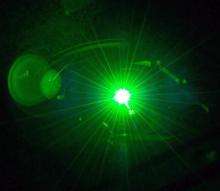
This weekend marked the 50th anniversary of the invention of the first working laser. Today, lasers can be found almost everywhere, from telephone lines to cutting edge scientific research, supermarket scanners, and even cat toys.
The first laser light was produced on May 16, 1960 at the Hughes Research Lab in Malibu, California when Theodore Maimen switched on his fist-sized device that flashed a bright red spot onto a photo-detector. Since then, lasers have become smaller, more powerful, and ubiquitous in modern technology.
"It's the invisible wheel. We so take it for granted now," said Tom Baer, the executive director of the Stanford Photonics Research Center, Palo Alto, California. "Half the [U.S] gross domestic product is impacted substantially by the laser."
Lasers have had an especially big impact on information technology. Sending data using digitized laser light signals over fiber optics has revolutionized the transfer of data. The IBM Roadrunner, the world's second fastest supercomputer, has over 45,000 lasers used for sending data across its 133,000 processing cores. Likewise, fiber optics make up the backbone of the Internet as nearly all data runs on fiber optic lines.
"Right now our whole economic infrastructure is based on information sent over fiber optics by lasers," Baer said. "If you shut down all the lasers, it would cripple our economy."
Other areas of the economy have been similarly affected. CDs, DVDs and Blu-ray discs all use lasers to read the information encoded on them. Laser cutters and welding torches play an integral role in manufacturing and machining goods. Lasik eye surgery is less invasive and painful than traditional eye surgeries. Researchers also think that a process that uses lasers to scan DNA will be the central to future technologies that can decode a human genome for cheap.
However, it was not always like this. In the '60s, Irnee D'Haenens, Maimen's assistant, often referred to the invention as "a solution looking for a problem." The product of basic research, no one quite knew how to turn the laser into a practical application.
"It took a long time before this became a matter of anything more than academic interest," said Jeff Hecht, author of several books about the history of lasers and optics.
Different research teams across the world had been competing to design and build the first working laser. Soon after Maimen completed his laser, researchers at other labs were able to build their own. These early lasers were powerful enough to shoot holes through metal, which soon turned into a minor arms race between the different teams vying to build the most powerful laser. The teams would measure the power of these early lasers based on the number of Gillette razor blades that the beams could shoot through.
"As production of these lasers became easier, people started looking at them for other purposes," Hecht said.
The development of different kinds of lasers took off soon after its invention. Researchers produced lasers that used a variety of materials such as helium-neon gas, carbon dioxide and semiconducting diodes.
Along with the development of new lasers came the first tentative forays into commercial applications. The first proof of concept that lasers could be used medicinally came in 1961 when Charles Campbell and Charles Koester used lasers to destroy a patient's eye tumor. In 1965, James Russell developed the first laser compact disc, a precursor to modern laserdiscs and CDs.
Once small and durable diode lasers could be mass-produced, starting in the '70s, commercial applications came fast. A supermarket barcode scanner read the price of a pack of Wrigley's gum in 1974. Consumer laserdiscs debuted in 1978 and CDs came two years later, and the first trans-Atlantic fiber optic cable carrying international phone calls were laid in 1988.
"I think the laser has essentially revolutionized in scientific research," said C. Kumar Patel, CEO of the laser spectroscopy firm Pranalytica in Santa Monica, California. Patel invented the first CO2 laser in 1963. "I know of very, very few scientific studies these days that don't use lasers in some way or another," Patel said.
Since their invention, 15 Nobel prizes in physics have used lasers as a critical component. In 1997, Secretary of Energy Dr. Steven Chu -- then a researcher at Stanford University -- was awarded the Nobel Prize for his work using lasers to optically trap and cool clouds of atoms to a fraction of a degree above absolute zero.
Last year's startup of the National Ignition Facility at Lawrence Livermore National Labs in California shows how lasers could provide cheap energy in the future. Researchers there hope to create a sustained fusion reaction by shining 192 of the world's most powerful lasers onto a small pellet of hydrogen. The amount of energy that results from the reaction should be greater than what it took to trigger it, a difference that researchers hope someday to harness.
"Scientists and engineers are looking at how to do things better, and how to do things that have never been done," said Patel. "The invention and development of lasers started off as a purely scientific activity and for a long time stayed as a scientific activity ... It takes a long time for an invention to mature and contribute to country's overall economic engine."
Provided by Inside Science News Service


