Beware of Hackers Controlling Your Automobile
May 18, 2010 by John Messina
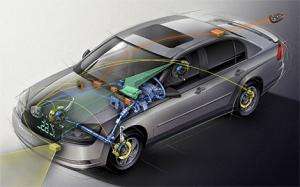
GMC's Yukon hybrid, control software logic analyzes hundreds of inputs every 10 milliseconds, including vehicle load, engine operations, battery parameters, and the temperatures in the high-voltage electric components. Credit: GMC
(PhysOrg.com) -- A team of researchers led by Professor Stefan Savage from the University of California, San Diego and Tadayoshi Kohno from the University of Washington set out to see what it would take to control an automobile’s electronic control units (ECUs); what they found out may surprise you.
The researchers focused their attacks of the automobile’s ECUs which are located all over a vehicle and control the workings of many car components. The hackers created software called ‘CarShark’ to monitor communications between the ECUs and used fake packets of data to carry out the attack.
Access to the automobile’s computer system was done through the computer’s access port that is standard among cars and used by mechanics to diagnose car’s performance before servicing.
The researchers launched a series of attacks against the automobile’s ECUs in a moving and stationary vehicle to determine how much control they could have on the car.
The researchers stated; "We are able to forcibly and completely disengage the brakes while driving, making it difficult for the driver to stop. Conversely, we are able to forcibly activate the brakes, forcing the driver forward and causing the car to stop suddenly."
The researchers found that practically every system in the car, such as brakes, light, engine, cooling, instrument panel, radio, and door locks, were vulnerable to attack.
The conclusion the team came to is that the vehicle’s software was “fragile” and easy to sabotage. In some cases simply sending imperfect packets of data, rather than specific control code, was enough for triggering a response from the vehicle.
Hacking into an automobile’s computer system is nothing new and has been happening since car computers systems have appeared. Typically hacking into a vehicle’s wireless key system or a car’s ECUs to boost engine performance has been happening for years.
As technology advances in automobiles, the risk grows greater that hackers will one day develop a means of getting into a vehicle’s control system remotely that will cause serious safety concerns.
More information: Experimental Security Analysis of a Modern Automobile
© 2010 PhysOrg.com
-
Automobile control research opens door to new safety features (w/ Video)
Apr 06, 2010 |
not rated yet |
0
-
Briefs: XM Satellite to unviel new services at CES
Dec 29, 2005 |
not rated yet |
0
-
The automobile of the future on the way
Jan 21, 2005 |
not rated yet |
0
-
Smart cars to rule the roads
Jul 14, 2006 |
not rated yet |
0
-
On the road to secure car-to-car communications
Sep 14, 2009 |
not rated yet |
0
-
Engineers build first sub-10-nm carbon nanotube transistor
Feb 01, 2012 |
4.9 / 5 (29) |
30
-
Something old, something new: Evolution and the structural divergence of duplicate genes
Jan 31, 2012 |
4.6 / 5 (7) |
1
-
The hidden nanoworld of ice crystals: Revealing the dynamic behavior of quasi-liquid layers
Jan 30, 2012 |
5 / 5 (3) |
1
-
Stock market network reveals investor clustering
Jan 27, 2012 |
3.9 / 5 (23) |
8
-
Of microchemistry and molecules: Electronic microfluidic device synthesizes biocompatible probes
Jan 26, 2012 |
5 / 5 (1) |
0
-
dynamics 2/32
2 hours ago
-
dynamics
2 hours ago
-
Vibration Absorbtion Problem
7 hours ago
-
Does anyone make a small high temperature and high pressure pump?
13 hours ago
-
Strange indexing in Fortran Code
Feb 07, 2012
-
Car Port post load calculation
Feb 07, 2012
- More from Physics Forums - General Engineering
More news stories
Windows 8 preview set for February 29
Microsoft on Wednesday revealed plans to unveil a test version of its latest Windows computer operating software later this month.
7 hours ago |
3.8 / 5 (4) |
5
Solar start-ups set new efficiency records
(PhysOrg.com) -- Although Alta Devices and Semprius make different types of solar panels, both start-ups have been breaking records in the past few days. Santa Clara, Calif.-based Alta Devices announced that ...
Groupon fails to turn profit as revenue grows
Daily deals site Groupon on Wednesday issued its first earnings report as a publicly traded company, saying it failed to turn a profit despite revenue nearly tripling from a year earlier.
5 hours ago |
not rated yet |
0
Lawsuit seeks to block Google's privacy changes
(AP) -- A consumer watchdog group is suing the Federal Trade Commission in an attempt to prevent Google from making sweeping changes to its privacy policies next month.
5 hours ago |
not rated yet |
0
Romanian accused of hacking NASA-JPL computers
(AP) -- The Los Angeles U.S. attorney's office says a federal grand jury has indicted a Romanian citizen on charges he hacked into 25 climate-research computers at NASA's Jet Propulsion Laboratory in Pasadena.
5 hours ago |
not rated yet |
0
Astronomy team discovers nearby dwarf galaxy
(PhysOrg.com) -- A team led by UCLA research astronomer Michael Rich has used a unique telescope to discover a previously unknown companion to the nearby galaxy NGC 4449, which is some 12.5 million light years ...
Amasia: As next supercontinent forms, Arctic Ocean, Caribbean will vanish first
(PhysOrg.com) -- Geologists at Yale University have proposed a new theory to describe the formation of supercontinents, the epic process by which Earths major continental blocks combine into a single ...
Why are there so few fish in the Earth's oceans?
(PhysOrg.com) -- A Stony Brook University researcher has found that, contrary to popular belief, there are not plenty of fish in the sea.
Transparent iron? For the first time, an experiment shows that atomic nuclei can become transparent
At the high-brilliance synchrotron light source PETRA III, a team of DESY scientists headed by Dr. Ralf Röhlsberger has succeeded in making atomic nuclei transparent with the help of X-ray light. At the ...
Physicists build highly efficient 'no-waste' laser
A team of University of California, San Diego researchers has built the smallest room-temperature nanolaser to date, as well as an even more startling device: a highly efficient, "thresholdless" laser that ...
Scientists strengthen memory by stimulating key site in brain
Ever gone to the movies and forgotten where you parked the car? New UCLA research may one day help you improve your memory.
May 18, 2010
Rank: 5 / 5 (1)
Really? It should surprise me that hackers with unfettered access to a car's computer modules should be able to screw up the car's operation? I could do worse with a bucket of sand and a pound of sugar.
If this article argues for anything, it's better locks. Meanwhile, don't create a traffic system that depends on centralized radio control. Now, if a hacker could generate bogus GPS signals, that would cause some serious havoc...
May 18, 2010
Rank: not rated yet
FEAR!!!
NEVER DRIVE AGAIN!!!
May 18, 2010
Rank: 5 / 5 (1)
Sure you could compromise the control system on say first gen ABS cars. But you'd probably need a jack and some wrenches. This is something a passenger could potentially even connect, and with wireless broadband etc., the enabling factors are now there for a real "remote control car" scenario.
May 18, 2010
Rank: not rated yet
May 18, 2010
Rank: 5 / 5 (2)
May 18, 2010
Rank: 5 / 5 (1)
This sort of tampering could be performed remotely and it is possible for the saboteur to cover his/her tracks - leaving the liability to the driver.
May 18, 2010
Rank: not rated yet
May 18, 2010
Rank: not rated yet
May 18, 2010
Rank: 5 / 5 (1)
May 18, 2010
Rank: not rated yet
May 19, 2010
Rank: not rated yet
May 19, 2010
Rank: 5 / 5 (1)