Greenland rapidly rising as ice melt continues
May 18, 2010
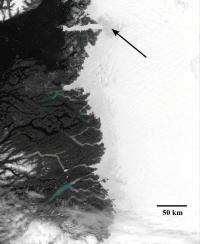
This is a satellite image of Western Greenland, acquired by NASA's MODIS satellite. The narrow grey band in the center of the image is melting ice, between the rocky coast to the left (west) and thicker, non-melting, higher altitude ice to the right (east). Small lakes form in this region during the summer. Arrow points to darker grey zone of rapidly thinning ice near the outlet of Jacobshavn glacier, which also loses mass due to iceberg calving. Credit: Courtesy of NASA
Greenland is situated in the Atlantic Ocean to the northeast of Canada. It has stunning fjords on its rocky coast formed by moving glaciers, and a dense icecap up to 2 km thick that covers much of the island--pressing down the land beneath and lowering its elevation. Now, scientists at the University of Miami say Greenland's ice is melting so quickly that the land underneath is rising at an accelerated pace.
According to the study, some coastal areas are going up by nearly one inch per year and if current trends continue, that number could accelerate to as much as two inches per year by 2025, explains Tim Dixon, professor of geophysics at the University of Miami Rosenstiel School of Marine and Atmospheric Science (RSMAS) and principal investigator of the study.
"It's been known for several years that climate change is contributing to the melting of Greenland's ice sheet," Dixon says. "What's surprising, and a bit worrisome, is that the ice is melting so fast that we can actually see the land uplift in response," he says. "Even more surprising, the rise seems to be accelerating, implying that melting is accelerating."
Dixon and his collaborators share their findings in a new study titled "Accelerating uplift in the North Atlantic region as an indicator of ice loss," The paper is now available as an advanced online publication, by Nature Geoscience. The idea behind the study is that if Greenland is losing its ice cover, the resulting loss of weight causes the rocky surface beneath to rise. The same process is affecting the islands of Iceland and Svalbard, which also have ice caps, explains Shimon Wdowinski, research associate professor in the University of Miami RSMAS, and co-author of the study.
"During ice ages and in times of ice accumulation, the ice suppresses the land," Wdowinski says. "When the ice melts, the land rebounds upwards," he says. "Our study is consistent with a number of global warming indicators, confirming that ice melt and sea level rise are real and becoming significant."
Using specialized global positioning system (GPS) receivers stationed on the rocky shores of Greenland, the scientists looked at data from 1995 onward. The raw GPS data were analyzed for high accuracy position information, as well as the vertical velocity and acceleration of each GPS site.
The measurements are restricted to places where rock is exposed, limiting the study to coastal areas. However, previous data indicate that ice in Greenland's interior is in approximate balance: yearly losses from ice melting and flowing toward the coast are balanced by new snow accumulation, which gradually turns to ice. Most ice loss occurs at the warmer coast, by melting and iceberg calving and where the GPS data are most sensitive to changes. In western Greenland, the uplift seems to have started in the late 1990's.
Melting of Greenland's ice contributes to global sea level rise. If the acceleration of uplift and the implied acceleration of melting continue, Greenland could soon become the largest contributor to global sea level rise, explains Yan Jiang, Ph.D. candidate at the University of Miami RSMAS and co-author of the study.
"Greenland's ice melt is very important because it has a big impact on global sea level rise," Jiang says. "We hope that our work reaches the general public and that this information is considered by policy makers."
This work was supported by the National Science Foundation and NASA. The team plans to continue its studies, looking at additional GPS stations in sensitive coastal areas, where ice loss is believed to be highest.
-
Greenland ice cap melting faster than ever
Nov 12, 2009 |
not rated yet |
0
-
Intensified ice sheet movements do not affect rising sea levels
Jul 08, 2008 |
not rated yet |
0
-
Greenland glacier study will help improve sea level forecasts
May 12, 2010 |
not rated yet |
0
-
Melting glacier worries scientists
Jul 25, 2005 |
not rated yet |
0
-
Arctic sea ice may be at 'tipping point'
Sep 16, 2005 |
not rated yet |
0
-
Engineers build first sub-10-nm carbon nanotube transistor
Feb 01, 2012 |
4.9 / 5 (31) |
30
-
Something old, something new: Evolution and the structural divergence of duplicate genes
Jan 31, 2012 |
4.6 / 5 (7) |
1
-
The hidden nanoworld of ice crystals: Revealing the dynamic behavior of quasi-liquid layers
Jan 30, 2012 |
5 / 5 (3) |
1
-
Stock market network reveals investor clustering
Jan 27, 2012 |
3.9 / 5 (23) |
8
-
Of microchemistry and molecules: Electronic microfluidic device synthesizes biocompatible probes
Jan 26, 2012 |
5 / 5 (1) |
0
-
Discrepancy between oxygen and carbon-dioxide levels
Feb 09, 2012
-
where gems are found in the world
Feb 09, 2012
-
Wind Waves in Reservoir ~ Wind run-up and Wind set-up
Feb 08, 2012
-
Balance of oxygen in the atmosphere
Feb 01, 2012
-
The case for a methanol-based economy
Jan 30, 2012
-
Weather in a rotating cylinder
Jan 25, 2012
- More from Physics Forums - Earth
More news stories
Humans may have helped the decline of African rainforests 3000 years ago
(PhysOrg.com) -- Large areas of rainforests in Central Africa mysteriously disappeared over three thousand years ago, to be replaced by savannas. The prevailing theory has been that the cause was a change ...
Could Venus be shifting gear?
(PhysOrg.com) -- ESAs Venus Express spacecraft has discovered that our cloud-covered neighbour spins a little slower than previously measured. Peering through the dense atmosphere in the infrared, the ...
Space & Earth / Space Exploration
14 hours ago |
5 / 5 (7) |
7
|
NASA budget will axe Mars deal with Europe: scientists
US President Barack Obama's budget proposal to be submitted next week for 2013 will cut NASA's budget by 20 percent and eliminate a major partnership with Europe on Mars exploration, scientists said Thursday.
Space & Earth / Space Exploration
17 hours ago |
5 / 5 (2) |
18
Mars Science Laboratory computer issue resolved
(PhysOrg.com) -- Engineers have found the root cause of a computer reset that occurred two months ago on NASA's Mars Science Laboratory and have determined how to correct it.
Space & Earth / Space Exploration
15 hours ago |
4.7 / 5 (6) |
3
|
NASA sees wide-eyed cyclone Jasmine
Cyclone Jasmine's eye has opened wider on NASA satellite imagery, as it moves through the Southern Pacific Ocean.
Space & Earth / Earth Sciences
6 hours ago |
3.5 / 5 (2) |
1
Google users warned of threat to smartphone wallets
Users of Google smartphone wallets were being warned on Friday that there is a way to crack pass codes intended to thwart thieves from going on illicit shopping sprees.
Anonymous knocks CIA website offline (Update)
The website of the Central Intelligence Agency was inaccessible on Friday after the hacker group Anonymous claimed to have knocked it offline.
New error-correcting codes guarantee the fastest possible rate of data transmission
Error-correcting codes are one of the triumphs of the digital age. Theyre a way of encoding information so that it can be transmitted across a communication channel such as an optical fiber o ...
Complex wiring of the nervous system may rely on a just a handful of genes and proteins
Researchers at the Salk Institute have discovered a startling feature of early brain development that helps to explain how complex neuron wiring patterns are programmed using just a handful of critical genes. ...
New power source discovered
(PhysOrg.com) -- Researchers at the Massachusetts Institute of Technology (MIT) and RMIT University have made a breakthrough in energy storage and power generation.
The power of estrogen -- male snakes attract other males
A new study has shown that boosting the estrogen levels of male garter snakes causes them to secrete the same pheromones that females use to attract suitors, and turned the males into just about the sexiest ...
May 18, 2010
Rank: 1.7 / 5 (17)
Is it possible that the Greenland rise is partially due to recent warming? Sure. But as anyone who passed Calculus will understand, the current rate of land rise integrates changes in ice levels over the past 10 to 20 thousand years. If the average in Europe is currently 11 mm/year, then 25 mm/year could be an outlier, but is probably due to the melting of "recent" ice buildup in Greenland during the Younger Dryas and Little Ice Age.
Oh, and notice the main effect of raising land levels in areas covered by ice during recent ice ages. This land rise will affect equatorial nations more than any rise due to warmer oceans.
May 18, 2010
Rank: 4 / 5 (12)
May 18, 2010
Rank: 1.6 / 5 (13)
The other alternative is that no one happened to notice or measure net changes with respect to mean sea level until someone took a GPS and mounted it near the coast. Possible? Sure. At a rate of about a centimeter a year, there could have been no observed change, even if the average mean sea level changed by several feet. Between tides and ice, it would have taken heroic measures to keep a consistent set of sea level over a period of decades prior to GPS.
May 18, 2010
Rank: 3.5 / 5 (11)
Enough smoke! If the landmass is rising, then measurements of sealevel taken over the past several years would have been indicating a DECREASE in sea level. Don't be a dolt. Of course it's understood that there are more than one mechanism for uplift/subsidence.
One more thing- if the landmass is, in fact, being uplifted, then that will certainly tend to INCREASE sea level for at least two reasons: icesheet melt adding water to oceans, and the addition of contiguous continental shelf/shallows to upper layer of ocean, and concurrent displacement of equivalent volume of water into surrounding ocean.
May 18, 2010
Rank: 4.1 / 5 (13)
Anyone who passed calculus would understand that the reported recent *acceleration* in rebound, which occurred on the scale of less than 1 decade, cannot be possibly due to integrated ice loss over preceding several centuries. The time scale of the derivative doesn't match the time scale of the integral. Try again.
And as for this:I'll quote the Wikipedia article you linked back at you:
May 18, 2010
Rank: 1.6 / 5 (13)
BTW, Wikipedia is notoriously biased with warming zealots. It is truly sad that the majority of otherwise quite intelligent people severely lack critical thinking.
May 19, 2010
Rank: 4.3 / 5 (12)
http://www.arctic...ps.shtml
Ice cover measures area. Melting impacts *volume*. IOW, thickness can degrade, while area is preserved.Reality tends to be notoriously biased against warming skeptics.Look in the mirror, and you'll observe one salient example.
May 19, 2010
Rank: 3 / 5 (3)
That might mitigate the sea level rise.
May 19, 2010
Rank: 5 / 5 (5)
May 19, 2010
Rank: 2.3 / 5 (6)
Also, the comment above about land rising in one place means land falling in another is correct. The shape of the earth is balanced by pressure and it's mostly liquid. If you push down in one place the pressure will push up everywhere else, and the converse is true as well. It's like filling a milk jug up with water and partially denting in the sides before puting the lid back on. When you push on one part it will pop the dents back out on other parts.
May 19, 2010
Rank: 2.6 / 5 (5)
As Pink Elephant said, it is about volume, not area. You've been told that repeatedly. Why do you continue to spout the same nonsense in every thread?
May 19, 2010
Rank: 2.3 / 5 (7)
I'm not arguing against the data, I'm just suspicious of the conclusion about the rate of rise being directly and linearly related to the rate of melt. It doesn't look like it works that way based on observation of the northern hemisphere.
May 19, 2010
Rank: 1.5 / 5 (8)
1. Obtained from many often unreliable sources
2. adjusted
3. interpolated onto vast areas such as Arctic
Ice pack cover is much simpler value, this is why I trust it more. For example, I don't challenge the 2007 event.
Now what is this volume argument? We are not talking about mile thick ice sheets, we are discussing floating ice (as temperature proxy). First, there currently is no reliable way to measure thickness (with precision comparable to that of the area). Second, I don't see why it would be important. For ice thickness argument to work one have to imagine the two scenarios under two different temperature conditions the ice area stays the same, but it thickness differ. I find hard to believe it.
May 19, 2010
Rank: 3.5 / 5 (8)
You find it hard to "believe it" because you are nothing more than a global warming thread troll with nothing to add except your own ignorant incredulity.
May 19, 2010
Rank: 1.4 / 5 (10)
May 19, 2010
Rank: 1.6 / 5 (10)
How do you think satellite measures ice pack cover? It has a photo sensor, and based upon the imagery (if the area is mostly blue or white) decides if it is ice covered or not. In a way, it records albedo directly!
May 19, 2010
Rank: 3.5 / 5 (8)
You got something right! Good job, get yourself a cookie before nap time.
Wrong! No cookie for you!
Scanning Multichannel Microwave Radiometer (SMMR) and Special Sensor Microwave/Imager (SSM/I) is used to determine ice extent and from those readings the volume is estimated. While there are photo sensors, they aren't used for more refined calculations. If you were even remotely serious, you'd have known that, or at least suspected it.
May 19, 2010
Rank: 1.4 / 5 (9)
May 19, 2010
Rank: 4 / 5 (12)
No it isn't. Where the hell did you come up with that? They've also been using EM based thickness measurements from ships and expeditions, on top of ice cores. The precision will be nice, but it isn't necessary to just wait for the results. Do you even know what the word "speculation" means? Do you have a scientific basis for any of your thoughts on AGW or are you just bored and trolling when you're supposed to be in gym class?
May 19, 2010
Rank: 3 / 5 (4)
May 19, 2010
Rank: 4.3 / 5 (10)
A lot of skeptics are changing their tune now that we're seeing good datasets over statistically significant timescales. Warming is most certainly occuring. The cause isn't nailed down, but CO2 is the leading hypothesis and as so far it sits unrefuted.
May 19, 2010
Rank: 3.7 / 5 (9)
@GSwift7,
A couple of fallacies in your thinking:
1. the Greenland icesheet is primarily resting ON LAND, not water, and therefore, as it melts, it is sea level ADDITIVE, in no way different than pouring water into a glass.
2. There is a net positive addition to sealevel when "sea ice" melts too: namely, the difference between the volume of solute in the salt water vs the freshwater ice, plus the "Bridged, or Suspended" ice that forms inshore, that is partially or fully supported by the shore itself, rather than bouyed. Smallish additive amounts, but not negligible.
May 19, 2010
Rank: 1.4 / 5 (10)
Correct.
The cause isn't nailed down, but CO2 is the leading hypothesis and as so far it sits unrefuted.
Wrong. Every statistically valid test of the relation between CO2 and global warming, has shown that higher temperatures cause higher CO2 levels, not the other way around. The AGW people claim that human contributions to CO2 levels are unprecedented, and as such are not refuted by the relation between temperature and CO2 levels over the last few million years. (CO2 levels lag temperature by about 800 years.)
For anyone who wants to debate AGW though, those two facts should be the starting point, instead of sweeping the second under the table.
In recent years whenever a public prediction has been made that due to CO2 forcing thus and such will happen, just the opposite occurred. You might want to contend that God has a seriously warped sense of humor, but that is the status quo.
May 19, 2010
Rank: 4 / 5 (8)
Massive anthropogenic CO2 emissions are a historically new phenomenon, artificially pumping additional greenhouse gas into atmosphere, at annual rates well exceeding 100x total natural volcanic emissions across the globe.
This will cause warming, which will cause more CO2 outgassing from oceans, which will cause more warming, etc. Except this time, there's an added artificial driver in the system, and so this time, CO2 is leading temperature.
May 19, 2010
Rank: 1.5 / 5 (8)
All this talk about the Arctic allegedly melting is avoiding inconvenient fact that Antarctic still fairs pretty well. This is confirmed both by ice pack extent measurements and temperature stations. Why asymmetry? Don't be quick to jump in with ridiculous "polar vertex" and "ozone hole": you are explaining something *after the fact*. It is your ability of making reliable predictions that is challenged.
May 19, 2010
Rank: 4 / 5 (8)
I don't know if you noticed, and it's already been pointed out above, but the ice in question here is the 2 km thick glacier covering GREENLAND. We aren't, in this instance, talking about polar ice sheets that float on the arctic ocean. While the distinction between old and young sea ice is indeed important, as are the times of melting/icing seasonal onsets, these are completely irrelevant when discussing what's going on with GREENLAND. Greenland is rebounding at an accelerating pace, meaning that its glacier is losing mass at an accelerating pace.
May 19, 2010
Rank: 1.8 / 5 (5)
May 19, 2010
Rank: 3.9 / 5 (7)
May 22, 2010
Rank: 1.6 / 5 (7)
No. You misinterpret the data. Greenland has been rebounding for the last 10 thousand years.
The big question is; where are the dairy farms? Greenland had a thriving dairy industry from AD 800 until AD 1400. If it is so warm, where are the dairy farms. Oh, it is still too cold, eh?
May 22, 2010
Rank: 4.3 / 5 (6)
Maybe you should stop swilling right-wing mental poison. It's not good for you...
http://www.spiege...,00.html
http://www.enviro...gain/392
Lookie what a simple 2-minute Google search can do...
May 22, 2010
Rank: 3.5 / 5 (8)
Of Course it's TOO COLD, you bonehead! The whole land mass, with only a small fraction exception, IS COVERED IN ICE! Stop with this whole idiotic "Greenland Farms Dairy" meme you seem to have stuck in your talk-box.
In case you weren't aware, there are circulating coldwater currents around Greenland, which keep the average temperature low enough to sustain the icesheet year over year. The fact that there is SUBSTANTIAL REDUCTION of this ice mass clearly points to average temperature increase sufficient to cause a net loss of ice mass- and quite a large one.
Perhaps in twenty years-maybe less- your cherished dream of Greenlandic dairies will once again be a reality. Until then, quit invoking it as some sort of magic-bullet AGW debunker. It simply isn't sufficient argument.
May 23, 2010
Rank: 4 / 5 (4)
If you've noticed, wind currents appear to drive the warmth and cold spells in Europe far more readily than any global average, as can be evidenced by the anomalous 2003 heat wave and the anomalous 2009 cold spell and storm intensities.
As Caliban said, this argument loses relevance when you look at a large framework of the climate system.
May 23, 2010
Rank: 1.6 / 5 (7)
Those dairy farms existed for >500 years and were not negatively impacted by normal variations in weather. Your 'hot' and 'cold' spells are normal variations in weather.
Your suggestion is that the MWP (medieval warm period) didn't exist. It did. Why do you deny it? Vineyards in Scotland. Dairy Farms in Greenland. TOO COLD NOW for either. And the Roman warm period was warmer and lasted longer than, the MWP. And with temps higher than ANYTHING seen today. And all that with little anthropomorphic CO2.
AGW is bunk and will be used by nefarious men to take your wealth and give it to someone else, while dipping their beak as well.
May 23, 2010
Rank: 3.7 / 5 (6)
I do not deny the Medieval Warm Period, nor do I state that it was a localized event.
Those two stances are not mutually exclusive. You're engaging in a straw man and you don't even know it.
May 23, 2010
Rank: 4.4 / 5 (7)
http://www.totalt...reweriesLet me rewrite this for you:
AGW *denial* is bunk and will be used by nefarious men to take your wealth and give it to someone else, while dipping their beak as well.
What a difference 1 extra word can make...
May 24, 2010
Rank: 1 / 5 (5)
The link you gave points to whiskey distillers in Scotland while falsely placing them on pages for wineries and vineyards and farms.
So far as I am aware, they do not distill whiskey in vineyards. The website you are using is providing not-so-correct listings. Want to see a real list of Scotland Vineyards? Go here:
https://www.local...cotland/
Choose any of the cities from the dropdown box and notice that as of this post there is nothing listed.
For every city listed I get:
"Sorry, we don't have any Wineries and Vineyards listed yet.
Help us out by spreading the word about our site to all your Winery friends. If you would like to submit your information, click the "Submit" button directly above this."
If you know of some actual vineyards in Scotland, however, please do add them to the list and give verification so that they can be added to the listings permanently. :)
May 25, 2010
Rank: 1 / 5 (3)
Above quote taken from:
http://www.telegr...say.html
May 25, 2010
Rank: 1 / 5 (6)
That there is ice melting in Greenland is true. However, it did it 50% faster from 1920-1930 than it did in the years 1995-2005. CO2 could not have been responsible for the faster melting and faster rising temperatures of the warmest decade in Greenland in recorded monitoring of temperatures.
Are we so sure it is responsible now? I still remain unconvinced for the time being. I, however, could change my mind if I see some better evidence than I have been seeing of late.
After all, even the above study states: "The measurements are restricted to places where rock is exposed, limiting the study to coastal areas."
To know for a certainty more data must be taken from further inland.
May 25, 2010
Rank: 1 / 5 (3)
They don't grow mangoes or pineapples in Scotland yet the vikings used to in Greenland. I had the links to proive this but my Banjo has just got stuck up my nose whilst I was picking it...the Banjo not the nose :)
May 25, 2010
Rank: 1 / 5 (4)
By the way, I do not play Banjo. Sounds like fun, though.
Does not change the facts, however, as well as it does not answer the questions about the range of uncertainties with studies such as the above.
Here is the thing. They may not have GIS measurements taken from anywhere there but the coasts alone but there is a way to do better. It is rather simple.
Just plant very long towers onto the bedrock and fasten them. This can be done where ice cores have already been taken. Yes, the infrastructure will not be cheap but I think it is a worthwhile investment into both Climate and Geological Sciences.
Is Greenland really rising due to mass loss? That is a question that cannot be answered with certainty under present conditions. Until such infrastructure is set up, the answer to the question will remain uncertain for the foreseeable future.
May 25, 2010
Rank: 3.4 / 5 (5)
May 25, 2010
Rank: 1 / 5 (4)
This is insufficient to answer the question concerning the remainder of the Greenland landmass. For instance, if only portions of the coasts are rising whereas the rest of Greenland may not be rising, can we really attribute the coastal rise to melting ice mass loss?
Satellites cannot pick up rising landmass with ice on top as the tops of the ice itself will build up and rise with added precipitation and fall with melt.
This is why I advocated placing towers onto the bedrock directly so as to prevent erroneous readings taken from GIS positioning and tracking from further inland.
May 25, 2010
Rank: 1.8 / 5 (5)
http://nsidc.org/...092.html
Your idea of placing towers in the bedrock has been tried before. Unfortunately the glaciers tend to shove them along or snap them off like twigs.
And the satellites can discern the changes in thickness of ice from the rising land in conjunction with land explorations to verify and supplement the satellite measurements. There are a number of experiments going on now looking at exactly what you are talking about to determine what the change in glacier thickness and change in land surface is. We will probably see the results here in a while. Stay tuned.
May 25, 2010
Rank: 1 / 5 (2)
We all know what happened with the IPCC and all the errors that are being found, and counting, in their reports. We also now know how foolish it is to use terms like 'unprecedented' when such often turns out not to be the case when we compare data and historical records from the past. :)
May 25, 2010
Rank: 1 / 5 (2)
The metadata gives me:
I need something more current, please. :)
May 26, 2010
Rank: 1 / 5 (2)
Ummm, I never said anything about placing them in active glaciers... Foot-in-mouth syndrome or just dyslexia?
May 26, 2010
Rank: 1 / 5 (2)
http://icesat.gsf...adar.pdf
This one is brief but has some interesting references to find and shows measurements being taken up through 2008. The new Cryosat 2 satellite has just been launched into a near polar orbit and should give us a good view of the ice on both poles.
http://www.pages-.../Special section/science highlights/Bamber_2009-2(52-54).pdf
Again, sorry for the older data the first time. I didn't look long this time either.
May 26, 2010
Rank: 1 / 5 (1)
http://www.pages-.../Special section/science highlights/Bamber_2009-2(52-54).pdf
May 26, 2010
Rank: 4 / 5 (4)
I'm going to go the science route here and ask you what evidence or observation you have to show that the continental plates are sinking rather than the sea level rising. We can engage in blind supposition all day long, but rather than saying "nuh uh!" let's be reasonable and logically talk it out.
What've you got? I'm completely unbiased and reading everything I can on the issue. Enlighten me.
May 26, 2010
Rank: not rated yet
So far as I am aware, I never said that the continental plates are sinking, per se, so I do not know what it is that I can show you. I also am not a Geologist.
However, it is a fact that there are areas where apparent sea level is falling rather than rising, and some of these do not have readily apparent geological causes. There are various websites that actually show the changes in sea level amongst the various cities and other locations of the world.
On the matter of sea level rising, even the TOPEX satellite-based observation data showed that there were places where sea level either stayed the same or had a negative or falling sea level, whereas other places had a very definite rise in sea level, particularly where the currents push hotter water.
I, too, am completely unbiased, which is why I ask questions in the manner that I do. I want to make sure that I see the best data possible so as to remove as much wiggle-room as possibly can be removed.
May 26, 2010
Rank: 2.3 / 5 (3)
http://sos.noaa.g...sha.html
Geodesy is the way that gravity interacts at a surface. Carried to the next post->
May 26, 2010
Rank: 2.3 / 5 (3)
http://en.wikiped.../Geodesy
The interplay between the simple view of mass change (melting or freezing water) and temperature (expansion and contraction of water) is complicated by the fact that the gravitational field is also heterogeneous and changes - just as the other variables do. As an example the tides are caused by the moon influencing the gravitational equipotential surface of the earth. The key is that we need to tease the mass portion of the signal out of the thermal heating and geodesy of the earth. Over a span of time the gravitational influences average out (except for changes like the large earthquakes which change the orbital precession of the earth and modify the geodesy). That leaves us with teasing the mass signal out of the total signal. That is the reason that looking at sea level is not as good an indicator as we would like. So, the task is to make an accurate mass balance given all of the unknowns.->
May 26, 2010
Rank: 2.3 / 5 (3)
May 27, 2010
Rank: 3.7 / 5 (3)
May 27, 2010
Rank: 1.5 / 5 (4)
I think you need to go back and read my actual posts rather than those of JayK's rear-underscore sockpuppets. You have got to watch for the extra underscores in the name. I have stated several times my actual stance on the matter in several places.
On the matter of climate forcings, even Dr. Phil Jones and others have admitted for the public record that neither warming nor cooling have been statistically significant from 1995 to the present. Has there been warming? It is a rather steep curve since the LIA.
But, take the stats back to before the MWP and we have not gotten back to where it was during the MWP.
Furthermore, go back and read Chylek et al., 2006, and you will see that it warmed 50% faster in 1920-1930 in Greenland than from 1995-2005. The CO2 just wasn't there.
On land use changes, I agree completely. I firmly believe land use changes significantly impact climate.
May 27, 2010
Rank: 3.7 / 5 (3)
Post limit sucks but I think that is significant enough a rebuttal to your opening statement.