Playing Favorites: Bacteria Share Genes, But Mostly with Family
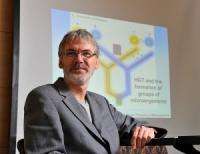
(PhysOrg.com) -- UConn researchers have shown that genetic similarity may come from preferential gene sharing rather than shared ancestry.
Scientists trying to reconstruct evolutionary history often refer to a “tree of life” because evolution seems to mimic a tree’s branching patterns, with organisms passing genes on only to their offspring. But in the past decade, geneticists have learned that horizontal gene transfer, or the exchange of genes between individuals, can be so common that it can overwhelm the effects of descent by lineage.
“When the first genomes from bacteria within the same species were sequenced, we were shocked,” says Peter Gogarten, Board of Trustees Distinguished Professor of Molecular and Cell Biology in the College of Liberal Arts and Sciences at the University of Connecticut. “Three different E. coli individuals shared only about 30 percent of their genes. Until then, we had no idea how much of this horizontal gene transfer was going on.”
Now another twist has been added to the story. Gogarten, who was one of the first to discover the prevalence of horizontal gene transfer, has shown that the phenomenon is biased in nature, occurring most frequently among closely-related individuals and species. The result is that instead of introducing “noise” into the evolutionary trees, horizontal gene transfer can actually reinforce patterns of evolution.
“This discovery throws a monkey wrench into our machinery of classification,” says Gogarten. “Things can look very similar to one another at the genetic level, but that signal of similarity isn’t necessarily from shared ancestry - it could be from preferential gene sharing.”
In a paper in the May 17 online edition of the journal Proceedings of the National Academy of Sciences, Gogarten and his colleagues constructed an evolutionary tree, or phylogeny, of all known bacteria using two different methods.
To get a sense of what bacterial evolution would look like without any horizontal gene transfer, the group first constructed a phylogeny using a piece of genetic material called ribosomal RNA (rRNA), which is part of the cell’s complex protein-making machinery and is rarely transferred among organisms. For this reason, says Gogarten, geneticists like to use it to measure evolution strictly based on lineage.
The group then compared this rRNA tree with another tree constructed using a type of protein called an aminoacyl tRNA synthetase, which can be transferred among organisms. When they compared the two evolutionary trees, they were surprised at what they found.
“We included all known bacteria in the phylogeny, because we were looking for genes where a group of organisms grouped in the wrong place,” Gogarten says.
But instead, the researchers found that at large taxonomic scales, such as broad classes of bacteria, the trees with and without horizontal gene transfer looked virtually identical to one another. It wasn’t until they scrutinized the lower taxonomic groups - such as at the genus and species level - that they saw differences between the trees. This suggested to them that the bacteria were mostly exchanging genes with their close relatives.
“The trees showed that bacteria might become more similar over time because they share genes preferentially with more closely-related organisms, not because they’re descended from them,” says Gogarten.
Some previous studies had revealed bacterial groups that shared most of their genes with other groups distantly related to them because of the environment they live in, such as the heat-loving bacteria in the family Thermotogales. These bacteria flourish in hydrothermal vents, where they have exchanged up to 70 percent of their genes with other distantly-related bacteria.
But this new study suggests these instances are relatively rare, especially since most organisms remain in fairly close proximity to their relatives. In most cases, says Gogarten, horizontal gene transfer will reinforce an organism’s ancestry.
Gogarten says the next step in his research is to collect quantitative data about the different characteristics that represent swapped genes within bacterial lineages. This will help shed light on the relative impacts of inheritance and horizontal gene transfer on the traits displayed by related bacteria.
Although his work continues to shed light on the mechanisms of evolution, Gogarten says it makes trying to reconstruct the tree - or rather, the web - of life that much more challenging.
“We would like to have a natural taxonomic system in which we call things by some name because they are related to one another,” says Gogarten. “So philosophically, this makes us uneasy. Do they look alike because they share ancestry or because they’ve swapped genes?”
More information: Proceedings of the National Academy of Sciences - www.pnas.org/
Provided by University of Connecticut


