Glucose biofuel cells may soon power implants
May 19, 2010 by Lin Edwards report
Glucose biofuel cells may soon power implants

Enlarge

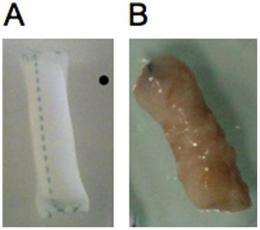
Implants containing both GOX and catalase, immobilized on barium alginate beads, in dialysis tubing wrapped in an exPTFE coating. (A) Before implantation. (B) After 3 months of implantation. A neo-vascular network can be seen, no sign of inflammation is present, proving the good tolerance of the rat for the implant. Image credit: PLoS ONE, doi:10.1371/journal.pone.0010476

(PhysOrg.com) -- Researchers in Grenoble, France have for the first time successfully implanted glucose biofuel cells in living rats. The results suggest such cells may one day use the body’s own glucose and oxygen supplies to power human implants and avoid the necessity for surgical replacement when the batteries are nearing the end of their lives.

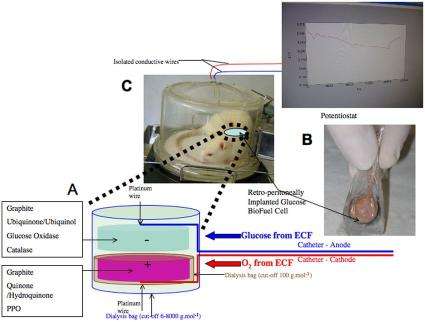
The device consists of electrodes of compressed graphite containing enzyme catalysts for the oxidation of glucose and chemicals called redox mediators. Redox mediators transport the electric charge from the enzymes to the electrodes leading from the fuel cell to the device it is powering. Glucose oxidase and ubiquinone were at the , while polyphenol oxidase and quinine were at the cathode.

The enzymes and redox mediators are contained within a dialysis bag that keeps them inside but allows glucose and oxygen obtained from the bodily fluids to pass through. The devices were implanted into the rats’ abdominal cavities and in one case monitored for three months. Once in place the enzymes triggered the oxidation of glucose, which generated electrical energy.

The research team, from the Joseph Fourier University, found that confining the enzymes to discs of graphite placed inside dialysis bags overcame the problems found in previous attempts at developing glucose biofuel cells (GBFCs), such as inhibition of the reaction by charged particles in the surrounding , or the need for low pH conditions.

Glucose biofuel cells may soon power implants
Enlarge

Summary of the principle, preparation, implantation and operation of an implantable “Quinone-Ubiquinone Glucose BioFuel Cell”. See the original paper for more details. Image: doi:10.1371/journal.pone.0010476

The team, led by biomedical engineer Philippe Cinquin, found in one rat the device could produce up 6.5 microwatts, and electrical output remained stable at two microwatts for 11 days, after which the rat was sacrificed. They calculated they obtained a maximum specific power of 24.4 microwatts per milliliter, which exceeds a pacemaker’s requirement of 10 microwatts.

The second rat was monitored for three months, and throughout the period its urine contained gluconate, a byproduct of glucose oxidation, indicating the device was still working. When this rat was sacrificed and dissected the scientists found a new vascular network had developed around the implant, and there was no sign of inflammation.

Cinquin said he was optimistic the efficiency could be improved, and achieving electrical outputs in the tens of milliwatts is not unrealistic in larger animals. He said he could see no reason why the devices could not work in people, and hoped to see them developed for use in humans within five to 10 years.

The biofuel cell could find application in devices such as insulin pumps, artificial urinary sphincters, biosensors, bone growth simulators and drug delivery devices as well as pacemakers. The research team want to continue their research by testing biofuel cells in larger animals and for longer periods.

The paper is available online at PLos One.

More information: Cinquin P, Gondran C, Giroud F, Mazabrard S, Pellissier A, et al. (2010) A Glucose BioFuel Cell Implanted in Rats. PLoS ONE 5(5): e10476. doi:10.1371/journal.pone.0010476

© 2010 PhysOrg.com

4.7 /5 (6 votes)  

Filter


Move the slider to adjust rank threshold, so that you can hide some of the comments.


Display comments: newest first

KronosDeret
May 20, 2010

Rank: not rated yet
Wow, nice. Thats great, that means my first implants wont come with batteries, it just mean ill have to ingest more suggar... agreed to that :)
Rank 4.7 /5 (6 votes)
Related Stories
Relevant PhysicsForums posts
  • Stoichiometry
    created7 hours ago
  • Boiling and melting point of impure substances
    created8 hours ago
  • Safe nitrogen compound to decompose a 500 deg C in a furnace?
    created15 hours ago
  • [ask]electron inside drinking water
    createdFeb 08, 2012
  • How to avoid formation of Lithium Chromate ???
    createdFeb 08, 2012
  • how to choose a reduced or oxidated form in a redox
    createdFeb 08, 2012
  • More from Physics Forums - Chemistry

More news stories

Under the microscope #7

In this video Dr Ingrid Graz shows us a thin layer of gold on top of rubber. Cracks in the gold allow it to stretch and we can use this for stretchable electronics.

Chemistry / Other

created 3 minutes ago | popularity not rated yet | comments 0

Hydrogen from acidic water: Researchers develop potential low cost alternative to platinum for splitting water

A technique for creating a new molecule that structurally and chemically replicates the active part of the widely used industrial catalyst molybdenite has been developed by researchers with the Lawrence Berkeley ...

Chemistry / Materials Science

created 17 hours ago | popularity 5 / 5 (11) | comments 11 | with audio podcast

Flexible paper robots

(PhysOrg.com) -- These inexpensive robots can stretch, bend and twist under control, and lift objects up to 120 times their own weight. Being soft, they can apply gentle and even pressure, and adapt to varied ...

Chemistry / Materials Science

created 15 hours ago | popularity 5 / 5 (5) | comments 3 | with audio podcast

New method makes culture of complex tissue possible in any lab

Scientists at the University of California, San Diego have developed a new method for making scaffolds for culturing tissue in three-dimensional arrangements that mimic those in the body. This advance, published online in ...

Chemistry / Biochemistry

created 14 hours ago | popularity 5 / 5 (4) | comments 0 | with audio podcast

Chemists harvest light to create 'green' tool for pharmaceuticals

(PhysOrg.com) -- A team of University of Arkansas researchers, including an Honors College undergraduate student, has created a new, "green" method for developing medicines. The researchers used energy from ...

Chemistry / Biochemistry

created 23 hours ago | popularity 5 / 5 (3) | comments 0 | with audio podcast


New error-correcting codes guarantee the fastest possible rate of data transmission

Error-correcting codes are one of the triumphs of the digital age. They’re a way of encoding information so that it can be transmitted across a communication channel — such as an optical fiber o ...

A frank discussion of the power law and linking correlation to causation

(PhysOrg.com) -- Michael Stumpf a mathematics professor at Imperial College in London, and Mason Porter a lecturer at Oxford have teamed together to write and publish a perspective piece in Science regarding the in ...

Mars Science Laboratory computer issue resolved

(PhysOrg.com) -- Engineers have found the root cause of a computer reset that occurred two months ago on NASA's Mars Science Laboratory and have determined how to correct it.

High school students test best with 7 hours' rest

(Medical Xpress) -- Whether or not you know any high school students that actually get nine hours of sleep each night, that’s what federal guidelines currently prescribe.

The question of life in the ancient world

There’s a general feeling that we don’t get the Greeks – ancient or modern. Many, including heads of state like Angela Merkel, visibly shake their head in exasperation, rightly or wrongly, at ...

Soccer -- the link between managers and captains

Soccer managers regard their captains as an extension of themselves, according to new research from Northumbria University, which could explain why Fabio Capello quit as England manager following the FA row ...