Australian scientists find Timor Sea meteorite crater
May 20, 2010
A Leonid meteor storm in 1999

Enlarge

A Leonid meteor storm in 1999. Australian scientists have discovered a crater deep beneath the Timor Sea made during a heavy meteor storm which may have altered the Earth's climate, the lead researcher said Thursday.

Australian scientists have discovered a crater deep beneath the Timor Sea made during a heavy meteor storm which may have altered the Earth's climate, the lead researcher said Thursday.

Scientists from The Australian National University have identified a dome at least 50 kilometres in diameter, buried under the Timor Sea that was created by a giant asteroid that collided with Earth around 35 million years ago - a period of heavy extraterrestrial bombardment.

Their findings, which could suggest a link between these impacts and a sharp fall in global temperatures preceding the formation of the Antarctic ice sheet, have been published in the new issue of the Australian Journal of Earth Sciences.

Seismic surveys in areas straddling the Ashmore Platform and Browse Basin led oil company geologist Dariusz Jablonski of Finder Exploration to suspect the large impact. Dr Glikson, who is a specialist in the study of extraterrestrial impacts, from the Planetary Science Institute and the School of Archaeology and Anthropology at ANU, was asked to study cuttings from the Mount Ashmore-1B well.

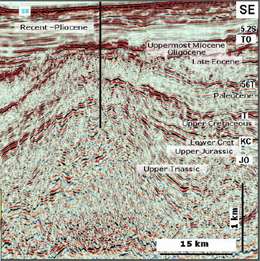
Dr Glikson said “The minimum size of the Mount Ashmore dome, which represents elastic rebound doming of the Earth crust triggered by the impact, is 50 kilometres at the base, but the full size of the impact crater - not yet defined - may be significantly larger”.

“The identification of microstructural and chemical features in drill fragments taken from the Mount Ashmore drill hole revealed evidence of a significant impact,” Dr Glikson said.

Dr Glikson said that the period when the asteroid hit coincided with a time of heavy asteroid bombardment of the Earth, which may have played a role in the sharp drop in global temperatures at the time.
Australian scientists find Timor Sea meteorite crater

A seismic reflection image of the Mount Ashmore buried dome.

“Round the same time as the Mount Ashmore impact, a 100 kilometre wide asteroid impact structure formed in Siberia, and another measuring 85 km in diameter in Chesapeake Bay, off Virginia, in the United States. Likewise a large field of tektites - molten rock fragments splashed by impact - fell over northeast America. This defined a major impact cluster across the planet,” he said.

“This impact cluster hit Earth about one million years before the Drake Passage, the ocean gap between Antarctica and South America, opened up. The opening of the Drake Passage allowed continuous circulation of the circum-Antarctic ocean current, isolating the Antarctic continent and allowing the onset of its large ice sheet, which acts as a ‘thermostat’ for the Earth’s climate.”

Dr Andrew Glikson said that the increase in geophysical surveys and drilling associated with oil exploration over the last few decades has allowed the identification of a number of large impact structures onshore and off the coast of Western Australia.

Provided by Australian National University

4.3 /5 (13 votes)  

Filter


Move the slider to adjust rank threshold, so that you can hide some of the comments.


Display comments: newest first

Nik_2213
May 20, 2010

Rank: 3.6 / 5 (5)
I think the report has confused impactor size with crater diameter...
furlong64
May 20, 2010

Rank: 3.3 / 5 (4)
I agree with you Nik_2213. Otherwise each of those impacts would have been utterly colossal, planet-sterilizing events an order of magnitude larger than Chixcilub.
TJ_alberta
May 20, 2010

Rank: 3.3 / 5 (4)
Nik - I believe you are correct. 100 and 85 Km diameter meteorites would have altered more than the climate.
Shootist
May 20, 2010

Rank: 4.8 / 5 (4)
The name of the 100km crater is Popigai. There is also a 25km crater off the coast of New Jersey (Tom's Canyon) that dates to 35My. This one in the Sea of Timor would make four (4) large craters dating from ~35My.

http://impacts.rajmon.cz/

Funny (strange) how there are no extinction events associated with this impact cluster.
Shootist
May 20, 2010

Rank: 3 / 5 (2)
I know the article mentions Antarctica freezing over but I believe that happened mebbe a million years later, 34My?

http://www.museum...le/2050/

http://www.lpi.us...3045.pdf

Caliban
May 20, 2010

Rank: 3 / 5 (2)
@shootist,

They point out in the article that these impacts occurred about 1MY before the Drake Passage opened up between Antarctica and S. America, which enabled the Circum-Antarctic current to develop, which is believed to be the main cause of Antarctica freezing over, and staying that way, although the two events might possibly be linked geologically, in some way.

Another curiosity is that-unless I'm thinking of another recently-discovered impact crater- this one was discovered based on Aboriginal tales of such an event...
out7x
May 21, 2010

Rank: not rated yet
end of Middle Eocene, 37 Ma, ice sheets built up slowly in Antarctica, Tethys sea narrowed.
Rank 4.3 /5 (13 votes)
Related Stories
Relevant PhysicsForums posts
  • Discrepancy between oxygen and carbon-dioxide levels
    createdFeb 09, 2012
  • where gems are found in the world
    createdFeb 09, 2012
  • Wind Waves in Reservoir ~ Wind run-up and Wind set-up
    createdFeb 08, 2012
  • Balance of oxygen in the atmosphere
    createdFeb 01, 2012
  • The case for a methanol-based economy
    createdJan 30, 2012
  • Weather in a rotating cylinder
    createdJan 25, 2012
  • More from Physics Forums - Earth

More news stories

Humans may have helped the decline of African rainforests 3000 years ago

(PhysOrg.com) -- Large areas of rainforests in Central Africa mysteriously disappeared over three thousand years ago, to be replaced by savannas. The prevailing theory has been that the cause was a change ...

Space & Earth / Environment

created 17 hours ago | popularity 4.2 / 5 (10) | comments 12 | with audio podcast report

Could Venus be shifting gear?

(PhysOrg.com) -- ESA’s Venus Express spacecraft has discovered that our cloud-covered neighbour spins a little slower than previously measured. Peering through the dense atmosphere in the infrared, the ...

Space & Earth / Space Exploration

created 13 hours ago | popularity 5 / 5 (7) | comments 7 | with audio podcast

NASA budget will axe Mars deal with Europe: scientists

US President Barack Obama's budget proposal to be submitted next week for 2013 will cut NASA's budget by 20 percent and eliminate a major partnership with Europe on Mars exploration, scientists said Thursday.

Space & Earth / Space Exploration

created 16 hours ago | popularity 5 / 5 (2) | comments 18

Mars Science Laboratory computer issue resolved

(PhysOrg.com) -- Engineers have found the root cause of a computer reset that occurred two months ago on NASA's Mars Science Laboratory and have determined how to correct it.

Space & Earth / Space Exploration

created 14 hours ago | popularity 4.7 / 5 (6) | comments 3 | with audio podcast

NASA sees wide-eyed cyclone Jasmine

Cyclone Jasmine's eye has opened wider on NASA satellite imagery, as it moves through the Southern Pacific Ocean.

Space & Earth / Earth Sciences

created 5 hours ago | popularity 3.5 / 5 (2) | comments 1


Google users warned of threat to smartphone wallets

Users of Google smartphone wallets were being warned on Friday that there is a way to crack pass codes intended to thwart thieves from going on illicit shopping sprees.

Anonymous knocks CIA website offline (Update)

The website of the Central Intelligence Agency was inaccessible on Friday after the hacker group Anonymous claimed to have knocked it offline.

New error-correcting codes guarantee the fastest possible rate of data transmission

Error-correcting codes are one of the triumphs of the digital age. They’re a way of encoding information so that it can be transmitted across a communication channel — such as an optical fiber o ...

Complex wiring of the nervous system may rely on a just a handful of genes and proteins

Researchers at the Salk Institute have discovered a startling feature of early brain development that helps to explain how complex neuron wiring patterns are programmed using just a handful of critical genes. ...

The power of estrogen -- male snakes attract other males

A new study has shown that boosting the estrogen levels of male garter snakes causes them to secrete the same pheromones that females use to attract suitors, and turned the males into just about the sexiest ...

New power source discovered

(PhysOrg.com) -- Researchers at the Massachusetts Institute of Technology (MIT) and RMIT University have made a breakthrough in energy storage and power generation.