Physicists prove Einstein wrong with observation of instantaneous velocity in Brownian particles
May 20, 2010
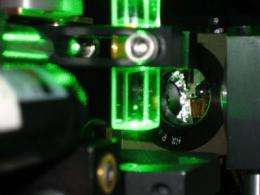
A 5-micrometer glass bead levitated in air by a single laser beam from below. This optical trap is formed by the balance between the scattering force from the laser beam and the gravitational force on the bead. Tongcang Li, et. al. used a similar optical trap to study the Brownian motion of a trapped bead in air with ultra-high resolution. Their paper is published in Science. Credit: Tongcang Li, the University of Texas at Austin
A century after Albert Einstein said we would never be able to observe the instantaneous velocity of tiny particles as they randomly shake and shimmy, so called Brownian motion, physicist Mark Raizen and his group have done so.
"This is the first observation of the instantaneous velocity of a Brownian particle," says Raizen, the Sid W. Richardson Foundation Regents Chair and professor of physics at The University of Texas at Austin. "It's a prediction of Einstein's that has been standing untested for 100 years. He proposed a test to observe the velocity in 1907, but said that the experiment could not be done."
In 1907, Einstein likely did not foresee a time when dust-sized particles of glass could be trapped and suspended in air by dual laser beam "optical tweezers." Nor would he have known that ultrasonic vibrations from a plate-like transducer would shake those glass beads into the air to be tweezed and measured as they moved in suspension.
Raizen's research, published in Science, is the first direct test of the equipartition theorem for Brownian particles, one of the basic tenets of statistical mechanics. It is also a step toward cooling glass beads to a state in which they could be used as oscillators or sensors.
The equipartition theorem states that a particles' kinetic energy—the energy it possesses due to motion—is determined only by its temperature, not its size or mass.
Raizen's study now proves that the equipartition theorem is true for Brownian particles; in this case, glass beads that were three micrometers across.
Raizen says he and his colleagues can now push the limits, moving the particles closer to a quantum state for observation.
"We've now observed the instantaneous velocity of a Brownian particle," says Raizen. "In some sense, we're closing a door on this problem in physics. But we are actually opening a much larger door for future tests of the equipartition theorem at the quantum level."
There, he expects that equipartition theory will break down, leading to new problems and solutions surrounding the quantum mechanics of small particles composed of many atoms.
-
Brownian motion under the microscope
Oct 11, 2005 |
not rated yet |
0
-
Rethinking Brownian motion with the 'Emperor's New Clothes'
Jul 27, 2009 |
not rated yet |
0
-
Staggering atoms sober up in physics detox cell
May 04, 2006 |
not rated yet |
0
-
Physicists move closer to the quantum limit
Apr 12, 2004 |
not rated yet |
0
-
Watching crystals grow provides clues to making smoother, defect-free thin films
Jan 21, 2010 |
not rated yet |
0
-
Engineers build first sub-10-nm carbon nanotube transistor
Feb 01, 2012 |
4.9 / 5 (31) |
30
-
Something old, something new: Evolution and the structural divergence of duplicate genes
Jan 31, 2012 |
4.6 / 5 (7) |
1
-
The hidden nanoworld of ice crystals: Revealing the dynamic behavior of quasi-liquid layers
Jan 30, 2012 |
5 / 5 (3) |
1
-
Stock market network reveals investor clustering
Jan 27, 2012 |
3.9 / 5 (23) |
8
-
Of microchemistry and molecules: Electronic microfluidic device synthesizes biocompatible probes
Jan 26, 2012 |
5 / 5 (1) |
0
-
Calculating Electrostatic force between parallel plates
1 hour ago
-
Strength of induced magnetic field inside an inductor
4 hours ago
-
increasing time of daylight
5 hours ago
-
Light & Sight
5 hours ago
-
Wind Turbine Power
8 hours ago
-
Steam Table issues
10 hours ago
- More from Physics Forums - General Physics
More news stories
Putting the squeeze on planets outside our solar system
(PhysOrg.com) -- Using high-powered lasers, scientists at Lawrence Livermore National Laboratory and collaborators discovered that molten magnesium silicate undergoes a phase change in the liquid state, abruptly ...
4 hours ago |
5 / 5 (1) |
0
|
Hovering not hard if you're top-heavy, researchers find
Top-heavy structures are more likely to maintain their balance while hovering in the air than are those that bear a lower center of gravity, researchers at New York University's Courant Institute of Mathematical Sciences ...
5 hours ago |
5 / 5 (1) |
1
|
SLAC, Stanford team focuses on high-energy electrons to treat cancer
Accelerator physicists at SLAC and cancer specialists from Stanford are working on a new technology that could dramatically reduce the time needed for cancer radiation treatments. The team ran an initial experiment ...
8 hours ago |
5 / 5 (1) |
0
Measurements from high-energy collisions lead to better understanding of why meson particles disappear
For several years, physicists at the Relativistic Heavy Ion Collider (RHIC) at Brookhaven National Laboratory (BNL), USA, have studied an unusual state of matter called the quarkgluon plasma, which they ...
8 hours ago |
5 / 5 (1) |
0
Explained: Sigma
It's a question that arises with virtually every major new finding in science or medicine: What makes a result reliable enough to be taken seriously? The answer has to do with statistical significance -- but ...
Feb 09, 2012 |
5 / 5 (15) |
46
Google users warned of threat to smartphone wallets
Users of Google smartphone wallets were being warned on Friday that there is a way to crack pass codes intended to thwart thieves from going on illicit shopping sprees.
NASA sees wide-eyed cyclone Jasmine
Cyclone Jasmine's eye has opened wider on NASA satellite imagery, as it moves through the Southern Pacific Ocean.
NASA sees Giovanna reach cyclone strength, threaten Madagascar
Tropical Storm 12S built up steam and became a cyclone on February 10, 2012 as NASA's Terra satellite passed overhead. Residents of east-central Madagascar should prepare for this cyclone to make landfall ...
CIA website offline, Anonymous takes credit
The website of the Central Intelligence Agency was unresponsive on Friday after the hacker group Anonymous claimed to have knocked it offline.
Complex wiring of the nervous system may rely on a just a handful of genes and proteins
Researchers at the Salk Institute have discovered a startling feature of early brain development that helps to explain how complex neuron wiring patterns are programmed using just a handful of critical genes. ...
The power of estrogen -- male snakes attract other males
A new study has shown that boosting the estrogen levels of male garter snakes causes them to secrete the same pheromones that females use to attract suitors, and turned the males into just about the sexiest ...
May 20, 2010
Rank: 3.1 / 5 (18)
May 20, 2010
Rank: 4.5 / 5 (23)
"When a distinguished but elderly scientist states that something is possible, he is almost certainly right. When he states that something is impossible, he is probably wrong."
BTW Einstein is not pope and calling someone wrong is not an insult, especially not in science.
May 20, 2010
Rank: 4.3 / 5 (7)
Well, perhaps I'm just nitpicking, but they really haven't - at least not in the way the phrasing of the article suggests. Quantum mechanics and Heisenburg's uncertainty principle limit the resolution of experiments in the following way (where UN stands for uncertainty):
(UNx)(UNp) >= Hbar/2
Of course, it's the writer of the article who is at fault here. Oh well.
May 20, 2010
Rank: 3 / 5 (2)
He knew he was right about his theories anyway.
May 20, 2010
Rank: 2.3 / 5 (3)
May 20, 2010
Rank: 2 / 5 (4)
May 20, 2010
Rank: 2.6 / 5 (5)
May 20, 2010
Rank: 5 / 5 (1)
A better example would be Einstein's change in heart over the expanding universe.
Also, I'm pretty sure nobody was putting any significant work into cold fusion until after Einstein died. I could be wrong.
May 21, 2010
Rank: 5 / 5 (5)
May 21, 2010
Rank: not rated yet
May 21, 2010
Rank: 5 / 5 (3)
May 21, 2010
Rank: 2 / 5 (4)
May 21, 2010
Rank: not rated yet
yes, agreed! To suggest he was 'wrong' about the future is an absurd criticism .. and, consequently, non-scientific .. but then, this is physorg ..
May 21, 2010
Rank: not rated yet
not in their work but in the interpretation and relationships. i will give a hint, as i dont feel like debating and who gives a rats bum any way?
here is the hint... think wavelength, and the time band each is capable of working in, and how a portion of what they are working with happens outside this band.
May 21, 2010
Rank: 1 / 5 (3)
Categorical claims about possibility of future experiments & observation are often absurd statements, too.
Lord Kelvin (1895): "Heavier-than-air flying machines are impossible."
Why he told this, if he knew about birds for sure? Such statement simply has no sense...
Kelvin is also known for an address to an assemblage of physicists at the British Association for the advancement of Science in 1900 in which he stated, "There is nothing new to be discovered in physics now. All that remains is more and more precise measurement." A similar statement is attributed to the American physicist Albert Michelson.
May 21, 2010
Rank: 1 / 5 (6)
In this connection it may be interesting, the 56-year period of financial crisis correlates well with average length of human generation [Mills (1867), McMinn (1997)].
May 21, 2010
Rank: 3.4 / 5 (5)
As an aside, he stated that it would likely be impossible to measure the instantaneous velocity of such particles. This is just a minor and understandable comment. In fact, it still holds true. This experiment doesn't measure BM in a liquid, but in air. That's because the velocities are lower in air. Doing so in water is still not possible.
Nothing like a sensationalist headline - 'Einstein proved wrong', or 'Darwin proved wrong"!
May 22, 2010
Rank: 1 / 5 (3)
May 22, 2010
Rank: 3 / 5 (2)
"Now, Mark Raizen, Tongcang Li and colleagues at the University of Texas at Austin have found a way round this problem by studying particles in air rather than a liquid. Because air is much less dense than water its molecules are farther apart and therefore the distance, and time, between Brownian collisions is much greater. Indeed, velocity of a Brownian particle changes about once every 100 µs in air".
http://physicswor...ws/42679
May 22, 2010
Rank: 5 / 5 (1)
May 22, 2010
Rank: 2 / 5 (2)
"Now, Mark Raizen, Tongcang Li and colleagues at the University of Texas at Austin have found a way round this problem by studying particles in air rather than a liquid. Because air is much less dense than water its molecules are farther apart and therefore the distance, and time, between Brownian collisions is much greater. Indeed, velocity of a Brownian particle changes about once every 100 µs in air".
"http://physicswor...9"
May 22, 2010
Rank: 5 / 5 (4)
May 25, 2010
Rank: 2 / 5 (4)
I also love how anything that refutes Einstein is accounted as wrong by presumption like the particles that seem to reach the Earth at velocities > c.
I especially love it when something that shows the Einstein was wrong is held up as showing he was right. That is the attraction to a moving magnet experiment which clearly shows that objects are attracted to where the magnet is now; not where it was.
May 25, 2010
Rank: 1.8 / 5 (4)
May 25, 2010
Rank: 3.7 / 5 (3)
May 25, 2010
Rank: 1 / 5 (3)
http://www.albert...-200.pdf
On page 185 Einstein says "the energy of the gravitational field shall act gravitationally in the same way as any other kind of energy". It's a concentration of energy that causes gravity. Matter only causes gravity because of the E=mc2 energy content. A gravitational field is a region of space with a higher-than-average energy density causing additional gravity, requiring an integration approach as per page 201.
Another interesting aspects of Einstein's interest about Brownian motion consist in fact, he explained phenomena, which he probably never saw by his own eyes.
http://physics.sj...Walk.pdf
Attempts had already been made to measure the velocity of Brownian particles, but they gave a nonsensical result: the shorter the measurement time, the higher the apparent velocity.
May 25, 2010
Rank: 1 / 5 (1)
Therefore I cannot understand, what Mr. Raizen really means, when he talks "We've now observed the instantaneous velocity of a Brownian particle".
It's just a confirmation of Einstein's work - or simply a nonsense, because instantaneous velocity cannot be seen due the relativity.
May 27, 2010
Rank: not rated yet
Is this "noise" only our ignorance; our limited perspective? Are these ideas of god and angels another placeholder for our current and temporary intellectual limitations?
May 28, 2010
Rank: 5 / 5 (1)
Also remember that even quantum theory breaks down at a small enough scale.
May 28, 2010
Rank: 1 / 5 (2)
May 28, 2010
Rank: 1 / 5 (2)
Several explanations of equipartition's failure were proposed. Lord Kelvin suggested, that the derivation of the equipartition theorem must be incorrect, since it disagreed with experiment, but was unable to show how. Boltzmann defended the derivation of his equipartition theorem as correct, but suggested that gases might not be in thermal equilibrium because of their interactions with the aether. In 1900 Rayleigh noted the need for a new principle that would provide an "escape from the destructive simplicity" of the equipartition theorem.
Jun 02, 2010
Rank: not rated yet
You are all over the place here. I don't think you use hypergeometry correctly, and the Turing analogy isn't apt. I roughly get where you're going, though. Theory, based on theories, based on ignorance; philosophy for the haphazardly educated, like me. :) Still, the "large object" is still a placeholder, and is why I'm temporarily finished with this kind of philosophy. No faith in science or otherwise here. :)