Paper supercapacitor could power future paper electronics
May 21, 2010 By Lisa Zyga
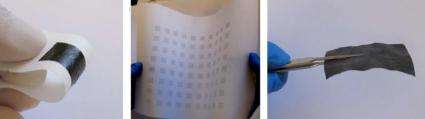
Photos at left and center show the paper supercapacitor printed on Xerox paper. The right photo shows the paper supercapacitor printed on newspaper. Image credit: Liangbing Hu, et al. ©2010 AIP.
(PhysOrg.com) -- All those paper transistors and paper displays that scientists have been designing can now be powered by an onboard power source, thanks to the development of a new paper supercapacitor. Designed by researchers at Stanford University, the paper supercapacitor is made by simply printing carbon nanotubes onto a treated piece of paper. The researchers hope that the integrated design could lead to the development of low-cost, disposable paper electronics.
In the paper supercapacitor, all the necessary components are integrated onto a single sheet of paper in the form of single walled carbon nanotubes (SWNTs). High-speed printing could be used to print the SWNTs directly onto a piece of paper - anything from Xerox paper to newspaper and even grocery ads will work. At first, the researchers found that the SWNTs were so small that they penetrated the paper through micron-sized pores, which would cause the device to short-circuit. To solve this problem, the researchers first coated both sides of the paper with polyvinylidene fluoride (PVDF), which blocked the pores but still allowed for electrolytes to be transported through the paper. As such, the treated paper could function as an electrolyte membrane and separator without short-circuiting.
“The key design is that SWNTs stick well on paper and do not penetrate through paper completely to avoid shorting,” Yi Cui of Stanford University told PhysOrg.com.
Once the SWNTs were printed onto the treated paper, they experienced strong bonding forces similar to those experienced when writing with a pen or pencil on paper. Even when rubbed or subjected to tape, the SWNTs remained attached to the paper. After printing SWNTs on both sides of single sheets of paper, electrolyte was loaded to form a supercapacitor. The SWNTs served as both the electrodes and current collectors in the supercapacitor, which had a capacitance of about 3 F/g. The device also showed an excellent cycling stability, with very little loss of capacitance after 2500 cycles. The researchers say the same concept could be extended to make batteries, as well.
The fully integrated supercapacitor is based on an earlier version that the researchers made, in which nanomaterials were coated separately onto different anode and cathode substrates and then assembled together with a separator. The advantage of the new integrated structure is that it allows for high-speed printing, which greatly reduces fabrication costs and brings disposable, flexible, and lightweight paper electronics closer to reality. Cui said that, in the future, the researchers plan “to use this new design for real applications.”
More information: Liangbing Hu, Hui Wu, and Yi Cui. “Printed energy storage devices by integration of electrodes and separators into single sheets of paper.” Applied Physics Letters 96, 183502 (2010). Doi:10.1063/1.3425767
Copyright 2010 PhysOrg.com.
All rights reserved. This material may not be published, broadcast, rewritten or redistributed in whole or part without the express written permission of PhysOrg.com.
-
At Stanford, nanotubes + ink + paper = equal instant battery (w/ Video)
Dec 07, 2009 |
not rated yet |
0
-
Tiny carbon nanotubes show big germ-fighting potential
Sep 03, 2007 |
not rated yet |
0
-
Carbon Nanotubes for State-of-the-art Packaging
Jul 12, 2004 |
not rated yet |
0
-
Palladium Nanoparticle Electrodeposition on Nanotubes Results in New Flexible Hydrogen Sensors
Aug 27, 2007 |
not rated yet |
0
-
Scientists report significant advances in flexible electronics research
Jun 18, 2009 |
not rated yet |
0
-
Engineers build first sub-10-nm carbon nanotube transistor
Feb 01, 2012 |
4.9 / 5 (30) |
30
-
Something old, something new: Evolution and the structural divergence of duplicate genes
Jan 31, 2012 |
4.6 / 5 (7) |
1
-
The hidden nanoworld of ice crystals: Revealing the dynamic behavior of quasi-liquid layers
Jan 30, 2012 |
5 / 5 (3) |
1
-
Stock market network reveals investor clustering
Jan 27, 2012 |
3.9 / 5 (23) |
8
-
Of microchemistry and molecules: Electronic microfluidic device synthesizes biocompatible probes
Jan 26, 2012 |
5 / 5 (1) |
0
-
polymer nanocomposites
1 hour ago
-
Corrosion Tests on Magnesium
14 hours ago
-
polyethylene copper nanocomposite
20 hours ago
-
Output of xrd analysis
Feb 08, 2012
-
Transport phenomena problem based on problems 18.B11 and 19B.6 from Bird, stewart, lw
Feb 06, 2012
-
Help with material selection - Car Piston
Feb 05, 2012
- More from Physics Forums - Materials & Chemical Engineering
More news stories
'Dark plasmons' transmit energy
Microscopic channels of gold nanoparticles have the ability to transmit electromagnetic energy that starts as light and propagates via "dark plasmons," according to researchers at Rice University.
10 hours ago |
5 / 5 (4) |
0
|
Nanotube therapy takes aim at breast cancer stem cells
Wake Forest Baptist Medical Center researchers have again proven that injecting multiwalled carbon nanotubes (MWCNTs) into tumors and heating them with a quick, 30-second laser treatment can kill them.
Nanotechnology / Bio & Medicine
15 hours ago |
5 / 5 (1) |
0
|
Inspired by steel, nanomanufacturing gets wear-resistant carbide tip
(PhysOrg.com) -- Scientists at the University of Pennsylvania, the University of Wisconsin-Madison and IBM Research - Zurich have fabricated an ultrasharp silicon carbide tip possessing such high strength ...
20 hours ago |
5 / 5 (3) |
1
|
New kind of solar cell could capture significantly more energy than current cells
New solar cells could increase the maximum efficiency of solar panels by over 25%, according to scientists from the University of Cambridge.
Feb 08, 2012 |
4.5 / 5 (11) |
14
|
New technology platform for molecule-based electronics
Researchers at the Nano-Science Center at the University of Copenhagen have developed a new nano-technology platform for the development of molecule-based electronic components using the wonder material graphene. At the same ...
Nanotechnology / Nanomaterials
17 hours ago |
5 / 5 (2) |
0
FDA-approved drug rapidly clears amyloid from the brain, reverses Alzheimer's symptoms in mice
Neuroscientists at Case Western Reserve University School of Medicine have made a dramatic breakthrough in their efforts to find a cure for Alzheimer's disease. The researchers' findings, published in the journal Science, show t ...
Hydrogen from acidic water: Researchers develop potential low cost alternative to platinum for splitting water
A technique for creating a new molecule that structurally and chemically replicates the active part of the widely used industrial catalyst molybdenite has been developed by researchers with the Lawrence Berkeley ...
Ultraviolet protection molecule in plants yields its secrets
Lying around in the sun all day is hazardous not just for humans but also for plants, which have no means of escape. Ultraviolet (UV) radiation from the sun can damage proteins and DNA inside cells, leading ...
Soraa LED light may dim 50-watt halogen rivals
(PhysOrg.com) -- Soraa, a Fremont, California company founded in 2008, this week launched its first product, a light that uses LEDS (light emitting diodes). The "Soraa LED MR16 lamp" is the "perfect" replacement ...
Anyone can learn to be more inventive, cognitive researcher says
There will always be a wild and unpredictable quality to creativity and invention, says Anthony McCaffrey, a cognitive psychology researcher at the University of Massachusetts Amherst, because an "Aha moment" is rare and ...
Engineers find inspiration for new materials in Piranha-proof armor
(PhysOrg.com) -- Its a matchup worthy of a late-night cable movie: put a school of starving piranha and a 300-pound fish together, and who comes out the winner?
May 21, 2010
Rank: 5 / 5 (1)
May 21, 2010
Rank: 5 / 5 (1)
usual capacitors are in the microfarad range!
TEH AWESOME IF TRUE!
May 21, 2010
Rank: 4.2 / 5 (5)
It's rather target for wide range consumer electronic, rather then pacemakers, where the large volume capacity, high energy density, stable voltage and low (self)discharge rate is required. The parameters of supercapacitors are exactly the opposite.
http://www.mpower...one3.gif
BTW The capacitance in range of 5 Farads per gram is still too low, as we have supercapacitors with 150 farads per gram already - and they're not used anyway. Whereas lithium batteries with pseudo-capacitance values in range 600 to 800 Farads per gram are used in the AA configuration commonly.
http://www.resear...ate.html
May 21, 2010
Rank: 5 / 5 (1)
neat idea...
May 21, 2010
Rank: not rated yet
May 22, 2010
Rank: 5 / 5 (1)
This does pose the question about just what could one day be possable. Tattooable Mobile Phones, Watches etc?
May 22, 2010
Rank: 1 / 5 (4)
http://www.nature...845.html
May 23, 2010
Rank: not rated yet
May 24, 2010
Rank: not rated yet
The future aways looks amazing with these research projects showing up in the news more and more.
May 24, 2010
Rank: not rated yet
The article left me a little confused as to whether it's 3 F/gram of SWNT or 3F/gram of printed capacitor, including the paper.
May 28, 2010
Rank: not rated yet
Interesting research.
May 28, 2010
Rank: 1 / 5 (3)
Anyway, such capacity is still nothing exceptional in the world of contemporary supercapacitors.