Japanese team discovers 'super disc' material
May 24, 2010
A single-layer Blu-ray disc can hold five times as much data as a conventional DVD

Enlarge

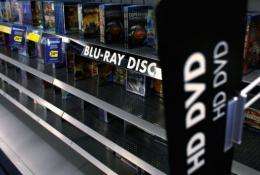
Blu-ray discs are seen next to HD DVDs on a shelf at a Best Buy store in San Francisco. A Japanese research team has found a material that could be used to make a low-price super disc with data storage capacity thousands of times greater than a DVD, the lead scientist has said.

A Japanese research team has found a material that could be used to make a low-price super disc with data storage capacity thousands of times greater than a DVD, the lead scientist said Monday.

The material transforms from a black-colour metal state that conducts electricity into a brown semiconductor when hit by light, according to Shin-ichi Ohkoshi, chemistry professor at the University of Tokyo.

The material, a new crystal form of titanium oxide, can switch back and forth between the metal and semiconductor states at room temperature when exposed to light, creating an effective on-off function for data storage.

It is "promising as a material for a next-generation optical ," Ohkoshi told AFP by telephone.

A material that changes colour with light can be used in storage devices as colours reflect light differently to contain different information.

His team has succeeded in creating the material in particles measuring five-to-20 nanometres (a five-billionth to 20-billionth of a metre) in diameter.

If the smallest particle is used, the new disc could hold more than 1,000 times as much information as a , provided that matching data-writing and reading equipment are developed.

A single-layer Blu-ray disc can hold five times as much data as a conventional DVD.

Titanium oxide's market price is about one-hundredth of the rare element -- germanium-antimony-tellurium -- that is currently used in rewritable Blu-ray discs and DVDs, Ohkoshi said.

"You don't have to worry about procuring rare metals. is cheap and safe, already being used in many products ranging from face powder to white paint," the professor said.

Ohkoshi said it was not known when a disc with the material would be manufactured and put to practical use, adding that he would start talks with private-sector companies for commercialisation.

The study was published in the advance online edition of the British magazine Nature Chemistry.

More information: Synthesis of a metal oxide with a room-temperature photoreversible phase transition, Nature Chemistry, Published online: 23 May 2010, doi:10.1038/nchem.670

(c) 2010 AFP

4.7 /5 (35 votes)  

Filter


Move the slider to adjust rank threshold, so that you can hide some of the comments.


Display comments: newest first

kevinrtrs
May 24, 2010

Rank: 1 / 5 (4)
Great stuff! They're going to have an interesting time creating mechanisms to read and write the data.

Sad Stuff - soon we'll all have to upgrade again....:-((((!

Sonhouse
May 24, 2010

Rank: 3.7 / 5 (3)
And anything recorded on the old blu ray or DVD's will have to be re-recorded on the new format or you will lose it in a few years when the old players stop working. Computer backups, family movies, photo's, all lost if you don't transfer them to the newer technology. Also, this new work does not mention the longevity of the material, does it become contaminated in ten years, does it lose its ability to transform itself and therefore can't record anymore? What is the shelf life, how long can it sit on the shelf and still be able to record. All these questions will have to be answered before this material can be used in a commercial product.
degojoey
May 24, 2010

Rank: not rated yet
if light changes its properties at room temperature, what kind of viable long term storage would you have here?
Nikola
May 24, 2010

Rank: 4.3 / 5 (6)
Interesting and amazing but....spinning media is not the future, solid state is.
iSynic
May 24, 2010

Rank: 2.7 / 5 (6)
Interesting and amazing but....spinning media is not the future, solid state is.


Solid State certainly has advantages, but spinning media will continue to have a place as long as it stays so comparatively cheap, while offering benefits such as capacity.

I'm not saying you're wrong, I just think the future you're thinking of is still a little ways off.
dtxx
May 24, 2010

Rank: 5 / 5 (5)
Even worse than spinning media, most backups these days go to tapes. What is that, early 1900s technology?
antialias_physorg
May 24, 2010

Rank: 4 / 5 (4)
if light changes its properties at room temperature, what kind of viable long term storage would you have here?


If you encase it (think old-school floppy discs) then the storage time could be quite long.

Interesting and amazing but....spinning media is not the future, solid state is.

It all depends on how you structure the hardware. If the point where the storage device is read can be shifted at will then you can use a static plate (or cube) of this stuff. Currently the cheapest option is to go for a spinning setup but that may change.

Then there is the issue of what types of data you have on it. If you need random access then solid state hardware is better. If you have largely sequential data (e.g. movies of huge medical datasets) then a spinning disc is just fine.
vivcollins
May 24, 2010

Rank: 4 / 5 (2)
Interesting and amazing but....spinning media is not the future, solid state is.


Solid State certainly has advantages, but spinning media will continue to have a place as long as it stays so comparatively cheap, while offering benefits such as capacity.

I'm not saying you're wrong, I just think the future you're thinking of is still a little ways off.


All agreed but personally I have no intention of making any significant investments in any spinning storage technology in the near or distant future for the above reasons, its now just a stepping stone
droid001
May 24, 2010

Rank: 3 / 5 (2)
The Future is Cloud Computing and lightning fast Ethernet. Spinning media? O no... plus few terabits solid state card for private data storage.
purringrumba
May 24, 2010

Rank: not rated yet
if light changes its properties at room temperature, what kind of viable long term storage would you have here?


It's a legitimate question. In any data storage, programming power efficiency, speed, and data retention are 3 opposing attributes that cannot be easily achieved simultaneously. Usually, you compromise one for others depending on application.

It would be interesting to know what balance TiO2 (or is it non-stoichiometric?) particles strike in this compromise.
slaveunit
May 24, 2010

Rank: not rated yet
Personally I think solid state based on graphene or some new material with high levels of durability will become the 'ultimate' storage device till then it will all go on hardrives and ssd's and be rewritten regularly/backed up to new devices to prevent loss for the ordinary punter. But people need to be educated to have good backup discipline or lots of personal stuff will be lost. For those who have faith in the cloud this is a supplement at best and even then only for things you are prepared to lose control of, unles your data is in your control you will lose control of it, privacy in the cloud is already highly in doubt and I for one will never trust any cloud provider to hold my data secure and available.
Alizee
May 25, 2010

Rank: 1 / 5 (2)
There is a supplementary movie of photoreversible phase transition.

http://www.nature...0-s2.mov
thematrix606
May 28, 2010

Rank: not rated yet
Interesting and amazing but....spinning media is not the future, solid state is.


Solid State certainly has advantages, but spinning media will continue to have a place as long as it stays so comparatively cheap, while offering benefits such as capacity.

I'm not saying you're wrong, I just think the future you're thinking of is still a little ways off.


I would have to totally disagree with you. I don't have a DVD ROM installed in my PC at all. I just borrowed one to install Windows. I have not used one in the last 2 years. Everything is digital (games, movies, etc... the legal kind). So it's all stored locally. And that's today, I think in a few years it will all be on the net so you won't even need anything at home but a box with a cable sticking out... which will be your monitor :)
Icester
May 29, 2010

Rank: not rated yet
It will be nice to finally backup my data to a single disc again! I finally had to go to off-line hard-drives because it is easier and more economical than backup to hundreds of DVDs.
Shootist
May 29, 2010

Rank: not rated yet
Even worse than spinning media, most backups these days go to tapes. What is that, early 1900s technology?


Ha. Wire recorders were in use in the 40s, tape somewhat afterwards.
El_Nose
May 30, 2010

Rank: not rated yet
Did everyone forget about Holographic Versitle disc's -- http://en.wikiped...ile_Disc
poi
May 30, 2010

Rank: not rated yet
I would have to totally disagree with you. I don't have a DVD ROM installed in my PC at all. I just borrowed one to install Windows. I have not used one in the last 2 years. Everything is digital

uhm... even spinning disc is digital (which refers to how the information is represented in the media - i.e. bits and bytes so DVD is digital)
(games, movies, etc... the legal kind). So it's all stored locally. And that's today, I think in a few years it will all be on the net so you won't even need anything at home but a box with a cable sticking out... which will be your monitor :)

uhm... i think yo have to look at the framework of the whole system. for example, where do the servers store anything? so storage is essential to the whole system, not just the end client's system.
gwrede
May 31, 2010

Rank: not rated yet
Since I don't download stolen movies and I'm not a digivideo freak, I constantly find myself wondering how I possibly could ever fill my current hard disk.

Next we'll have simply outrageous storage capacities, simply "because we can". I wonder what real use we'd find for them.
Rank 4.7 /5 (35 votes)
Relevant PhysicsForums posts
  • Looking for a safe endothermic chemical reaction
    created17 hours ago
  • Anomalies of H20
    created21 hours ago
  • Orbital Hybridization - Real or Approximation
    createdFeb 07, 2012
  • hybridisation of Mn in MnO4-
    createdFeb 07, 2012
  • numbers if molecules for differnt velocities in gas
    createdFeb 06, 2012
  • Caculating the enthalpy change of reaction from delta T values(experimentally)
    createdFeb 06, 2012
  • More from Physics Forums - Chemistry

More news stories

Scientists develop biological computer to encrypt and decipher images

Scientists at The Scripps Research Institute in California and the Technion–Israel Institute of Technology have developed a "biological computer" made entirely from biomolecules that is capable of deciphering ...

Chemistry / Biochemistry

created 12 hours ago | popularity 4.5 / 5 (8) | comments 2 | with audio podcast

New form of hafnium oxide developed

(PhysOrg.com) -- A novel material developed by researchers at the University of Cambridge is opening up new possibilities for next generation electronic and optoelectronic devices, and paving the way for further ...

Chemistry / Materials Science

created 20 hours ago | popularity 4.6 / 5 (5) | comments 4 | with audio podcast

All foamed up: Synthesis of macroporous polystyrene through polymerization of foamed emulsions

(PhysOrg.com) -- Packaging, insulation, and impact protection are examples of commercial uses of polymer foams. Depending on the intended application, the properties required of these foams can differ greatly. In the journal ...

Chemistry / Materials Science

created 15 hours ago | popularity not rated yet | comments 0 | with audio podcast

Learning about material integrity from statistical data

Whether it protects space satellites or sequesters nuclear waste, scientists want to understand tiny features that could significantly alter how a material behaves. Locating microscopic defects can be done ...

Chemistry / Materials Science

created 20 hours ago | popularity not rated yet | comments 0

Nanodiamond coatings safe for implants: study

Nanodiamonds designed to toughen artificial joints also might prevent the inflammation caused when hardworking metal joints shed debris into the body, according to an early study published this week in the ...

Chemistry / Materials Science

created Feb 05, 2012 | popularity 5 / 5 (8) | comments 5 | with audio podcast


Tiny primate 'talks' in ultrasound

One of the world's smallest primates, the Philippine tarsier, communicates in a range of ultrasound inaudible to predator and prey alike, according to a study published on Wednesday.

Study examines role of bilingualism in children's development

A new study on children who are raised bilingual examined the effects on children's development of growing up speaking two languages. The study found that different factors were responsible for the language- and non-language-related ...

2.1 million viewers live stream Super Bowl online

(AP) -- The first live stream of the Super Bowl drew 2.1 million unique viewers, NBC said Thursday.

Getting caffeine fix as easy as taking deep breath

(AP) -- Move over, coffee and Red Bull. A Harvard professor thinks the next big thing will be people inhaling their caffeine from a lipstick-sized tube. Critics say the novel product is not without its risks.

Ship noise boosts stress in whales, 9/11 reveals: study

The steady drone of motors along busy commercial shipping lanes not only alters whale behaviour but can affect the giant sea mammals physically by causing chronic stress, a study published Wednesday has reported ...

Japan electronic giants eye chip merger: reports

Three of Japan's biggest electronics companies are to join forces in a chip-making venture, according to reports, days after a swathe of dire results from a sector struggling to compete globally.